
Introduction
If you are researching Leexi, you are probably looking for a smarter way to handle meeting notes, call summaries, follow-ups, and CRM updates without adding more manual work to your day.
Leexi is a European AI note taker and meeting assistant built for teams that rely heavily on conversations. It records meetings, transcribes discussions, summarizes key points, identifies action items, and helps you move meeting insights into the tools you already use.
This Leexi review is updated for 2026 and focuses on what matters most when choosing an AI meeting assistant: transcription quality, summaries, CRM and VoIP integrations, pricing, security, privacy, and how it compares with alternatives like ClickUp Notetaker, Fathom, and Fireflies.
Leexi is not just a basic transcription tool. Its strongest value is in business workflows where meeting notes need to become usable data, especially for sales teams, customer success teams, recruiters, consultants, and European companies that care about GDPR-conscious data handling.
Here’s what we’ll cover:
- What Leexi is and who it is best for
- Its core AI note-taking, transcription, and summary features
- CRM, VoIP, calendar, and automation integrations
- Security, privacy, GDPR, and European data hosting
- Current Leexi pricing and plan differences
- Pros, cons, setup tips, and practical use cases
- How Leexi compares with ClickUp Notetaker, Fathom, and Fireflies
Quick Overview
What Is Leexi?
Leexi is an AI-powered meeting assistant that automatically records, transcribes, summarizes, and organizes your meetings. It works with video conferencing tools, calendar systems, CRMs, VoIP platforms, collaboration tools, and automation apps.
Instead of taking notes manually, you let Leexi capture the conversation in the background. After the meeting, it generates a structured report with the transcript, summary, chapters, key takeaways, follow-up tasks, and next steps.
A quick background
Leexi is a European AI note-taking platform with a strong focus on business users. It is especially relevant for teams that manage a high volume of sales calls, customer meetings, recruiting interviews, consulting sessions, or internal business meetings.
Its positioning is different from many lightweight AI note takers. While tools like Fathom and Otter.ai focus heavily on meeting notes and transcripts, Leexi leans further into CRM updates, VoIP call capture, team workflows, and European data protection.
Where Leexi fits in the AI note-taking market
The AI note-taking category is crowded, with tools such as Fireflies, Fathom, Otter.ai, MeetGeek, tl;dv, Read AI, and ClickUp Notetaker competing for attention.
Leexi stands out because it combines meeting transcription with deeper operational workflows. It is particularly strong if you need:
- CRM integrations for sales and customer-facing teams
- VoIP support for call recording and call summaries
- European data hosting and GDPR-focused positioning
- Custom prompts and vocabulary for industry-specific meetings
- Meeting summaries that can support follow-up, coaching, and reporting
In simple terms, Leexi is best viewed as a business meeting intelligence tool, not just a meeting recorder.
Leexi review summary
| Category | Leexi Details |
| Best for | Sales teams, customer success, recruiters, consultants, agencies, and European businesses |
| Main strengths | AI summaries, CRM and VoIP integrations, GDPR focus, European hosting, mobile recording |
| Main limitations | No forever-free plan, best integrations require Business, Starter has usage limits |
| Starting price | Starter from $12/user/month, billed yearly, excluding VAT |
| Best plan for teams | Business, because it adds CRM and VoIP integrations |
| Best alternatives | Fireflies, Fathom, ClickUp Notetaker, Otter.ai, tl;dv, MeetGeek |
Ideal use cases
Leexi works especially well when the conversation does not end when the meeting ends. If your team needs to turn calls into CRM updates, follow-up emails, tasks, coaching notes, or searchable knowledge, Leexi can reduce a lot of repetitive admin work.
- Sales teams can summarize calls and update CRM records faster
- Customer success teams can capture onboarding and renewal conversations
- Recruiters can document interviews and compare candidate discussions
- Consultants can summarize workshops and client meetings professionally
- Managers can review action items without replaying entire calls
Core Features
Main Features Breakdown
Leexi’s feature set is built around a practical promise: spend less time taking notes and more time acting on what was discussed. It captures your meetings, structures the transcript, summarizes the conversation, and helps distribute the right information to the right place.
Real-time transcription and speaker identification
Leexi automatically transcribes meetings and organizes the transcript with speaker identification, timestamps, and searchable text. This helps you review long meetings faster and find exact moments without replaying the entire recording.
- Transcription in 100+ languages
- Automatic language detection
- Speaker identification and organized transcripts
- Support for Zoom, Google Meet, Microsoft Teams, Apizee, and Jitsi
The transcription quality is strongest when participants use clear audio and avoid overlapping speech. Like any AI transcription tool, Leexi may still require manual corrections for names, acronyms, accents, or technical terminology.
AI summaries, chapters, and action items
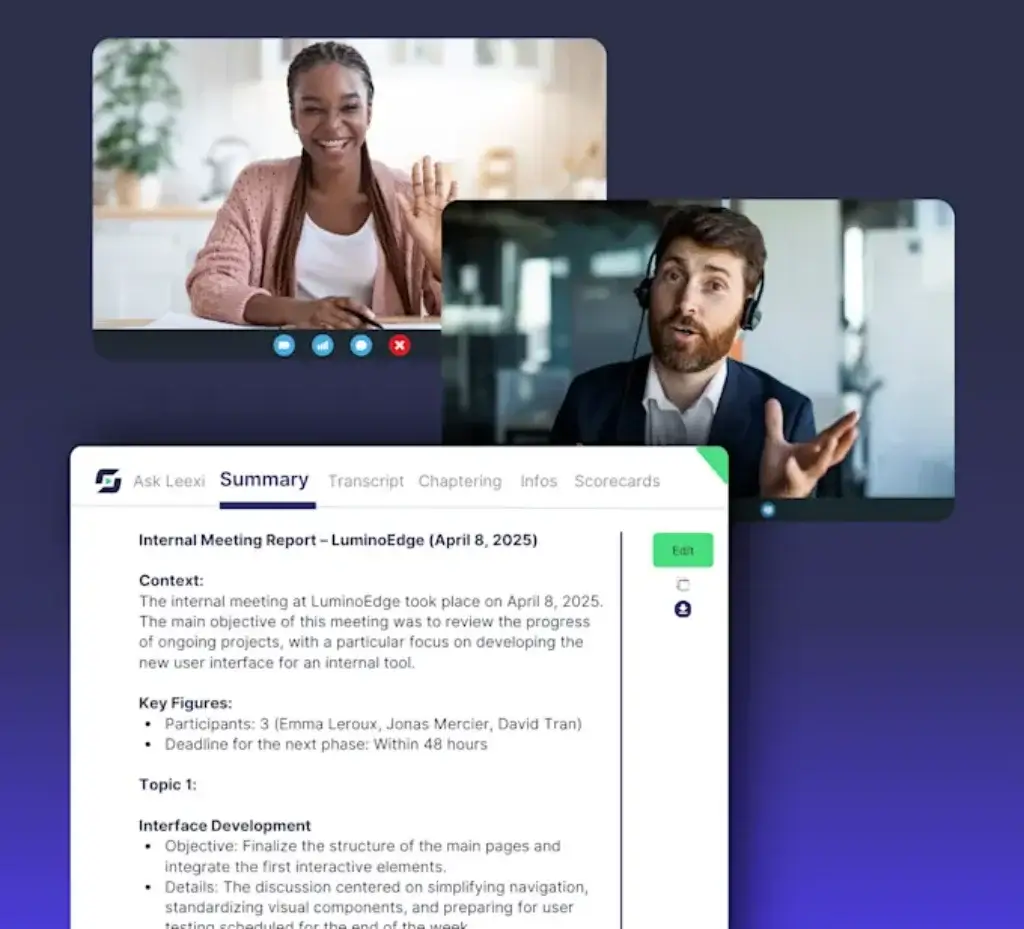
After the meeting, Leexi generates a structured summary that helps you understand what happened without reading the entire transcript. This includes the main topics, decisions, follow-up tasks, and relevant context from the conversation.
- Automatic call summaries with context
- Chapters for easier review
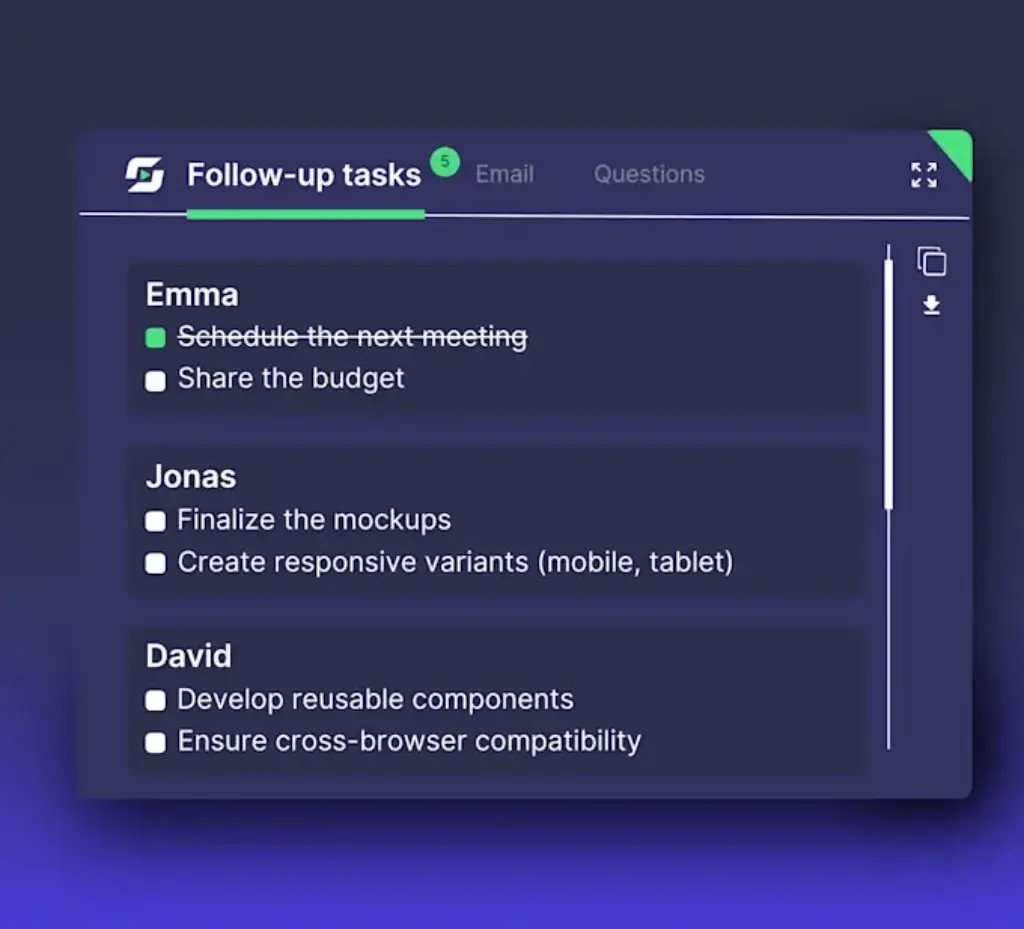
- Follow-up tasks and next steps
- Summary sharing with participants or internal teams
This is where Leexi becomes more valuable than a simple recorder. It helps you move from raw conversation to usable business output.
Ask Leexi and searchable meeting knowledge
Ask Leexi lets you ask questions about your meetings instead of manually searching through transcripts. This is especially useful when you want to retrieve a client objection, a pricing concern, a candidate answer, or a decision made in a previous meeting.
For teams that run many calls every week, this can turn past meetings into a searchable knowledge base. Instead of asking “who remembers what the client said?”, you can search the meeting history and find the relevant answer faster.
Custom prompts and custom vocabulary
Leexi supports custom prompts and custom vocabulary on higher-tier plans. This matters because generic AI summaries are not always enough for business teams.
A sales team may want summaries organized by pain points, objections, budget, competitors, next steps, and buying timeline. A recruiting team may want summaries structured around experience, motivation, technical skills, salary expectations, and availability.
Custom vocabulary also helps Leexi better understand internal acronyms, product names, industry terms, and client-specific terminology.
CRM, VoIP, and workflow integrations
Leexi’s integration depth is one of its strongest advantages. It connects with meeting platforms, calendars, collaboration apps, CRMs, ATS tools, VoIP systems, and automation platforms.
- Video platforms: Zoom, Google Meet, Microsoft Teams, Apizee, Jitsi
- CRMs: Salesforce, HubSpot, Pipedrive, Odoo, Zoho, Sellsy, Tribe, Microsoft Dynamics
- VoIP systems: Aircall, Ringover, CloudTalk, Vonage, 3CX, Teams Phone, Keyyo, Dstny, ALLOCloud
- Collaboration and automation: Slack, Notion, Google Docs, Zapier, Make
- Recruiting: RecruitCRM
The most important point is that Leexi can push meeting notes and summaries into the systems where your team already works. For sales and customer success teams, this can reduce forgotten CRM updates and improve call follow-up consistency.
Mobile app and in-person meeting recording
Leexi is not limited to online meetings. Its mobile app helps you record in-person meetings from your phone, then generate summaries, transcripts, and follow-up tasks inside your Leexi workspace.
This is useful for consultants, field sales teams, recruiters, workshops, internal leadership meetings, and customer visits. The app can also record without network coverage, which makes it more practical for meetings outside a stable office environment.
Privacy, security, and European data hosting
Security is one of the main reasons to consider Leexi over some US-first AI note takers. Leexi emphasizes GDPR compliance, ISO 27001 certification, access rules, permissions, encryption, and data storage and transit within France.
For European companies, legal teams, HR departments, sales teams, consultants, and organizations handling sensitive conversations, this can be a meaningful differentiator.
- GDPR-conscious data handling
- ISO 27001 certification
- Encryption in transit and at rest
- Data storage and transit within France
- Access rules, permissions, and enterprise controls
That said, privacy-sensitive teams should still review Leexi’s Data Processing Agreement, consent settings, retention options, and AI processing terms before rolling it out company-wide.
User Experience and Interface
How Everyday Work With Leexi Looks
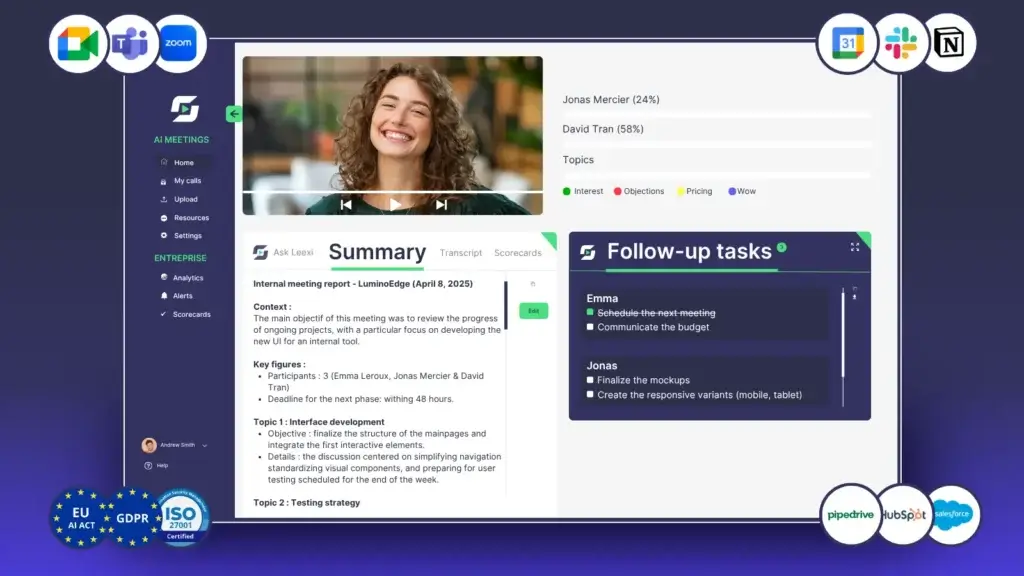
Leexi is designed to reduce meeting admin, not create a new system your team has to manage all day. Once your calendar and meeting tools are connected, the workflow becomes fairly simple: Leexi joins or records the meeting, captures the discussion, and sends the summary afterward.
Clean dashboard and meeting library
The dashboard gives you access to upcoming meetings, past meetings, transcripts, summaries, recordings, and shared notes. You can review a meeting, search for a specific keyword, identify a speaker contribution, and share the outcome with teammates.
This structure is especially helpful if you manage many calls per week. Instead of having meeting notes scattered across docs, emails, CRM comments, and Slack messages, Leexi gives you one central place to review and reuse meeting information.
Multi-platform access
Leexi works across web, video meeting tools, calendar integrations, and mobile devices. The mobile app is particularly useful because it extends Leexi beyond remote meetings into face-to-face conversations.
- Web app: Review meetings, summaries, transcripts, and settings
- Meeting tools: Capture meetings from Zoom, Meet, Teams, and more
- Mobile app: Record in-person meetings from your phone
- Calendar sync: Automate meeting detection and recording workflows
Sharing, collaboration, and follow-up
Leexi makes it easier to share what happened after a meeting. You can send summaries to participants, share meeting pages, export insights, add comments, and move important details into other systems.
This is particularly useful for asynchronous teams. A teammate who missed the meeting can read the summary, review the transcript, and understand the decisions without asking for a full recap.
Pros And Cons
Real-World Advantages and Disadvantages
Leexi is a strong AI meeting assistant, but it is not the best fit for every user. Its value depends heavily on whether you need business integrations, team workflows, and privacy-conscious meeting documentation.
Positive
✅ Strong AI summaries
✅ CRM and VoIP integrations
✅ GDPR and ISO 27001 focus
✅ Useful mobile app for in-person meetings
✅ Good fit for sales and customer-facing teams
Negative
❌ No forever-free plan
❌ CRM and VoIP integrations require Business
❌ Starter plan has usage and license limits
❌ Some transcripts may need manual edits
❌ Less suitable for simple personal note taking
Pros
1. Strong meeting summaries
Leexi does a good job turning long conversations into structured summaries, next steps, and follow-up tasks. This saves time after meetings and makes it easier to keep everyone aligned.
2. Excellent CRM and VoIP workflow potential
Leexi is especially useful when connected to CRMs and VoIP systems. Sales and customer success teams can reduce manual admin work by pushing notes and summaries into customer records.
3. Strong European privacy positioning
Leexi’s GDPR focus, ISO 27001 certification, and French data hosting make it attractive for European teams and privacy-conscious organizations.
4. Useful for both virtual and in-person meetings
The mobile app makes Leexi more flexible than many meeting assistants that only work well with Zoom, Teams, or Google Meet.
5. Custom prompts improve business relevance
Custom prompts and vocabulary help teams tailor summaries to their specific sales process, recruiting workflow, consulting format, or internal reporting structure.
Cons
1. No permanent free plan
Leexi offers a free trial, but it does not compete with tools that provide a generous forever-free plan for individual users.
2. The best integrations require Business
If you want CRM and VoIP integration, the Business plan is the more relevant option. That makes Leexi more expensive for teams that need deeper automation.
3. Starter has clear limitations
The Starter plan is useful for testing Leexi, but it has a monthly meeting-hour limit, storage limits, and a maximum license count. Growing teams will likely need AI-Meeting or Business.
4. AI output still needs review
Leexi can save hours, but you should not treat every transcript or summary as perfect. Technical terms, accents, overlapping speakers, and unclear audio may still require review.
5. Not ideal for very basic personal use
If you only need occasional meeting notes and do not care about CRM, VoIP, or compliance, tools like Fathom or Fireflies may feel simpler and more cost-effective.
Pricing and Tiers
How Much Does Leexi Cost?
Leexi pricing is plan-based and depends on how much automation, storage, and integration depth you need. The most important distinction is that CRM and VoIP integrations are available on the Business plan, which is likely the best fit for sales-driven teams.
Leexi offers a free trial, so you can test the product before committing. Pricing may change, so you should always confirm the latest plan details on the official Leexi pricing page before purchase.
Leexi pricing overview
| Plan | Price | Best For | Key Features Included |
| Starter | $12/user/month, yearly billing, excl. VAT | Small teams testing Leexi | 100+ languages, Zoom/Meet/Teams, AI summaries, 6 months storage, max 5 licenses |
| AI-Meeting | $23/user/month, yearly billing, excl. VAT | Professionals needing stronger AI meeting management | Ask Leexi, custom prompts, custom vocabulary, access rules, 2 years storage |
| Business | $39/user/month, yearly billing, excl. VAT | Sales, recruiting, consulting, and customer-facing teams | CRM and VoIP integrations, weekly trends, AI briefing, CRM field auto-completion, priority support |
| Enterprise | Custom pricing | Larger organizations | SSO, public API, call analytics, automated alerts, automatic scoring, advanced support |
Which Leexi plan should you choose?
Choose Starter if you want to test Leexi with a small number of users and do not need advanced integrations.
Choose AI-Meeting if you want custom prompts, custom vocabulary, Ask Leexi, better storage, and a stronger meeting review workflow.
Choose Business if your team uses a CRM or VoIP system. This is the plan I would consider the most relevant for sales teams, customer success teams, recruiters, and consulting firms.
Choose Enterprise if you need SSO, public API access, advanced analytics, scoring, alerts, stronger governance, and custom support.
Is Leexi worth the price?
Leexi is worth it if meetings create important business data for your team. If Leexi saves each user several hours per month, improves CRM hygiene, and reduces missed follow-ups, the Business plan can justify itself quickly.
However, if you only need occasional personal meeting notes, Leexi may be more than you need. In that case, a free or lower-cost AI note taker may be a better starting point.
Who Is It Best For?
Is Leexi The Right Fit For Your Workflow?
Leexi is best for teams that want meeting information to become structured, searchable, and actionable. It is less about passive note storage and more about making meetings easier to review, share, and operationalize.
Sales teams
Sales teams are one of the strongest use cases for Leexi. Reps can focus on the conversation while Leexi captures the call, summarizes buyer needs, identifies next steps, and helps keep CRM records updated.
Managers can also use meeting summaries to review objections, analyze deal risks, coach reps, and understand what is happening across the pipeline without listening to every call in full.
Customer success and support teams
Customer success teams can use Leexi to document onboarding calls, renewal conversations, escalation meetings, and product feedback sessions. This reduces the risk of losing important customer context after a call.
Recruiters and HR teams
Recruiters can use Leexi to record interviews, summarize candidate answers, and keep structured notes for hiring discussions. This is especially helpful when multiple stakeholders need to compare candidate feedback.
Consultants, agencies, and client-facing teams
Consultants and agencies can use Leexi to summarize workshops, discovery sessions, strategy calls, and project meetings. The tool can help turn client conversations into clearer next steps, deliverables, and internal briefs.
European and privacy-conscious businesses
Leexi is particularly relevant for businesses that want an AI note taker with a European privacy angle. If GDPR, European hosting, ISO 27001, and access governance are important to your buying decision, Leexi has a stronger positioning than many general-purpose tools.
Leexi VS Alternatives
Comparison With Other AI Note Takers
Leexi competes in a busy market. The right choice depends on whether you prioritize cost, simplicity, CRM workflows, privacy, video summaries, or task management integration.
Here is how Leexi compares with ClickUp Notetaker, Fathom, and Fireflies.
| Feature | Leexi | ClickUp Notetaker | Fathom | Fireflies.ai |
| Best for | Sales, customer success, recruiting, consulting, European teams | Teams already using ClickUp | Individuals and teams wanting simple free meeting notes | Teams wanting broad meeting transcription and integrations |
| Live transcription | Yes | Yes | Yes | Yes |
| AI summaries | Yes, with follow-up tasks and custom prompts | Yes, connected to ClickUp workflows | Yes, clean and easy to use | Yes, with notes and action items |
| CRM integrations | Strong, especially on Business | Best inside ClickUp | More limited | Strong for common sales workflows |
| VoIP support | Strong | Limited | Limited | Available, but varies by workflow |
| Privacy positioning | GDPR, ISO 27001, European hosting focus | Enterprise-grade ClickUp security | GDPR-focused features | SOC 2 and GDPR positioning |
| Free plan | Free trial, no forever-free plan | Included within ClickUp ecosystem | Strong free option | Free tier available |
| Main advantage | CRM, VoIP, privacy, and business workflows | Task management integration | Simplicity and generous free use | Broad adoption and meeting search |
Leexi vs ClickUp Notetaker
ClickUp Notetaker is a good option if your team already works inside ClickUp and wants meeting notes connected to tasks, projects, and workspace activity.
Leexi is the better fit if your meeting workflow sits closer to sales calls, CRM updates, VoIP calls, customer conversations, recruiting interviews, or GDPR-sensitive documentation.
Choose Leexi if you need a dedicated AI meeting assistant. Choose ClickUp Notetaker if your meeting notes mainly need to become ClickUp tasks.
👉🏼 Read full ClickUp Note Taker review or visit ClickUp directly
Leexi vs Fathom
Fathom is one of the easiest AI meeting assistants to recommend for individual users because it is simple, polished, and offers a strong free experience.
Leexi is stronger when your meetings need to connect with CRM, VoIP, governance, European hosting, and structured business workflows.
Choose Fathom if you want a simple and affordable AI note taker. Choose Leexi if you need business-grade meeting intelligence with stronger workflow depth.
👉🏼 Read Full Fathom review here or visit Fathom website for more info
Leexi vs Fireflies.ai
Fireflies is a well-known AI meeting assistant with a broad feature set, a free tier, meeting search, transcription, summaries, and integrations.
Leexi’s advantage is its European positioning and its stronger emphasis on CRM and VoIP workflows. For sales and customer-facing teams that want meeting data pushed into operational systems, Leexi can be the more focused option.
Choose Fireflies if you want a popular, flexible AI note taker with a free tier. Choose Leexi if privacy, European hosting, and CRM/VoIP workflows matter more.
👉🏼 Read Full Fireflies AI review or visit Fireflies AI here
Setup Guide
Getting Started with Leexi
Getting started with Leexi is straightforward. The basic setup is simple enough for individual users, but teams should spend extra time configuring integrations, permissions, and consent settings.
1. Sign up and connect your calendar
Go to Leexi’s website, create your account, and connect your Google or Microsoft calendar.
Calendar sync helps Leexi detect upcoming meetings and reduce the need for manual setup before every call.
2. Connect your meeting tools
Next, connect the tools you use for meetings, such as Zoom, Google Meet, or Microsoft Teams. Depending on your setup, you can configure which meetings Leexi should record automatically and which meetings should be handled manually.
3. Add CRM, VoIP, or workflow integrations
This is where Leexi becomes more valuable for teams. If you use Salesforce, HubSpot, Pipedrive, Ringover, Aircall, Slack, Notion, Zapier, or Make, connect those tools early.
The more your team relies on meeting notes after the call, the more important these integrations become.
4. Configure privacy and consent settings
Before recording meetings, make sure your team understands the consent requirements in your region and industry. Configure recording notices, opt-out options, access rights, and sharing permissions carefully.
5. Run your first meeting and review the summary
After your first recorded meeting, review the transcript, summary, chapters, and action items. Check whether the structure matches your workflow and adjust prompts or vocabulary if needed.
6. Train your team on the follow-up workflow
Leexi is easy to use, but the biggest gains come from workflow discipline. Show your team how to review summaries, correct transcripts, search meetings, share notes, and push information into your CRM or collaboration tools.
Tips & Best Practices for Using
How To Get The Most Out of Leexi
Leexi works best when it is part of a clear meeting process. If you only record calls and never review or share the output, you will miss much of the value.
1. Use clear meeting agendas
AI summaries improve when the meeting has structure. Add an agenda to your calendar invite and keep the discussion organized around clear topics.
2. Create custom prompts by meeting type
Do not use the same summary format for every conversation. Sales demos, discovery calls, hiring interviews, onboarding calls, and internal planning meetings all need different outputs.
3. Add custom vocabulary early
Add product names, client names, acronyms, and industry-specific terms. This can improve transcript readability and summary quality.
4. Review transcripts before sharing externally
Before sending a summary to a client, candidate, or external stakeholder, review the text for accuracy. AI-generated notes are helpful, but they should still be checked when the conversation is important.
5. Connect your CRM before scaling usage
If your team uses Leexi for sales or customer success, connect your CRM early. The return on investment is much stronger when meeting insights automatically support pipeline management and customer records.
6. Set access rules by team and role
Not every employee should have access to every meeting. Configure roles, permissions, and team access carefully, especially for HR, legal, finance, leadership, and customer-sensitive conversations.
Conclusion
Final Thoughts – Is Leexi Worth It in 2026?
Leexi is worth considering if you need more than simple meeting transcription. Its strongest value is for business teams that want AI summaries, CRM updates, VoIP call support, meeting search, custom prompts, and privacy-conscious European data handling in one platform.
It is especially useful for sales teams, customer success teams, recruiters, consultants, and organizations where meetings directly affect revenue, hiring, client delivery, or compliance-sensitive documentation.
Leexi is not the cheapest AI note taker, and it is not the best option if you only want a free personal tool. But if your team spends hours every week writing notes, updating CRM records, summarizing calls, and chasing follow-ups, Leexi can deliver strong operational value.
Leexi’s standout strengths
- AI meeting summaries with follow-up tasks and chapters
- CRM and VoIP integrations for business workflows
- European data hosting and GDPR-focused positioning
- Custom prompts and vocabulary for better summaries
- Mobile recording for in-person meetings
Final recommendation
Leexi is best for teams that want meeting notes to become structured business intelligence, not just stored transcripts.
If you work in sales, customer success, recruiting, consulting, or any meeting-heavy role, Leexi can help you save time, improve follow-up quality, and reduce the manual work that usually happens after every call.
For the best value, I would look closely at the Business plan if CRM or VoIP integration is important to your workflow. For simpler use, the AI-Meeting plan may be enough.
Have more questions?
Frequently Asked Questions
What is Leexi?
Leexi is an AI meeting assistant and AI note taker that records, transcribes, summarizes, and organizes meetings. It helps you capture decisions, action items, follow-ups, and meeting insights from online and in-person conversations.
Is Leexi an AI note taker or a meeting assistant?
Leexi is both. It works as an AI note taker by transcribing and summarizing meetings, but it also acts as a meeting assistant by generating follow-up tasks, supporting CRM and VoIP integrations, and helping teams manage meeting intelligence.
How much does Leexi cost?
Leexi pricing starts with the Starter plan at $12 per user per month when billed yearly, excluding VAT. The AI-Meeting plan is $23 per user per month, Business is $39 per user per month, and Enterprise uses custom pricing.
Does Leexi have a free plan?
Leexi does not offer a permanent free plan, but it does offer a free trial. This makes it suitable for testing the product before choosing a paid plan, but less attractive if you need a forever-free AI meeting assistant.
Which meeting platforms does Leexi support?
Leexi supports major meeting platforms such as Zoom, Google Meet, and Microsoft Teams. It also supports additional conferencing tools such as Apizee and Jitsi, depending on your plan and setup.
Does Leexi integrate with CRM tools?
Yes. Leexi integrates with CRM tools such as Salesforce, HubSpot, Pipedrive, Odoo, Zoho, Sellsy, Tribe, and Microsoft Dynamics. CRM integration is especially useful for sales and customer success teams that want meeting notes attached to customer records.
Is Leexi GDPR compliant?
Leexi positions itself as GDPR compliant and ISO 27001 certified, with data storage and transit within France. Privacy-sensitive teams should still review the Data Processing Agreement, consent settings, retention controls, and security documentation before rollout.
Does Leexi work for in-person meetings?
Yes. Leexi offers a mobile app that lets you record in-person meetings from your phone. The app can capture conversations, generate transcripts, summarize discussions, and create follow-up tasks inside your Leexi workspace.
What are the best Leexi alternatives?
The best Leexi alternatives include Fireflies, Fathom, ClickUp Notetaker, Otter.ai, tl;dv, MeetGeek, and Read AI. Fathom is strong for simple free meeting notes, Fireflies is a broad meeting assistant, and ClickUp Notetaker is useful for teams already using ClickUp.
Is Leexi worth it for sales teams?
Yes, Leexi can be worth it for sales teams because it supports call summaries, follow-up tasks, CRM integrations, VoIP workflows, and meeting search. It is most valuable when your team wants to reduce manual CRM updates and improve post-call follow-up quality.