
Introduction
Choosing the best corporate cards is no longer just about giving employees a way to pay for business expenses. The strongest corporate card platforms now help you control spending before it happens, automate receipt collection, enforce policies, reconcile transactions, manage budgets, and connect card activity directly to your accounting system.
For finance teams, this matters because card spend can become messy very quickly. Employees use personal cards, managers approve expenses late, receipts go missing, vendor subscriptions renew without review, and accounting teams only see the full picture after the month is already closed.
The right corporate card program gives you visibility earlier in the workflow. Instead of chasing expense reports after the fact, you can issue virtual cards, set limits, lock cards to vendors, require receipts, route approvals, and sync coded transactions into systems like QuickBooks, Xero, NetSuite, Sage Intacct, Microsoft Dynamics, or Workday.
In this guide, you’ll find the best corporate cards to consider in 2026: Ramp, Brex, BILL Spend & Expense, Rho, Spendesk, Slash, Paylocity for Finance, Navan, Mesh Payments, Expensify, and Mercury IO.
If you want one quick takeaway before diving in, here it is: Ramp is the best overall choice for modern finance teams that want corporate cards, expense automation, AP, procurement, and strong controls in one platform. Brex is excellent for startups and global companies that need scalable card policies and multi-entity visibility. BILL Spend & Expense is best for businesses already using BILL or looking for a no-subscription card and expense platform. Rho is a strong option for startups that want banking, cards, bill pay, and expense controls together. Spendesk is the strongest fit for European mid-market companies that need procure-to-pay workflows, approval chains, prepaid cards, invoices, and reimbursements in one system. Slash is best for high-spend teams that want cashback, unlimited virtual cards, banking, and spend controls in one platform.. Paylocity for Finance is best for mid-market companies that need corporate cards connected to AP and procurement. Navan is best for travel-heavy companies. Mesh is strong for global and SaaS-heavy teams. Expensify is best for companies that prioritize simple expense management and receipt automation.
What to look for in a corporate card
The best corporate card depends on how your company spends money. A startup that needs fast virtual cards does not need the same program as a global company managing travel, SaaS subscriptions, multiple entities, procurement, and strict approval policies.
- Card controls: Look for limits, merchant locks, category rules, and approval workflows.
- Virtual cards: Prioritize one-time, vendor-specific, and subscription cards.
- Expense automation: Review receipt capture, matching, policy checks, and reminders.
- Accounting sync: Confirm integrations with your accounting or ERP system.
- Rewards: Compare cashback, points, travel rewards, and eligibility rules.
- Eligibility: Check revenue, funding, cash balance, credit, and personal guarantee requirements.
- Global support: Review currencies, countries, entities, and local card availability.
- AP and procurement: Decide whether you need bill pay, purchase requests, and vendor controls.
Best Corporate Cards in 2026
Ramp

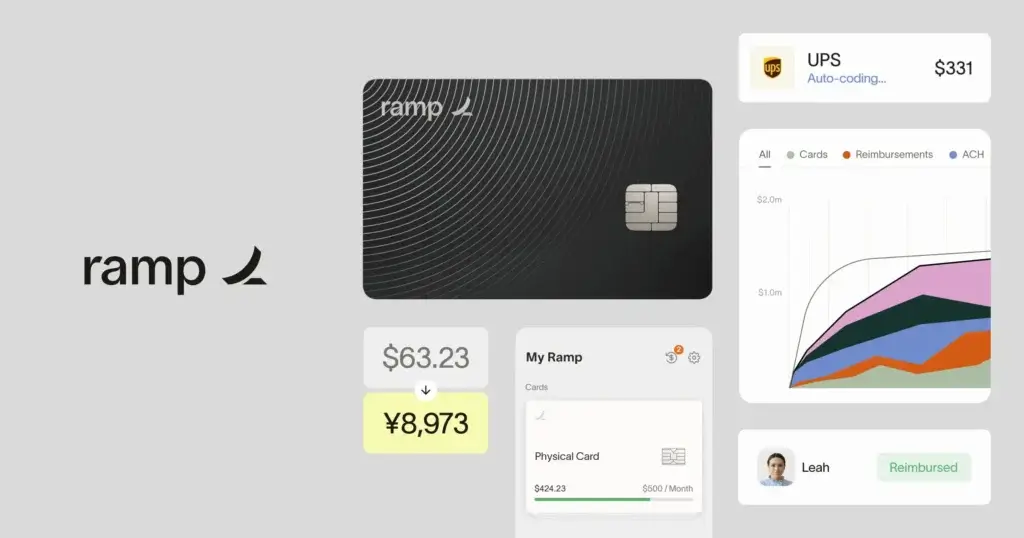
Ramp is one of the best corporate cards for companies that want more than a payment card. It combines corporate cards, virtual cards, expense management, bill pay, procurement, travel, reimbursements, vendor management, accounting automation, and reporting in one finance platform.
The main reason Ramp ranks first is its balance of usability and control. Employees get a simple way to spend, submit receipts, and complete expense tasks, while finance teams get real-time visibility, policy enforcement, approval routing, card issuing controls, and automated accounting sync.
Ramp is especially strong if you want to reduce unnecessary spend. Its platform is built around savings insights, vendor visibility, subscription control, policy automation, and finance workflows that prevent waste before it becomes a month-end problem.
Key features
- Unlimited physical and virtual corporate cards
- Card limits, merchant controls, and category controls
- Expense automation with receipt collection and matching
- Bill pay, vendor management, and approval workflows
- Procurement workflows and purchase order support on higher plans
- Travel booking, travel policies, and reimbursement workflows
- Accounting integrations with QuickBooks, Xero, NetSuite, Sage Intacct, and more
Pros and cons
Pros
✅ Best all-around corporate card and spend platform
✅ Strong controls for virtual cards, subscriptions, and employee spend
✅ Excellent fit for startups, SMBs, and mid-market finance teams
✅ Broad platform with AP, travel, procurement, reimbursements, and reporting
Cons
❌ Some advanced automation requires paid plans
❌ Procurement is stronger on Plus or Enterprise plans
❌ Not every business will qualify for the card program
❌ Best value comes when you centralize spend inside Ramp
Pricing
Ramp offers a Free plan at $0 per user per month with corporate cards, unlimited cards, card issuing controls, travel and expense features, basic accounting rules, QuickBooks Online and Xero integrations, budgets, and reporting. Ramp Plus is listed at $15 per user per month, plus a platform fee based on team size. Enterprise pricing is custom.
Who should use Ramp?
Ramp is best for startups, small businesses, and mid-market companies that want a modern corporate card connected to expense management, AP automation, procurement, travel, and accounting workflows. It is my top recommendation for most finance teams because it gives you strong card controls without feeling like a heavy enterprise system.
Brex


Brex is one of the strongest corporate card platforms for startups and scaling companies. It combines corporate cards, virtual cards, expense management, travel, bill pay, budgets, approvals, global payments, and policy automation.
Brex is especially useful when your company is growing quickly and simple card limits are no longer enough. Finance teams can create policies by role, department, entity, category, vendor, or budget, which helps reduce manual reviews and keeps spending aligned with company rules.
It is also a strong option for companies with global operations. Brex offers multi-entity controls, international payment capabilities, travel workflows, and integrations that make it relevant for startups that expect to scale beyond basic card management.
Key features
- Corporate cards with spend limits and real-time controls
- Virtual cards for vendors, subscriptions, and employee spend
- Expense policies by user, category, department, and budget
- Travel booking, travel policies, and expense automation
- Bill pay, reimbursements, and vendor payments
- Multi-entity support for growing and global companies
- ERP and HRIS integrations for finance automation
Pros and cons
Pros
✅ Excellent for startups and scaling companies
✅ Strong policy controls and approval automation
✅ Good fit for global and multi-entity teams
✅ Combines cards, travel, expenses, bill pay, and budgets
Cons
❌ Eligibility may not fit every business
❌ Advanced features require paid plans
❌ Some smaller businesses may not need its full platform depth
❌ Not as procurement-focused as Paylocity for Finance or Coupa-style platforms
Pricing
Brex states that some products have associated fees. Plans start at $0 per user per month, while more advanced features are available for $12 per user per month. Enterprise needs, global complexity, and advanced controls may require a deeper sales conversation.
Who should use Brex?
Brex is best for startups, venture-backed businesses, technology companies, and global teams that want a scalable corporate card platform with strong spend policies, travel workflows, accounting automation, and multi-entity visibility.
BILL Spend & Expense
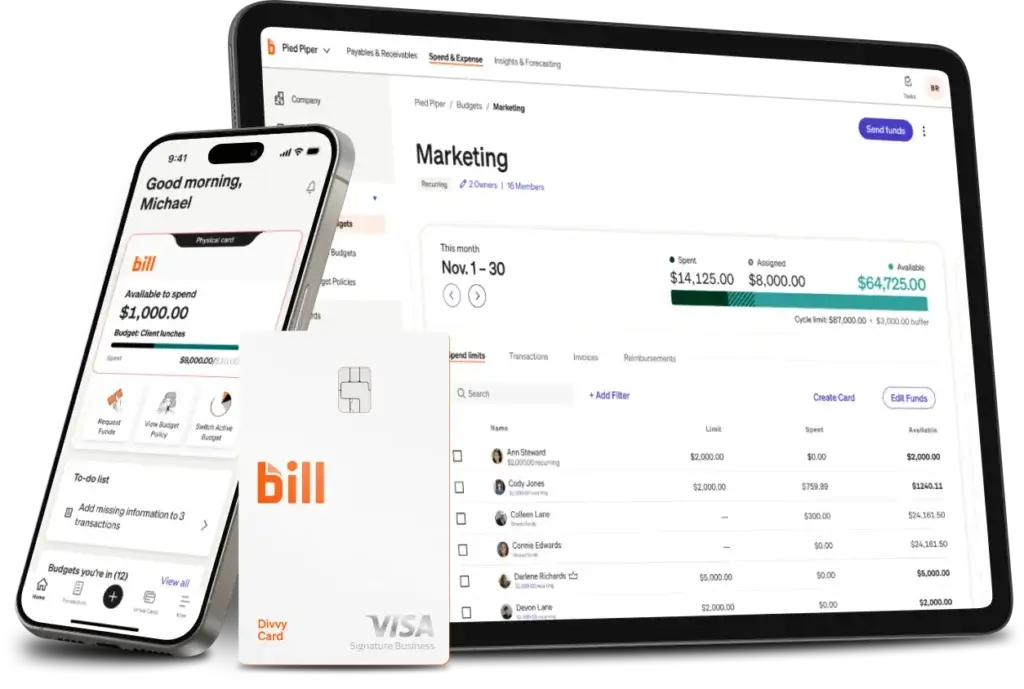
BILL Spend & Expense, formerly associated with Divvy, is a strong corporate card and expense management platform for small and mid-sized businesses. It combines the BILL Divvy Card with expense management, budget controls, physical cards, virtual cards, reimbursements, receipt capture, transaction coding, and accounting integrations.
The biggest advantage is cost accessibility. BILL says Spend & Expense has no subscription or per-user software fees, which makes it attractive for companies that want to issue cards and manage expenses without committing to a paid per-seat platform.
It is also a natural fit if your business already uses BILL for accounts payable or accounts receivable. Keeping AP, AR, spend, cards, and expense workflows closer together can reduce tool sprawl and make finance operations easier to manage.
Key features
- Physical and virtual corporate cards
- Budget controls and proactive spend management
- AI-powered receipt capture and expense matching
- Transaction coding and mobile expense workflows
- Real-time transaction tracking and reporting
- Employee reimbursements and flexible rewards
- Integrations with accounting and finance tools
Pros and cons
Pros
✅ No subscription or per-user software fees for Spend & Expense
✅ Strong fit for companies already using BILL
✅ Good controls for budgets, cards, and employee expenses
✅ Useful for small businesses that want a practical card platform
Cons
❌ Not as advanced as Ramp or Brex for broader finance automation
❌ AP and AR plans are priced separately if you need more BILL products
❌ Card program eligibility and limits should be reviewed carefully
❌ Less suitable for complex global or multi-entity card programs
Pricing
BILL states that Spend & Expense has no subscription or per-user software fees. Businesses can issue cards and add cardholders without changing AP and AR software costs, although standard card and payment fees may apply where relevant.
Who should use BILL Spend & Expense?
BILL Spend & Expense is best for small and mid-sized businesses that want a no-subscription corporate card and expense management platform. It is especially strong if your business already uses BILL or plans to centralize AP, AR, spend, and expense workflows in the same ecosystem.
Rho


Rho is a strong corporate card option for startups and growing companies that want cards connected to broader finance operations. It offers corporate cards, business checking, treasury, bill pay, expense management, receipt capture, approvals, and accounting integrations.
Rho’s main positioning is simplicity. It promotes finance automation without subscription fees, which can appeal to founders who want to manage cash, vendor payments, and card spend without stacking several finance tools early in the company lifecycle.
The Rho corporate card is particularly relevant for companies that want to issue cards quickly, earn cashback, avoid a personal guarantee, and maintain real-time spend controls. It is less of a travel platform than Navan and less procurement-heavy than Paylocity for Finance, but it is very compelling as a startup finance stack.
Key features
- Corporate cards with up to 1.5% cashback
- Physical and virtual cards for employees and vendors
- Real-time spend controls and policy visibility
- No personal guarantee positioning for qualifying businesses
- Receipt capture and expense management workflows
- Bill pay with vendor payment workflows
- Business banking, savings, and treasury products
Pros and cons
Pros
✅ Strong fit for startups that want banking and cards together
✅ No subscription fee positioning
✅ Useful virtual card and spend control capabilities
✅ Good option for founders that want simpler finance operations
Cons
❌ Not as broad as Ramp for procurement and platform depth
❌ Less travel-focused than Navan
❌ Eligibility and rewards terms should be confirmed
❌ Best fit is companies comfortable using Rho as a finance hub
Pricing
Rho positions its platform around finance automation without subscription fees. Businesses should confirm current card terms, cashback eligibility, banking requirements, and any treasury or advanced service conditions directly with Rho during evaluation.
Who should use Rho?
Rho is best for startups and growing companies that want corporate cards, business banking, bill pay, and expense controls in one connected finance workflow. It is a strong choice if you want card controls and cash management together rather than a standalone corporate card.
Spendesk

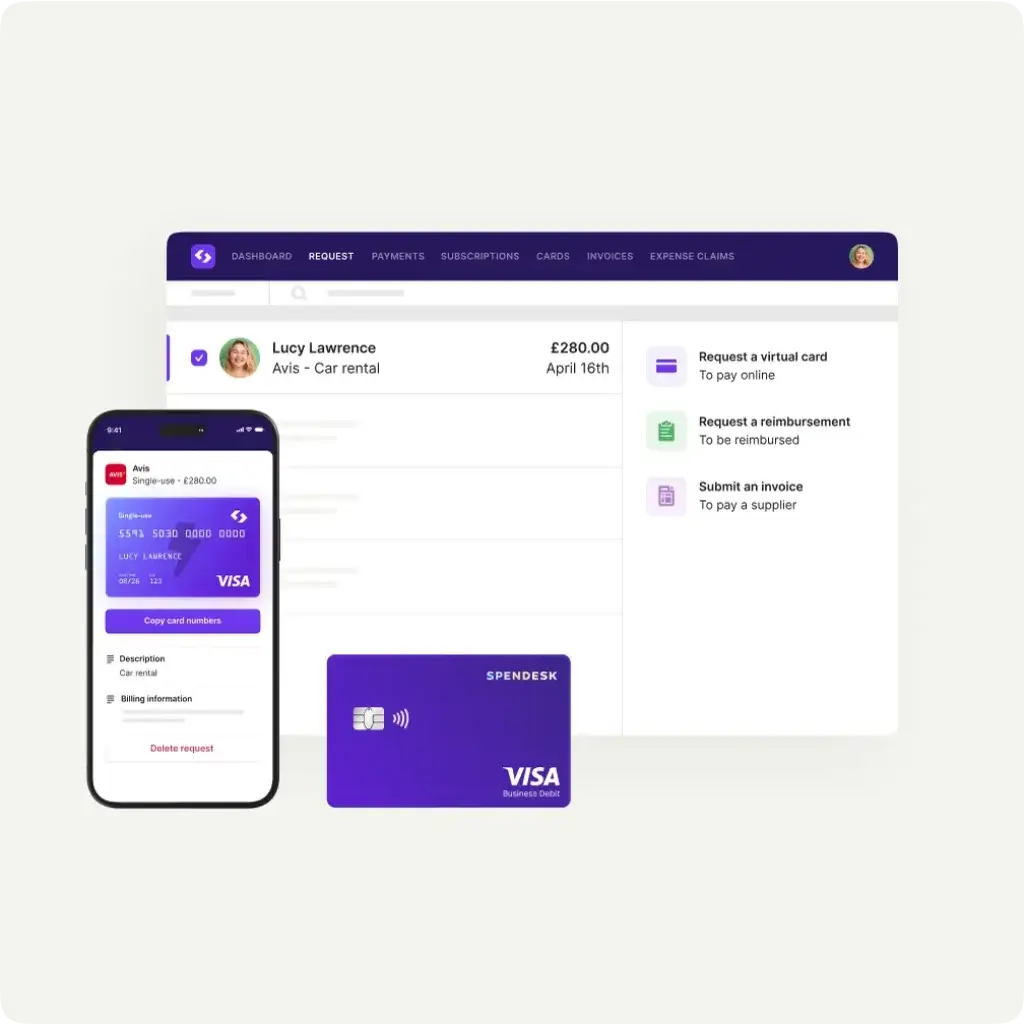
Spendesk is a spend management and procure-to-pay platform built for finance teams that want to control company spending before it happens. It is especially relevant for European mid-market companies with structured approval needs, multiple teams, recurring supplier payments, and a growing volume of card, invoice, and reimbursement activity.
The biggest advantage is pre-spend control. Instead of only reviewing expenses after employees make purchases, Spendesk lets teams create purchase requests, route them through approval chains, and connect approved spend to prepaid cards, supplier invoices, or reimbursements. This helps finance teams keep budget commitments and approval trails in place before money leaves the business.
Spendesk is also strong because it connects several finance workflows in one system. Prepaid corporate cards, virtual cards, supplier invoice management, employee reimbursements, approval workflows, and accounting exports all sit inside the same platform. That makes it a strong fit if you want to reduce the gap between cards, AP, expenses, and procurement.
Key features
- Prepaid physical cards and unlimited virtual cards on paid plans
- Purchase requests with configurable approval workflows
- Supplier invoice management and automated invoice processing
- Employee reimbursements and expense claims
- Receipt collection, policy controls, and card access enforcement
- Accounting integrations with tools like Xero, QuickBooks, Sage, NetSuite, and DATEV
- Support for European finance workflows, including UK and German compliance needs
Pros and cons
Pros
✅ Strong procure-to-pay controls for mid-market finance teams
✅ Combines cards, invoices, reimbursements, approvals, and accounting workflows
✅ Unlimited virtual cards and unlimited users are included on paid plans
✅ Strong fit for European companies that need structured spend governance
Cons
❌ Less ideal for very small businesses that only need a simple card
❌ Pricing is subscription-based rather than fully free-to-use
❌ US-focused companies may prefer Ramp, Brex, Rho, or BILL depending on their needs
❌ Implementation may require more process planning than lightweight card tools
Pricing
Spendesk uses a fixed monthly subscription model based on the platform plan you choose. Its pricing includes access to payment methods and unlimited users, while paid plans include unlimited virtual cards. Companies should request a quote to confirm the right plan, available payment methods, regional availability, and any implementation requirements.
Who should use Spendesk?
Spendesk is best for European mid-market companies that want more control over spend before purchases happen. It is especially strong if your finance team needs purchase approvals, prepaid cards, virtual cards, invoice management, reimbursements, accounting sync, and audit-ready spend data in one connected procure-to-pay workflow.
Slash


Slash is a business banking platform built for modern businesses that want to manage cards, payments, invoices, treasury, and more from one dashboard. Their corporate charge card, the Slash Visa® Platinum Card, offers up to 2% cashback on business expenses. Teams that want to extend spending privileges to their employees can issue an unlimited number of virtual cards, each with their own permissions, spend caps, and merchant restrictions.
These features allow businesses to closely manage employee purchases, vendor payments, and subscriptions while earning strong cashback.
Slash’s integrated dashboard gives users access to business banking, invoice automation, global payments, working capital, and spend management features. This means your corporate card program can stay connected to your operating account rather than being stuck on a different piece of software.
The platform is especially relevant for high-spend businesses, ecommerce companies, SaaS teams, agencies, startups, and online businesses that spend with cards and want a more centralized view of their finances. With stablecoin support, Slash is also a good fit for teams that routinely send and receive crypto.
Key features
- Unlimited virtual corporate cards
- Up to 2% cashback on eligible card spend
- Granular spend controls and card limits
- Automated tools that flag suspicious transactions and help prevent fraud
- Accounting integrations with QuickBooks, Xero, NetSuite, and Sage
- Business banking and money movement tools
- FDIC insurance up to hundreds of millions
- Free and paid plan options
Pros and cons
Pros
✅ Strong cashback potential for high-spend businesses
✅ Unlimited virtual cards included
✅ Cards are fully configurable with spend limits and controls
✅ Combines business banking and corporate cards in one platform
Cons
❌ Less focused on deep AP and procurement than Ramp, Spendesk, or Paylocity for Finance
❌ Cashback eligibility and rates may need to be reviewed carefully
❌ Not the best fit if you only need traditional expense reporting
❌ Some businesses may prefer a more established enterprise spend platform
Pricing
Slash offers a Free plan at $0 per month and a Pro plan at $25 per month. Both plans include unlimited virtual cards, while the Pro plan eliminates several transfer fees. Businesses should review the latest pricing, cashback eligibility, card fees, transfer fees, and account requirements before choosing a plan.
Who should use Slash?
Slash is best for high-spend businesses that want corporate cards, unlimited virtual cards, high cashback, and business banking in one platform. It’s especially useful for ecommerce companies, agencies, SaaS teams, online businesses, and startups that need flexible virtual card controls without adopting a heavier procurement or AP platform.
Paylocity for Finance
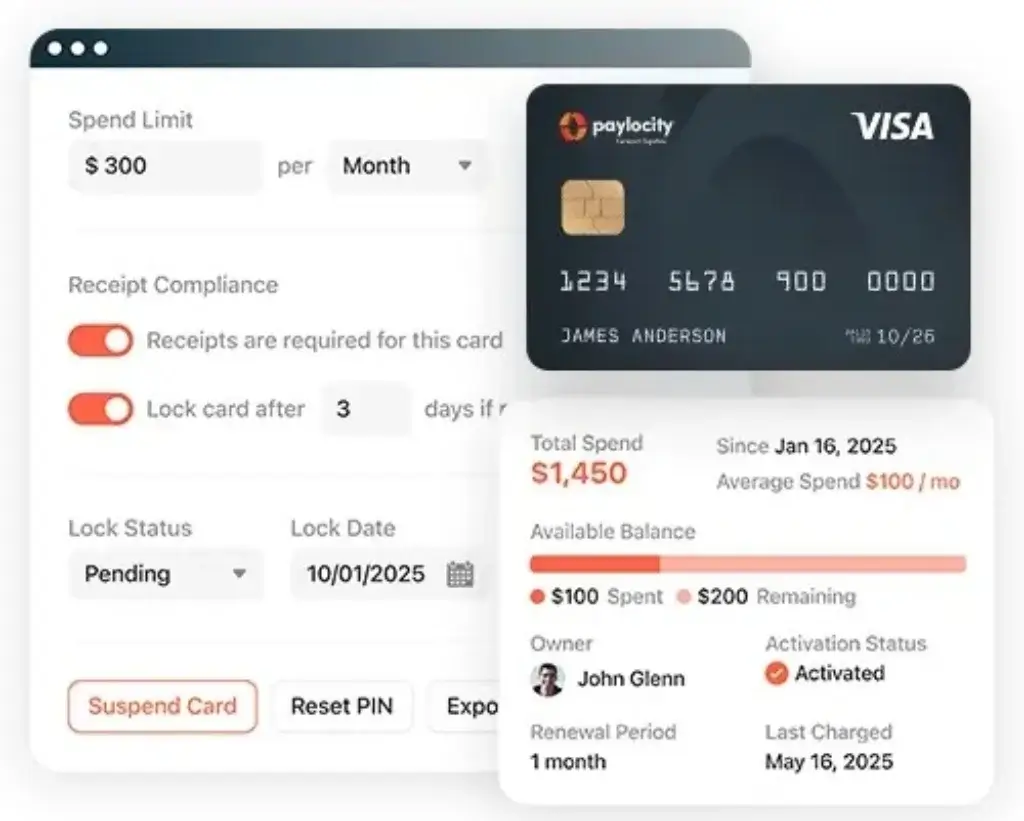
Paylocity for Finance (formely know as Airbase) by Paylocity is a strong corporate card platform for mid-market companies that need more control over non-payroll spend. It combines corporate cards, accounts payable automation, expense reimbursements, procurement intake, approval workflows, accounting automation, and audit trails.
Where Paylocity for Finance stands out is spend control before the purchase happens. Many corporate card tools are strong after the transaction, but Paylocity for Finance is built for companies that need purchase requests, approval routing, AP controls, and card spend management in one structured finance workflow.
Paylocity for Finance is now part of Paylocity, which makes it especially relevant for companies that want finance workflows closer to HCM, payroll, employee data, and operational controls. For mid-market buyers, this broader direction can be a meaningful advantage.
Key features
- Corporate cards with spend limits and controls
- Virtual cards for vendors and subscriptions
- Expense reimbursements and mobile workflows
- Accounts payable automation and bill payments
- Procurement intake and purchase approval workflows
- Budget controls and accounting automation
- ERP integrations and audit-ready approval trails
Pros and cons
Pros
✅ Strong fit for mid-market finance teams
✅ Combines cards, AP, procurement, and reimbursements
✅ Better pre-spend controls than many card-first platforms
✅ Relevant for companies evaluating Paylocity finance workflows
Cons
❌ Pricing is typically quote-based
❌ More complex than basic card programs
❌ Smaller teams may not need the full workflow depth
❌ Buyers should confirm current Paylocity packaging and modules
Pricing
Paylocity for Finance pricing is generally quote-based and depends on company size, modules, workflows, entities, integrations, and implementation needs. Buyers should confirm current Paylocity packaging and product availability before making a decision.
Who should use Paylocity for Finance?
Paylocity for Finance is best for mid-market companies that need corporate cards connected to procurement, AP automation, reimbursements, approval workflows, and accounting controls. It is a strong option if your biggest issue is unmanaged spend before it reaches the accounting team.
Navan

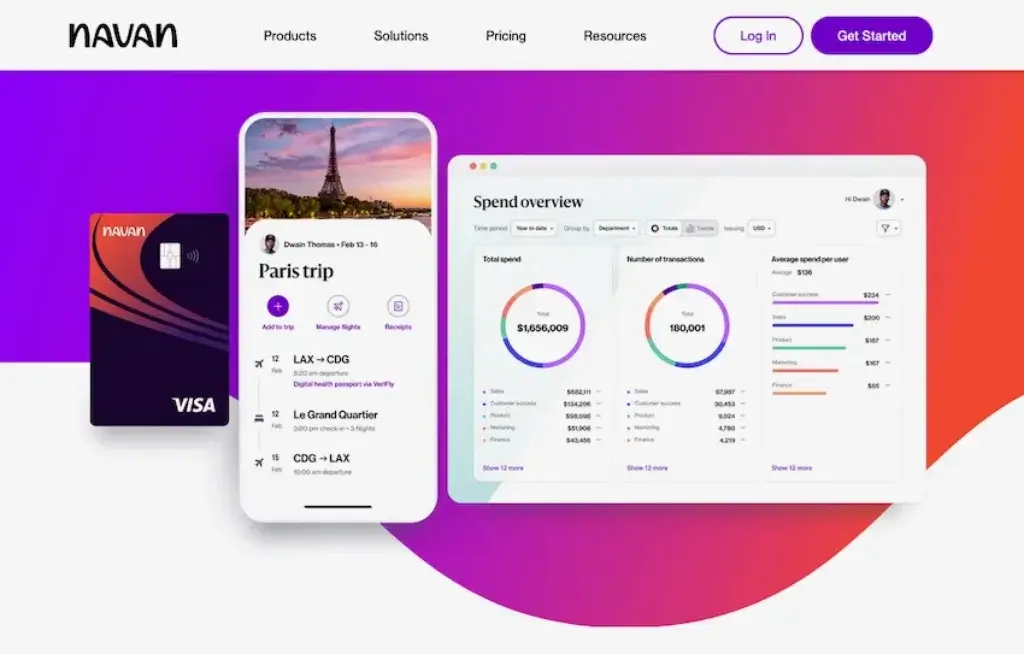
Navan is one of the best corporate card options for companies where travel and expense management are closely connected. It combines corporate travel booking, expense management, corporate cards, reimbursements, policy controls, analytics, and mobile workflows.
The strongest reason to choose Navan is the travel experience. Employees can book business travel while finance teams maintain policy control. Card transactions can flow into expense workflows, which reduces the manual burden of matching travel bookings, receipts, card charges, and reimbursement activity.
Navan is not primarily an AP or procurement platform. It is strongest when your corporate card strategy is tied to travel, distributed employees, mobile expense workflows, and real-time travel spend visibility.
Key features
- Corporate cards for travel and everyday business spend
- Virtual cards for travel bookings and vendor payments
- Travel booking for flights, hotels, cars, and trains
- Expense management with policy controls
- Reimbursements and mobile expense workflows
- Travel analytics and department-level spend visibility
- Bring-your-own-card options through Navan Connect
Pros and cons
Pros
✅ Best fit for travel-heavy companies
✅ Combines travel booking, cards, and expenses
✅ Strong mobile experience for employees
✅ Useful for policy control and travel spend visibility
Cons
❌ Less AP-focused than Paylocity for Finance or Ramp
❌ Less procurement-heavy than enterprise spend platforms
❌ Enterprise pricing requires a demo
❌ Best value depends on travel volume and user adoption
Pricing
Navan states that companies with 300 or fewer employees can book unlimited trips with Navan Travel. Navan Expense is free for the first 5 monthly expensing users, then $15 per user per month. Companies with more than 300 employees should request a demo for enterprise pricing.
Who should use Navan?
Navan is best for companies that need corporate cards connected to travel and expense management. It is especially useful if employees travel often and finance wants better control over bookings, expenses, reimbursements, and card activity.
Mesh Payments

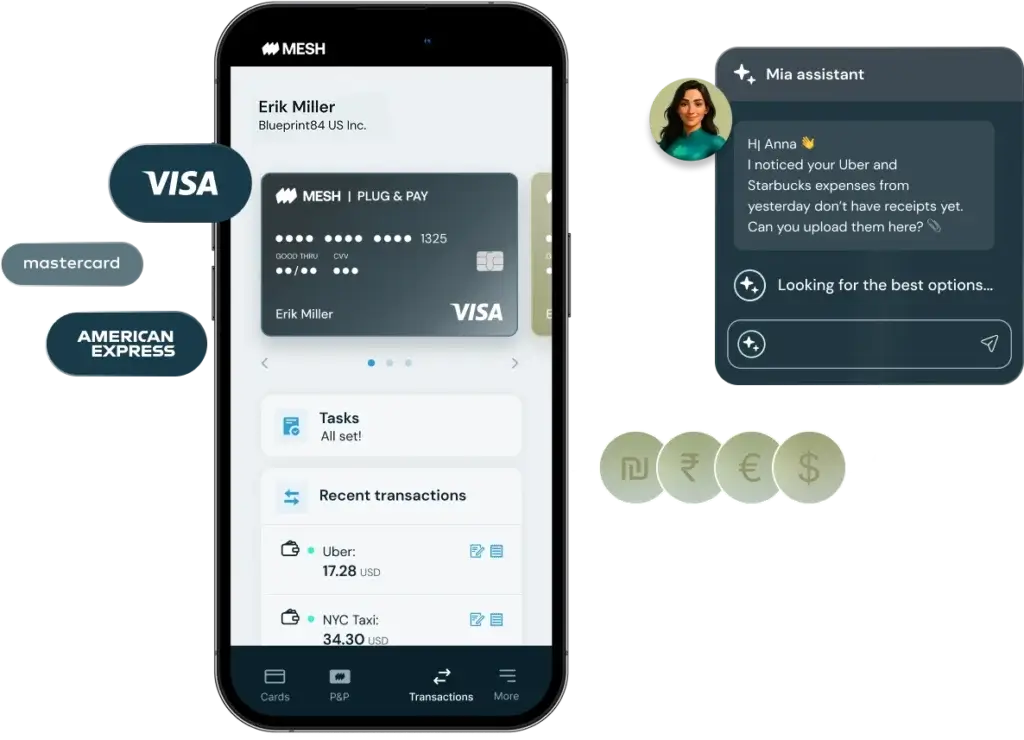
Mesh Payments is a corporate card and travel expense platform built for companies that want real-time spend visibility, virtual cards, physical cards, travel controls, reimbursements, SaaS spend management, and ERP synchronization.
Mesh is especially useful for SaaS-heavy companies. Finance teams can create vendor-specific cards, monitor subscription spend, track recurring payments, and control software-related expenses before they expand across departments unnoticed.
It is also a good fit for global and distributed teams. Mesh emphasizes global spend control, multi-entity visibility, travel workflows, and finance automation for companies that need more flexibility than a simple business credit card can provide.
Key features
- Virtual corporate cards and physical card options
- Vendor-specific cards and subscription controls
- Travel and expense management workflows
- Receipt collection, matching, and reconciliation
- SaaS spend visibility and optimization insights
- Real-time reporting and role-based permissions
- ERP synchronization and global spend controls
Pros and cons
Pros
✅ Strong virtual card controls for SaaS and vendor spend
✅ Good fit for global and distributed teams
✅ Useful travel, expense, and reimbursement workflows
✅ Real-time visibility across card and business spend
Cons
❌ Cashback has eligibility requirements
❌ Buyers should confirm country and card availability
❌ Not a full enterprise procurement suite
❌ Best fit is companies with meaningful SaaS, card, or travel spend
Pricing
Mesh states that its platform is free and includes unlimited cards and unlimited users. Cashback eligibility applies to eligible payments, with a minimum $50K monthly spend requirement. Businesses should confirm the latest eligibility, transaction terms, and geographic availability.
Who should use Mesh Payments?
Mesh Payments is best for global companies, SaaS-heavy teams, and distributed organizations that want virtual cards, real-time spend controls, travel expense workflows, reimbursements, and ERP sync.
Expensify Card

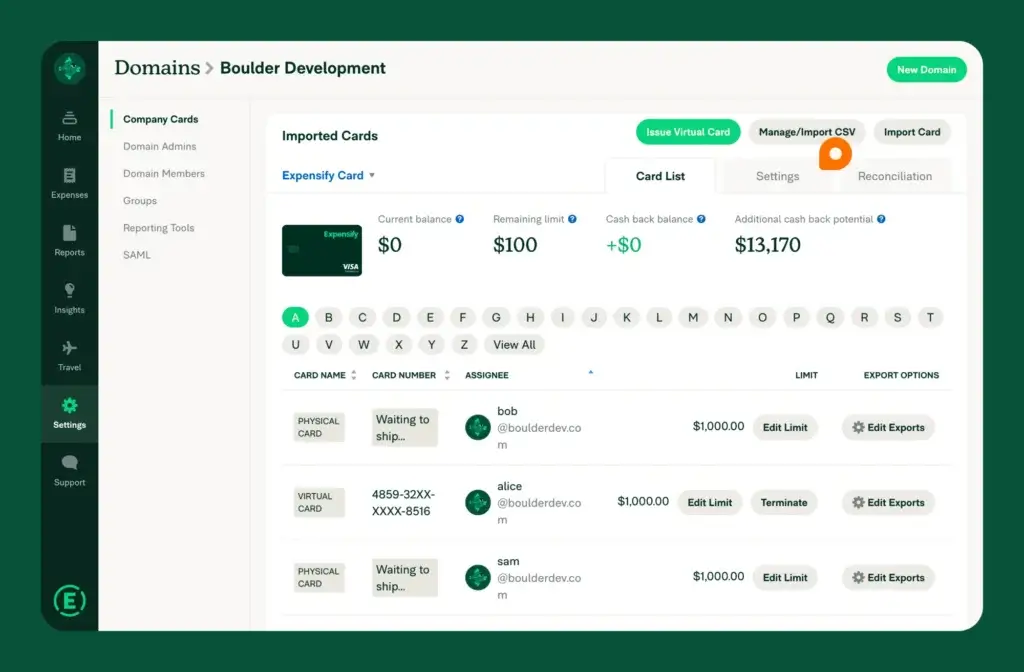
Expensify is best known for expense management, but its corporate card offering makes it a strong option for companies that want card spend connected to receipts, expense reports, approvals, reimbursements, and accounting integrations.
The biggest strength is simplicity. Expensify is easy for employees to understand, and its receipt capture, expense categorization, approvals, and integrations make it practical for teams that do not need a full procurement or AP platform.
Expensify also supports bring-your-own-card workflows, which is important if your company already uses another corporate card but wants better expense automation. That flexibility makes it easier to improve expense operations without immediately switching card programs.
Key features
- Expensify Card for company spending
- Receipt capture and expense report automation
- Bring-your-own-card support
- Travel, reimbursements, and employee expense workflows
- Policy controls and approval routing
- 45+ integrations with accounting and business systems
- Cashback options that can help offset software costs
Pros and cons
Pros
✅ Very strong receipt and expense automation
✅ Easy for employees and small teams to adopt
✅ Supports companies that do not want to switch cards
✅ Good accounting integrations for SMBs and mid-market teams
Cons
❌ Less broad than Ramp for AP and procurement
❌ Card program is strongest when paired with Expensify workflows
❌ Larger companies may need more advanced controls
❌ Pricing depends on plan and usage model
Pricing
Expensify is free for individuals. For companies, plans start at $5 per member. Expensify also states that the card can help offset software costs through cashback, depending on usage and eligibility.
Who should use Expensify?
Expensify is best for companies that want a simple corporate card and expense management experience. It is especially useful for teams that care most about receipts, reimbursements, approval workflows, accounting integrations, and employee adoption.
Mercury IO


Mercury IO is a good corporate card option for startups that already use Mercury business banking. It is designed as a credit card that scales with your Mercury account, with unlimited cashback for eligible businesses and cards for team spending.
Mercury IO is not as feature-heavy as Ramp, Brex, or Paylocity for Finance when it comes to advanced spend management. Its biggest strength is convenience. If your operating account, startup banking, and card program already sit in Mercury, issuing and managing cards can feel very natural.
It is a particularly good fit for early-stage startups that want fewer tools, simple card access, and no annual fees. However, companies that need advanced policy automation, AP workflows, procurement controls, or complex approval routing may outgrow Mercury IO as their finance operations mature.
Key features
- Mercury IO credit card for eligible Mercury customers
- Unlimited 1.5% cashback positioning for eligible businesses
- No annual fee on IO credit cards
- Team card issuing and spend visibility
- Automatic monthly payoff structure
- Banking and card activity in one Mercury account
- Paid plan option for enriched NetSuite accounting automation
Pros and cons
Pros
✅ Convenient for startups already using Mercury
✅ No annual fee on IO credit cards
✅ Simple banking and card setup in one environment
✅ Good fit for early-stage companies that want fewer tools
Cons
❌ Only relevant if you use Mercury banking
❌ Less advanced than dedicated spend management platforms
❌ NetSuite automation requires a paid Mercury plan
❌ Not ideal for complex procurement or multi-entity controls
Pricing
Mercury states that all USD transactions on Mercury debit cards and IO credit cards are free, although non-USD transactions are subject to an international transaction fee. Mercury does not charge annual fees on IO credit cards. Enriched NetSuite accounting automations require a paid Mercury plan starting at $35 per month.
Who should use Mercury IO?
Mercury IO is best for startups and small businesses already using Mercury as their banking platform. It is a practical option if you want simple corporate cards connected to your operating account, but it is not the best choice if you need advanced spend management depth.
Feature comparison table
| Corporate Card | Best For | Biggest Strength | Main Tradeoff |
| Ramp | Startups, SMBs, and mid-market finance teams | Best overall mix of cards, expenses, AP, procurement, travel, and controls | Advanced automation requires paid plans |
| Brex | Startups, global companies, and scaling teams | Strong policies, multi-entity controls, budgets, cards, and travel workflows | Eligibility and advanced features should be reviewed carefully |
| BILL Spend & Expense | Small and mid-sized businesses | No subscription or per-user software fees for Spend & Expense | Less advanced than broader spend platforms |
| Rho | Startups that want banking and cards together | Business banking, cards, bill pay, and expense controls in one finance stack | Less travel and procurement depth than specialist tools |
| Spendesk | European mid-market companies with procure-to-pay workflows | Pre-spend approvals, prepaid cards, invoice management, reimbursements, and accounting sync | Better suited to structured finance teams than very small businesses |
| Slash | High-spend businesses that want cashback, banking, and unlimited virtual cards | Up to 2% cashback, unlimited virtual cards, spend controls, and business banking in one platform | Less advanced for procurement and AP workflows than broader spend management platforms |
| Paylocity for Finance | Mid-market companies with structured finance workflows | Cards, AP, procurement, reimbursements, and approvals in one workflow | Quote-based pricing and more implementation complexity |
| Navan | Travel-heavy companies | Corporate cards connected to travel booking and expense management | Less focused on AP and procurement |
| Mesh Payments | Global and SaaS-heavy teams | Virtual cards, SaaS controls, travel, reimbursements, and real-time visibility | Cashback and availability depend on eligibility |
| Expensify | Teams prioritizing simple expense automation | Receipt capture, expenses, reimbursements, BYOC, and accounting integrations | Less broad than full spend management platforms |
| Mercury IO | Startups already using Mercury banking | Simple no-annual-fee card connected to Mercury business banking | Less advanced spend management functionality |
How to choose the best corporate card
The best corporate card depends on what you are trying to fix. Some companies need better employee spending controls. Others need virtual cards for subscriptions. Others need travel cards, AP automation, or a traditional corporate card program with rewards and global service.
Before choosing a card, map your company’s spend into categories: employee expenses, travel, SaaS subscriptions, vendor payments, procurement, reimbursements, and recurring bills. The platform that matches your largest pain point will usually create the most value.
Best overall choice
Ramp is the best overall corporate card for most modern finance teams. It combines strong card controls with expense management, AP, travel, procurement, reimbursements, vendor management, and accounting automation. It is broad enough for growing companies but easier to adopt than enterprise procurement systems.
Best for startups
Brex, Ramp, Rho, Slash, and Mercury IO are the strongest startup-focused options. Brex is best for venture-backed and global startups. Ramp is best when you want spend controls and broader finance automation. Rho is strong when banking and cards should sit together. Mercury IO is practical if you already use Mercury.
Best for small businesses
BILL Spend & Expense is a strong small business option because it has no subscription or per-user software fees for Spend & Expense. Expensify is also a good choice if your team mainly needs receipt capture, expense reports, reimbursements, and accounting sync.
Best for mid-market finance teams
Spendesk and Paylocity for Finance is one of the strongest options for mid-market companies that need corporate cards connected to procurement, AP, reimbursements, and approvals. Ramp and Brex can also fit well depending on whether your priority is ease of adoption, startup scalability, or broader spend control.
Best for travel-heavy companies
Navan is the strongest option when travel booking and card spend are tightly connected. It helps employees book travel while giving finance teams policy control, expense visibility, and card workflows in one system.
Best for global and SaaS-heavy teams
Mesh Payments is especially relevant for global and SaaS-heavy companies. It helps finance teams issue virtual cards, control vendor spend, track recurring subscriptions, manage travel expenses, and sync transactions into ERP workflows.
Final thoughts
Corporate cards have become much more than payment tools. The best platforms now act as finance control systems, helping you issue cards, prevent out-of-policy spend, capture receipts, approve transactions, sync accounting data, and understand where company money is going in real time.
For most businesses, Ramp is the best overall choice because it combines strong corporate cards with expense management, AP, procurement, travel, reimbursements, and real-time reporting. It is modern, practical, and broad enough for growing finance teams.
Brex is the strongest alternative for startups and global teams that need scalable card policies, multi-entity support, travel, bill pay, and advanced spend controls.
BILL Spend & Expense is a smart choice for smaller companies that want a free-to-use spend and expense platform, especially if they already use or plan to use BILL for AP and AR.
Spendesk is one of the strongest options for European mid-market companies that need more control before spend happens. It is a particularly good fit if your finance team wants procure-to-pay workflows, pre-spend approvals, prepaid cards, invoice management, reimbursements, and accounting sync in one connected platform.
Slash is a strong option for high-spend startups, ecommerce companies, and SaaS-heavy teams that want cashback, unlimited virtual cards, business banking, and spend controls in one platform.
Paylocity for Finance is best when your finance team needs card spend connected to AP, procurement, reimbursements, and approval workflows. Navan is best when travel is the main spend category. Mesh is a strong fit for SaaS-heavy and global companies. Expensify is best when ease of use and expense automation matter most.
The best approach is to choose based on your dominant spend workflow. If your issue is employee card spend, start with Ramp or Brex. If your issue is travel, evaluate Navan. If your issue is procurement and AP control, look at Paylocity for Finance. If your issue is simple receipt automation, Expensify may be enough. Once you match the card to the workflow, the decision becomes much clearer.
FAQs
What is a corporate card?
A corporate card is a payment card issued to employees for business spending. Modern corporate card platforms usually include virtual cards, spend limits, receipt capture, policy controls, approvals, accounting sync, and reporting.
What is the best corporate card in 2026?
Ramp is the best overall corporate card for many modern finance teams because it combines corporate cards, virtual cards, expense management, AP automation, procurement, travel, reimbursements, and real-time spend controls. Brex, BILL Spend & Expense, Rho, Paylocity for Finance, Navan, Mesh, Expensify, and Mercury IO are stronger for specific use cases.
Are corporate cards the same as business credit cards?
Not exactly. A business credit card is often designed for small business owners and may involve personal credit or a personal guarantee. A corporate card program is usually built for company-managed employee spend, with controls, policies, approvals, virtual cards, and centralized reporting.
Which corporate card is best for startups?
Brex, Ramp, Rho, and Mercury IO are strong options for startups. Brex is best for scaling and global startups, Ramp is best for broader spend control, Rho is strong for banking and cards together, and Mercury IO is convenient for startups already using Mercury banking.
Which corporate card is best for small businesses?
BILL Spend & Expense is a strong option for small businesses because it has no subscription or per-user software fees for the spend and expense product. Ramp and Expensify are also strong options depending on whether you need broader finance automation or simpler expense management.
Which corporate card is best for travel?
Navan is the best corporate card option for travel-heavy companies because it connects corporate cards with travel booking, expense management, policy controls, reimbursements, and travel analytics.
Do corporate cards require a personal guarantee?
Some corporate card programs do not require a personal guarantee, but eligibility depends on the provider, business profile, cash balance, revenue, creditworthiness, and underwriting model. Always confirm current requirements before applying.
Can you issue virtual corporate cards?
Yes. Most modern corporate card platforms let you issue virtual cards for employees, vendors, subscriptions, travel bookings, one-time purchases, and department budgets. Ramp, Brex, BILL Spend & Expense, Rho, Mesh, Paylocity for Finance, and Navan all support virtual card workflows.
What accounting software do corporate cards integrate with?
Corporate card platforms commonly integrate with accounting and ERP systems such as QuickBooks, Xero, NetSuite, Sage Intacct, Microsoft Dynamics, Workday, and other finance tools. Integration depth varies by provider and plan.
How should you choose a corporate card?
Choose a corporate card based on your main spend workflow. Prioritize Ramp or Brex for broad spend control, BILL Spend & Expense for no-subscription card management, Paylocity for Finance for AP and procurement, Navan for travel, Mesh for SaaS and global spend, and Expensify for simple expense automation.