
Introduction
Choosing recruiting software is not only about tracking applicants. It affects how your hiring team attracts candidates, evaluates talent, collaborates with managers, manages compliance, and connects recruitment data with broader HR decisions.
In this Tellent review, you will get a practical look at the platform, including its applicant tracking product, Tellent Recruitee. You will see what Tellent does well, where it may fall short, how its pricing works, and which types of companies should consider it in 2026.
Tellent is especially interesting because it is not just another standalone ATS vendor. The company now positions itself as a modular HR platform that combines recruitment, core HR, and performance management. That makes it relevant for companies that want to improve hiring today, while also building a more connected people operations stack over time.
What Is Tellent?
Tellent is a People Decision Platform designed to help HR teams manage hiring, employee data, performance, engagement, and people analytics through modular HR software. The platform brings together Tellent Recruitee for applicant tracking, Tellent HR for HRIS and performance management, and supporting tools for employee journeys, reporting, and integrations.
The clearest value of Tellent is flexibility. You can start with the ATS if recruitment is your priority, then connect broader HR and performance workflows when your people operations become more mature.
Background and Positioning
Tellent was formed from the evolution of Recruitee, KiwiHR, and Javelo into a broader HR platform. Recruitee remains the company’s recruiting product, while Tellent HR now covers core HR and performance management capabilities.
This matters because many growing companies do not want a heavy enterprise HCM system, but they also do not want disconnected recruiting, onboarding, and performance tools. Tellent sits in that middle ground, with a modular approach that can support hiring teams first and HR teams later.
Target Users and Use Cases
Tellent is especially relevant for several buyer types:
- Growing companies – You can centralize recruiting without buying a full enterprise HR suite.
- Collaborative hiring teams – Recruiters, hiring managers, and interviewers can work from one ATS.
- European and international HR teams – Tellent puts strong emphasis on compliance and localized support.
- Companies replacing spreadsheets – Recruitee offers a cleaner way to manage pipelines and feedback.
- HR teams planning beyond recruitment – Tellent HR adds employee data, absence, performance, and engagement tools.
That said, Tellent is not always the best fit if you only hire occasionally, need a very low-cost ATS, or want a single global enterprise HCM suite with payroll, benefits, workforce planning, and finance-grade reporting in one system.
Core ATS Features
How Does Tellent Recruitee Work?
Tellent Recruitee is the recruiting engine inside the Tellent ecosystem. It is a collaborative applicant tracking system built to help you attract candidates, manage hiring pipelines, coordinate interviews, collect feedback, and make more consistent hiring decisions.
Applicant Tracking and Candidate Pipelines
At its core, Tellent Recruitee gives you a centralized ATS for jobs, candidates, applications, pipeline stages, recruiter activity, and team collaboration. This helps you replace scattered email threads, spreadsheets, and manual status updates with one shared hiring workspace.
The pipeline tools are practical for companies that need visibility. Recruiters can move candidates between stages, automate parts of the workflow, review candidate profiles, and keep hiring managers aligned without losing context.
CareersHub and Employer Branding
Tellent Recruitee includes CareersHub, a branded careers site builder that helps you publish open roles and present your employer brand more professionally. This is useful when your company wants a polished candidate-facing experience without relying heavily on developers.
For early-stage teams, the single-page no-code careers site can be enough. For more mature teams, the value comes from connecting job publishing, branded pages, application flow, and candidate communication in one ATS.
Multi-Job Board Posting
One of Recruitee’s stronger practical advantages is job distribution. The platform helps you publish roles across multiple job boards, which can save time for recruiters and improve role visibility.
This is particularly helpful for companies hiring across multiple roles or countries. Instead of manually updating job posts across many channels, you can manage distribution and applicant flow from the same system.
Team Collaboration Tools
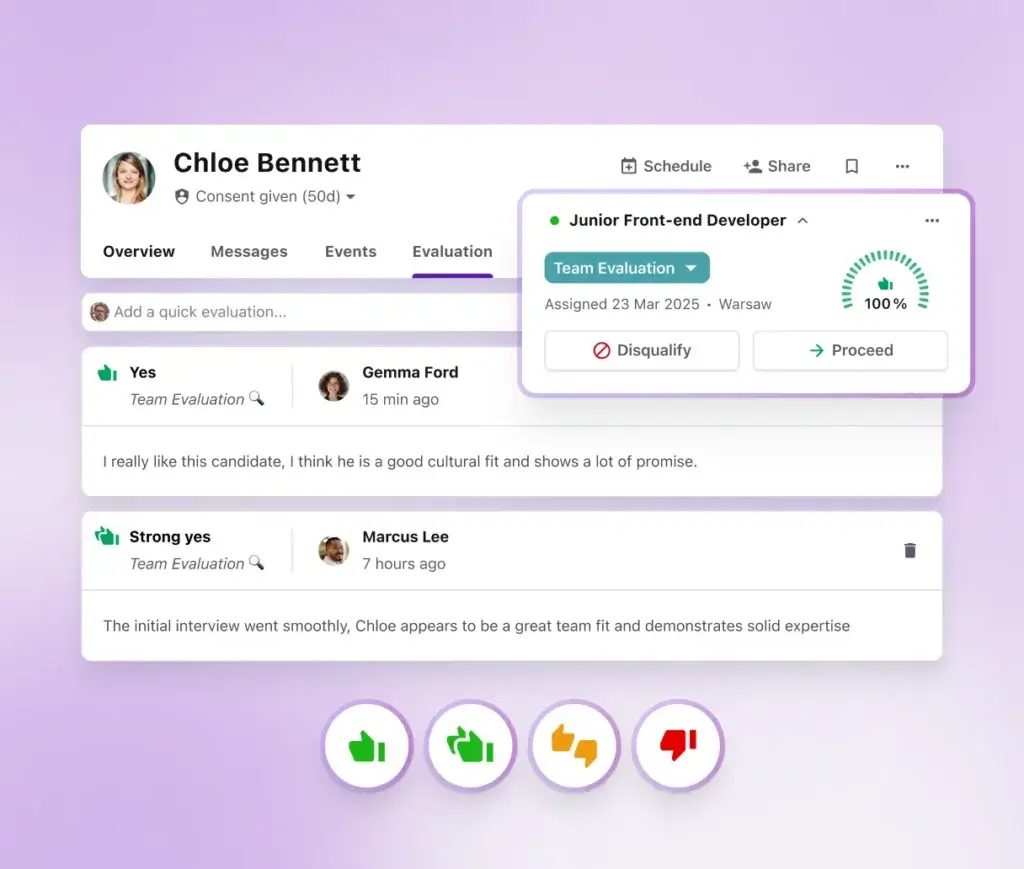
Tellent Recruitee is built around collaborative hiring. You can assign roles and tasks, mention colleagues, leave notes, collect feedback, and keep hiring stakeholders involved throughout the process.
This is valuable because many hiring delays are not caused by sourcing alone. They come from unclear ownership, late feedback, inconsistent evaluation, and poor communication between recruiters and hiring managers.
Interview Management and Feedback
The platform helps interviewers evaluate candidates in a centralized space. Hiring teams can review profiles, share feedback, and keep interview decisions connected to the candidate record.
This makes Recruitee a good fit for companies that want a more organized hiring process, but do not want the heavier structure of enterprise recruiting systems like Workday Recruiting or iCIMS.
AI Writing and Automation
Tellent Recruitee includes AI-powered support for tasks such as email writing and feedback writing. This is not a replacement for recruiter judgment, but it can reduce repetitive writing work and speed up candidate communication.
The automation features are most useful when your team has repeatable hiring steps. You can reduce manual reminders, standardize parts of communication, and keep candidate movement through the funnel more consistent.
Reporting and Hiring Insights
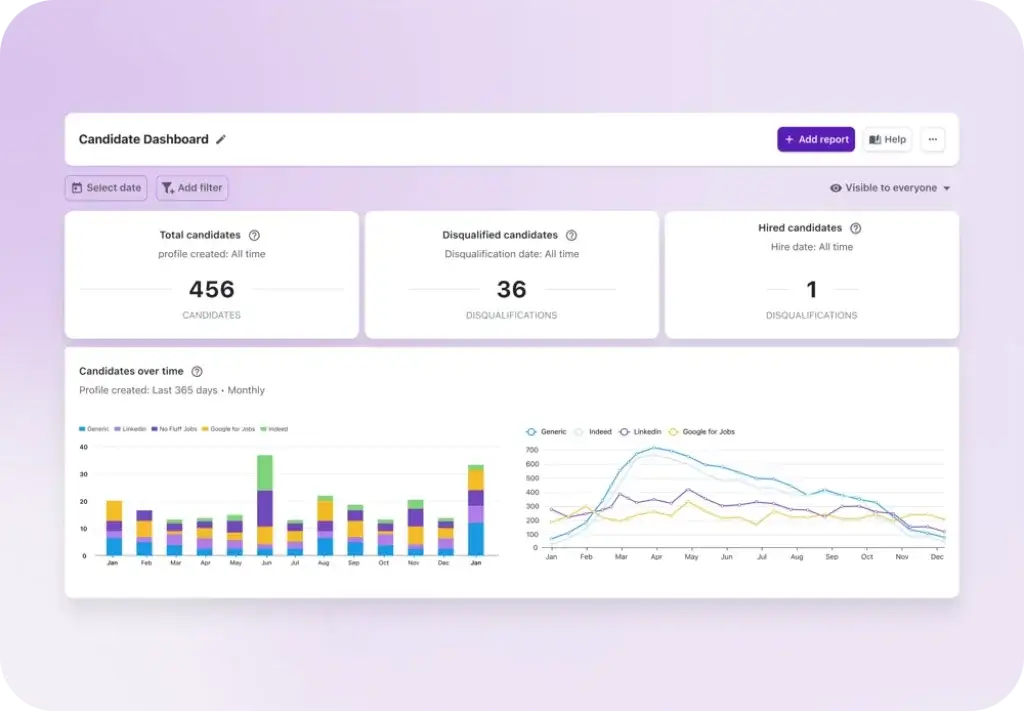
Tellent Recruitee includes standard reporting and analytics, with stronger reporting options available as you move into more advanced needs. You can use reports to understand pipeline performance, hiring activity, job progress, and bottlenecks.
The reporting is strong enough for many growing companies, but highly analytical recruiting teams may still prefer more advanced platforms or BI connections if they need deeper custom dashboards.
Integrations and API Access
Tellent Recruitee offers a marketplace with more than 200 integrations, plus API access for connecting the ATS with other HR, productivity, and business systems.
This matters because recruiting software rarely works alone. Your ATS may need to connect with HRIS tools, assessment platforms, calendar apps, background checks, sourcing tools, payroll systems, and business intelligence tools.
Email and Calendar Sync
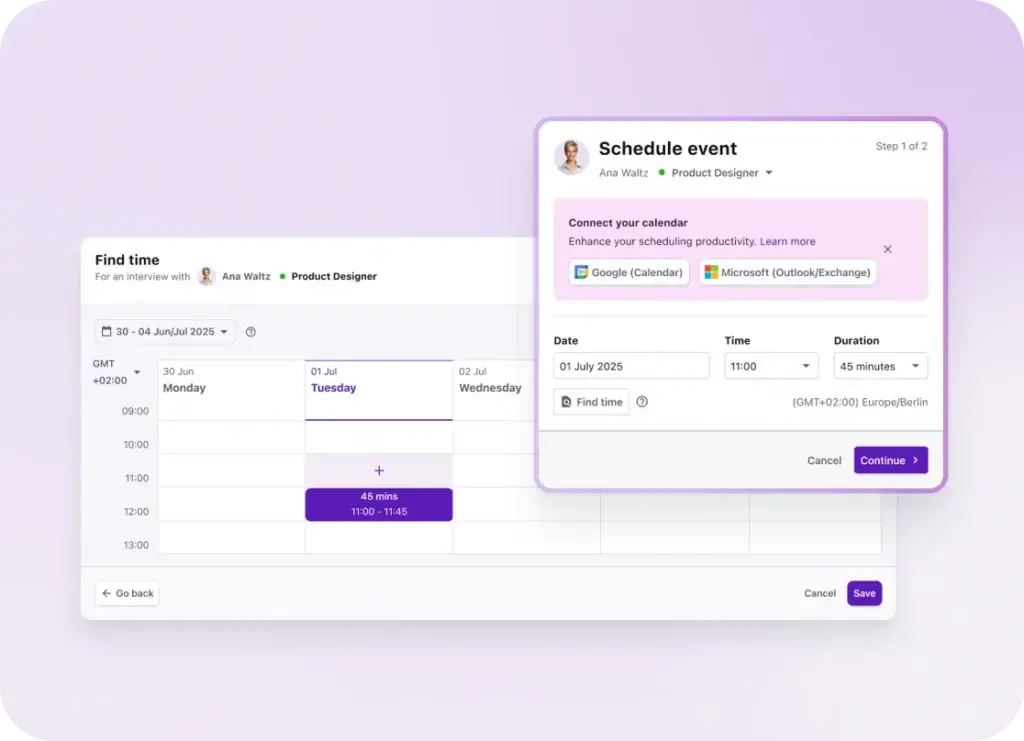
Email and calendar sync allow recruiters to communicate and schedule interviews from inside the hiring workflow. This can reduce the back-and-forth that often slows down interview coordination.
For smaller recruiting teams, this is one of the most immediately useful features because it improves daily execution without requiring a complex implementation.
Beyond the ATS
Tellent HR and Platform Capabilities
Tellent is more than Recruitee. The wider platform also includes Tellent HR, which brings together HRIS and performance management capabilities for companies that want to manage more of the employee lifecycle in one environment.
Core HR Management
Tellent HR includes employee database tools, time and attendance tracking, absence management, expense management, HR reports, payroll-related workflows, and custom modules.
This makes Tellent more relevant if your hiring process is connected to broader HR operations. For example, once a candidate is hired through Recruitee, the employee journey can continue into employee records, onboarding, absence tracking, and performance workflows.
Performance Reviews and Feedback
Tellent HR also supports performance reviews, 360-degree feedback, employee development plans, and engagement surveys. This gives HR teams a way to connect hiring decisions with long-term employee development.
For organizations that care about retention, this is important. Hiring is only the first step. You also need a way to track development, identify engagement risks, and make better people decisions after the employee joins.
Employee Journeys
Employee Journeys can support structured workflows across pre-onboarding, onboarding, and other candidate or employee experiences. This is especially useful when your HR team wants to reduce manual follow-ups after an offer is accepted.
The Journeys add-on is a good example of where Tellent’s modular strategy makes sense. You can add process structure where you need it, instead of adopting a broad HR suite all at once.
Security, Compliance, and Data Protection
Tellent puts visible emphasis on security and compliance, including GDPR-focused hiring processes. This is particularly relevant for European companies, international employers, and HR teams handling sensitive candidate and employee data.
For any ATS or HRIS buyer, compliance should not be treated as a secondary feature. Candidate records, interview feedback, offer details, performance data, and employee files all require careful handling.
Localized Support
Tellent highlights live chat and localized support, including regional and language-specific support. This can be an advantage for companies operating in Europe or across multiple regions.
Support quality matters because ATS adoption depends on recruiters and hiring managers actually using the system consistently. Localized help can make onboarding and troubleshooting easier for distributed HR teams.
Pros and Cons
Benefits and Limitations of Using Tellent
Positive
✅ Strong collaborative ATS
✅ Modular HR platform
✅ Good candidate management
✅ Useful integrations
Negative
❌ Pricing can rise
❌ Advanced features vary
❌ Not full enterprise HCM
❌ Reporting may feel basic
Strengths & Benefits
Tellent is strongest when you want a modern ATS that can connect to broader HR workflows without forcing you into an oversized enterprise suite.
- Strong collaborative ATS – Recruitee is easy for recruiters and hiring managers to use together.
- Modular HR platform – You can combine ATS, HRIS, and performance tools as needed.
- Good candidate management – Pipelines, notes, feedback, and automation help organize hiring.
- Useful integrations – Marketplace apps and API access support a connected HR stack.
- European compliance angle – GDPR awareness and localized support are meaningful strengths.
Limitations & Drawbacks
Tellent is a strong option, but it is not perfect for every hiring team.
- Pricing can rise – Public user feedback includes concerns about annual price increases.
- Advanced features vary – Some capabilities depend on plan level or add-ons.
- Not full enterprise HCM – Large companies may still need deeper HR, payroll, and workforce planning tools.
- Reporting may feel basic – Data-heavy recruiting teams may want more advanced analytics.
- Modular setup needs planning – You should map which Tellent products and add-ons you actually need.
Operational Fit
Tellent User Experience, Support, and Security
Product fit is not just about feature depth. It also depends on how quickly teams adopt the system, how easy it is to configure, and whether the vendor can support sensitive HR processes.
Ease of Use
Tellent Recruitee is generally easy to understand, especially for teams moving from spreadsheets or lightweight tools. The interface is built around pipelines, candidate profiles, jobs, feedback, and team activity.
This makes it accessible for recruiters and hiring managers who need to participate in hiring but may not use recruiting software every day.
Implementation Experience
Implementation should be manageable for most small and mid-sized hiring teams, but it still requires planning. You should define pipeline stages, team roles, job templates, feedback workflows, approval logic, and integrations before rollout.
The biggest mistake is treating ATS setup as a purely technical task. The real value comes when the system reflects how your team actually hires.
Customer Support
Tellent offers live chat and localized support, which can be helpful for companies operating across different regions or languages. This support model is useful because recruiting workflows often involve many non-HR users, including managers and interviewers.
As with most SaaS platforms, support experience can vary depending on plan, implementation complexity, and internal expectations. For larger teams, it is worth asking what onboarding and customer success resources are included.
Security and Compliance
Tellent Recruitee emphasizes secure and compliant hiring, including GDPR-focused candidate data handling. This is important because ATS platforms store resumes, contact details, feedback, interview notes, and sometimes sensitive hiring documentation.
Before buying, you should confirm your specific requirements around data residency, retention policies, access controls, SSO, audit needs, and integrations with other HR systems.
AI Governance Considerations
Tellent includes AI-supported writing and automation features. These can be useful for drafting emails, summarizing feedback, and reducing repetitive work.
However, HR teams should still define clear internal rules for AI usage in recruitment. AI should support recruiter productivity, not replace structured evaluation, fair hiring practices, or human review.
Pricing
Tellent Pricing & Plans
Tellent pricing is modular, which means your total cost depends on whether you buy Tellent Recruitee, Tellent HR, add-ons, or a wider platform package. For the ATS product, Tellent Recruitee currently uses Start, Advance, and Optimize plans.
How Tellent Recruitee Structures Its Plans
The Start plan is designed for early-stage teams building their hiring foundation. It includes 5 active job posts, CareersHub, multi-job board posting, collaboration tools, candidate management, pipeline automation, AI writing, email and calendar sync, standard reporting, the mobile app, marketplace integrations, unlimited data storage, live chat, localized support, and API access.
More advanced plans are designed for teams that need broader hiring scale, deeper workflows, stronger analytics, or more enterprise-oriented controls. Optional add-ons can include SSO, texting, Journeys, AgencyHub, WhatsApp Hiring, and Tellent HR.
What Affects Total Cost
Your final cost may depend on job volume, plan level, contract terms, add-ons, HRIS needs, integrations, support requirements, and whether you need additional modules such as employee journeys or performance management.
This is why you should evaluate Tellent as both an ATS purchase and a wider HR platform decision. A company buying only Recruitee will have a different cost profile than a company adopting ATS, HRIS, and performance tools together.
Pricing Table
The table below gives a practical summary of how Tellent pricing works today.
| Feature Type | Tellent Recruitee | What it means for buyers |
| Pricing model | Modular subscription pricing | You choose ATS, HRIS, performance tools, and add-ons based on need |
| ATS plans | Start, Advance, Optimize | Plans scale from hiring foundations to more advanced recruiting operations |
| Start plan | 5 active job posts | Good fit for smaller teams building a structured hiring process |
| Core ATS features | CareersHub, job posting, pipelines, collaboration, AI writing | Covers the main needs of growing hiring teams |
| Integrations | Marketplace and API access | Useful for connecting ATS workflows with the wider HR stack |
| Add-ons | SSO, texting, Journeys, AgencyHub, WhatsApp Hiring | Advanced needs may increase the total cost |
| Best for | Growing and mid-sized hiring teams | Best when you need collaborative recruiting plus room to expand into HR |
What to Ask Before You Buy
Before choosing Tellent, ask which features are included in each plan, whether pricing is based on job slots or package level, what add-ons cost, how annual renewals work, and what support is included.
You should also ask whether Tellent HR is priced separately, how Recruitee connects with your existing HRIS, and whether the platform supports your required compliance and data retention policies.
Use Cases
Who Should Use Tellent?
Tellent is not for every organization, but it fits several use cases very well.
Growing Companies That Need a Better ATS
If your company is hiring regularly and spreadsheets are no longer enough, Tellent Recruitee is a strong upgrade. It gives you pipelines, candidate profiles, job posting, collaboration, and automation in one system.
Recruiting Teams That Need Manager Collaboration
Tellent Recruitee is a good fit when hiring managers, interviewers, and recruiters all need to participate in the process. The platform helps reduce fragmented communication and keeps feedback connected to each candidate.
European HR Teams
Tellent is especially relevant for European and international HR teams because of its compliance positioning, localized support, and HR platform direction.
Companies That Want ATS Plus HRIS Expansion
If your immediate need is recruiting but your future need is broader HR management, Tellent deserves serious consideration. You can evaluate Recruitee first, then consider Tellent HR for employee data, absence, performance, and engagement.
When Tellent Might Not Be Right
Tellent may not be the best choice if you only hire a few times per year, need the cheapest possible ATS, or require a full enterprise HCM platform with deep payroll, benefits, finance, and workforce management capabilities.
User Feedback
Tellent Customer Reviews
Public user reviews for Tellent Recruitee are generally positive, with strong ratings on major review platforms. Users often highlight the friendly interface, collaboration tools, candidate tracking, and the improvement it brings compared with spreadsheets or manual hiring workflows.
What Users Like Most
The most common strengths are ease of use, clean candidate management, simple collaboration, and helpful recruiting workflows. These are important because ATS adoption depends heavily on whether hiring managers and recruiters actually use the system.
Recruitee performs well for teams that want structure without unnecessary complexity. That is one of the reasons it remains competitive in the growing-company ATS market.
Common Complaints
The most common concerns are usually around pricing, renewals, feature depth, or limitations compared with heavier enterprise systems. Some users also want more advanced reporting or deeper customization.
These issues do not make Tellent a weak platform, but they do mean buyers should be careful during procurement. You should clarify renewal terms, add-on pricing, reporting depth, and plan limits before committing.
My Take on the Review Pattern
The review pattern suggests that Tellent Recruitee succeeds when buyers want a user-friendly, collaborative ATS. It is not trying to be the most complex enterprise recruiting platform. Instead, its value is in making hiring more organized, more collaborative, and easier to manage.
For most growing businesses, that is exactly the right balance. For very large enterprises or highly analytical recruiting operations, platforms like Greenhouse, iCIMS, Ashby, or Workday Recruiting may be more appropriate depending on the use case.
Competitors
Tellent Alternatives and Competitors
Tellent Recruitee competes with ATS and recruiting platforms such as Greenhouse, Lever, Workable, SmartRecruiters, and iCIMS. The right choice depends on your company size, hiring complexity, budget, and whether you want standalone ATS software or a broader HR platform.
| Feature Type | Tellent Recruitee | Greenhouse | Lever | Workable |
| Core angle | Collaborative ATS within modular HR platform | Structured hiring platform | ATS and CRM balance | Recruiting software for SMBs and mid-market teams |
| Best for | Growing teams wanting ATS plus HR expansion | Teams prioritizing structured hiring | Teams needing sourcing and candidate relationship management | Companies wanting fast setup and broad recruiting tools |
| Ease of use | Very approachable | Mature and polished | Generally user-friendly | Simple and practical |
| HR platform depth | Stronger due to Tellent HR | Hiring-focused | Hiring-focused | Mostly recruiting-focused |
| Analytics depth | Good for growing teams | Strong for structured recruiting | Solid CRM and recruiting insights | Practical but not always enterprise-grade |
| Overall fit | Best for modular HR growth | Best for hiring process rigor | Best for ATS plus CRM strategy | Best for fast, accessible recruiting |
Compared with Greenhouse, Tellent Recruitee is usually more attractive if you want a simpler collaborative ATS that can connect to HRIS and performance tools. Greenhouse is stronger if your main priority is structured hiring methodology and mature recruiting governance.
Compared with Lever, Tellent Recruitee is often a better fit for teams focused on straightforward hiring collaboration and HR platform expansion. Lever may be stronger for companies that want deeper candidate relationship management and outbound recruiting workflows.
Compared with Workable, Tellent Recruitee has a stronger platform story because of Tellent HR. Workable may appeal more to SMBs that want fast recruiting execution and a broad set of hiring features without thinking as much about HRIS expansion.
Best Practices
Getting Started with Tellent
To get the most value from Tellent, you should approach implementation as a hiring process improvement project, not just a software setup.
Map Your Hiring Workflow First
Before configuring Recruitee, define your hiring stages, candidate sources, approval steps, feedback expectations, and hiring manager responsibilities.
This helps you avoid building a messy ATS that simply copies your existing process problems into a new tool.
Standardize Candidate Communication
Use templates, email sync, AI writing support, and automation to make candidate communication more consistent. This can improve candidate experience and reduce recruiter workload.
Set Clear Collaboration Rules
Decide who can move candidates, who owns feedback, when hiring managers should respond, and how interview notes should be submitted.
Collaborative hiring only works when responsibilities are clear.
Connect Your HR Stack
Use integrations and API access to connect Tellent Recruitee with your HRIS, calendar, assessment tools, background checks, payroll workflows, or BI systems.
If you plan to use Tellent HR, map the handoff from accepted offer to employee record and onboarding workflow before launch.
Review Pricing and Add-Ons Carefully
Because Tellent is modular, check exactly which features are included in your selected plan. Pay attention to SSO, texting, WhatsApp Hiring, Journeys, AgencyHub, BI integrations, and Tellent HR modules.
Conclusion
Final Thoughts
Tellent is a strong option for companies that want a modern, collaborative ATS with room to expand into broader HR and performance management. Its most important product for hiring teams is Tellent Recruitee, which combines applicant tracking, candidate pipelines, careers site tools, job posting, collaboration, automation, AI writing, integrations, and compliance-focused recruiting workflows.
The platform’s biggest strengths are ease of use, collaborative hiring, modular HR expansion, localized support, and a practical feature set for growing companies. Its main limitations are pricing clarity, potential renewal concerns, add-on complexity, and reporting depth for more advanced recruiting operations.
Overall, Tellent is worth considering if your team wants to move beyond spreadsheets or basic ATS software, but does not want to commit to a heavy enterprise HCM platform. Recruitee is the main reason to shortlist it for recruiting, while Tellent HR makes it more compelling for companies that want hiring, employee management, performance, and people insights to become more connected over time.
Have more questions?
Frequently Asked Questions
What is Tellent?
Tellent is a modular HR platform that combines applicant tracking, HRIS, performance management, employee journeys, reporting, and integrations to help HR teams make better people decisions.
Is Recruitee part of Tellent?
Yes. Recruitee is now Tellent Recruitee, the applicant tracking system within the wider Tellent platform. It focuses on collaborative hiring, candidate management, job posting, and recruiting workflows.
What is Tellent Recruitee best used for?
Tellent Recruitee is best used for applicant tracking, hiring pipeline management, careers site publishing, job board posting, team collaboration, interview feedback, automation, and candidate communication.
How much does Tellent Recruitee cost?
Tellent Recruitee uses modular subscription pricing across Start, Advance, and Optimize plans. Final pricing depends on plan level, add-ons, contract terms, and whether you also need Tellent HR.
Does Tellent Recruitee offer a free trial?
Tellent Recruitee promotes a free trial option, allowing teams to test the ATS before committing. You should confirm current trial limits, job posting access, and plan availability directly with Tellent.
Does Tellent include HRIS features?
Yes. Tellent HR includes HRIS and performance management capabilities such as employee data, time and attendance, absence management, expenses, performance reviews, feedback, engagement surveys, and HR reporting.
Is Tellent good for small businesses?
Tellent can work well for growing small businesses that hire regularly and want a more structured ATS. Very small teams that hire only occasionally may prefer a simpler or lower-cost recruiting tool.
Does Tellent Recruitee support integrations?
Yes. Tellent Recruitee supports marketplace integrations and API access, helping teams connect the ATS with HR tools, calendars, assessments, sourcing software, productivity tools, and reporting systems.
What are the best Tellent alternatives?
The best Tellent alternatives include Greenhouse, Lever, Workable, SmartRecruiters, iCIMS, and Ashby. The right choice depends on whether you need structured hiring, CRM depth, enterprise scale, or easier SMB recruiting.
Is Tellent worth it?
Tellent is worth considering if you need a collaborative ATS and want room to expand into HRIS and performance management. It is strongest for growing companies that want structured hiring without adopting a heavy enterprise HCM suite.