Introduction
Choosing recruiting software is no longer just about collecting applications and moving candidates through a pipeline. For many organizations, the applicant tracking system has become the operating layer for hiring strategy, recruiter productivity, candidate experience, compliance, and workforce planning.
That is where iCIMS stands out. iCIMS is not a lightweight ATS for occasional hiring. It is an enterprise-grade talent acquisition platform built for companies that need structured workflows, high-volume hiring support, candidate engagement, onboarding, AI-powered recruiting tools, and a large integration ecosystem.
In this iCIMS review, you will get a practical look at what the platform offers, where it performs well, where it can feel heavy, and which types of hiring teams will get the strongest return from it in 2026.
What Is iCIMS?
iCIMS is a cloud-based talent acquisition platform that helps organizations attract, engage, hire, and advance talent. Its product suite includes applicant tracking, candidate relationship management, text recruiting, recruitment marketing, career sites, onboarding, offer management, analytics, AI recruiting, and integrations with HR systems and recruiting tools.
The platform is best understood as a recruiting ecosystem rather than a single-purpose ATS. You can use iCIMS to manage open roles, automate workflows, communicate with candidates, coordinate interviews, create offer workflows, onboard new hires, and connect recruiting data with the rest of your HR tech stack.
Background and Positioning
iCIMS positions itself as an enterprise talent acquisition platform for organizations that need scale, configurability, security, and flexibility. It is especially relevant for companies with complex hiring processes, multiple hiring teams, high requisition volume, distributed locations, or industry-specific recruiting requirements.
The company’s Talent Cloud is built around four core areas: attract, engage, hire, and advance. This gives iCIMS a broader footprint than basic ATS tools, while keeping the platform focused on recruiting and talent mobility rather than trying to become a full HRIS or payroll system.
Target Users and Use Cases
iCIMS is especially relevant for several buyer types:
- Enterprise hiring teams – You get deeper workflow control, governance, and integrations than most lightweight ATS tools.
- High-volume employers – Retail, hospitality, healthcare, manufacturing, and frontline hiring teams can benefit from text, automation, and career site tools.
- Talent acquisition leaders – Reporting, pipeline visibility, candidate engagement, and recruiter productivity are core use cases.
- Global organizations – iCIMS supports multilingual and multi-location recruiting requirements.
- Companies with complex HR stacks – The platform is built to integrate with HCM, payroll, background check, assessment, and job advertising systems.
That said, iCIMS is not the best fit if you only hire occasionally, want a simple ATS with transparent monthly pricing, or need an all-in-one HR system with payroll and benefits built in. It is strongest when recruiting is strategic, distributed, complex, or high-volume.
Core Features of the Platform
How Does iCIMS Work?
iCIMS works by centralizing the recruiting lifecycle inside one configurable platform. Instead of forcing recruiters to manage job posts, applications, candidate communication, interview scheduling, offers, onboarding, and reporting across disconnected systems, iCIMS gives talent teams a connected environment for enterprise hiring operations.
The biggest advantage is not one individual feature. It is the way iCIMS brings applicant tracking, engagement, AI, automation, and integrations together for companies that hire at scale.
Applicant Tracking and Hiring Workflows
The iCIMS ATS is the foundation of the platform. It helps your team manage requisitions, job postings, applications, candidate records, hiring stages, approvals, interview feedback, offers, and recruiting activity from one system.
The platform is designed for enterprise hiring workflows, which means it can support multiple departments, user roles, approval chains, business units, hiring locations, and candidate flows. This is useful when your recruiting process is too complex for a simple drag-and-drop applicant tracker.
Job Posting and Requisition Management
iCIMS helps teams create and manage job postings with templates, approval workflows, and integrated job advertising options. Recruiters can standardize job content, publish roles across channels, and keep internal stakeholders aligned during the requisition process.
This is especially valuable for organizations that need consistency across many hiring managers or locations. A small company might not need that level of control, but a larger employer usually benefits from the structure.
Candidate Relationship Management
iCIMS Engage adds candidate relationship management and recruitment marketing capabilities. It helps your team build talent pools, nurture passive candidates, automate campaigns, and maintain candidate relationships before a person applies to a specific job.
This matters because many companies still treat recruiting as a reactive process. iCIMS is more useful when you want to build pipelines in advance, especially for hard-to-fill roles or recurring hiring needs.
Career Sites and Employer Branding
iCIMS includes employer branding and career site tools that help companies create branded application experiences. This can include career pages, AI-powered digital assistants, candidate-facing content, and employee testimonial videos.
For enterprise employers, the career site is often one of the most important conversion points in the hiring funnel. iCIMS gives you more control over that experience than a basic ATS career page typically provides.
Text Recruiting and Candidate Communication
iCIMS Text Engagement helps recruiters communicate with candidates through SMS and automated text workflows. You can use it for text-to-apply campaigns, candidate reminders, interview scheduling, and re-engagement campaigns.
This is one of the more practical features for high-volume hiring. Candidates do not always respond quickly to email, especially in frontline, hourly, retail, hospitality, or healthcare hiring. Text messaging can reduce friction and keep candidates moving through the process.
Interview Scheduling and Hiring Team Collaboration
iCIMS supports interview scheduling templates, candidate self-scheduling, calendar integrations, and automated reminders. This helps reduce the repetitive coordination work that slows down recruiters and frustrates candidates.
The platform also supports collaboration through approval workflows, internal notifications, candidate submissions, and hiring team feedback. This is important because hiring delays are often caused by poor stakeholder coordination, not by a lack of applicants.
Offer Management
iCIMS includes offer management capabilities that help teams create, review, approve, and send offer letters. Templates and approval chains can make the offer process more consistent while reducing manual work for recruiters and HR operations teams.
This is particularly useful when your company has different compensation structures, departments, geographies, or compliance requirements. A controlled offer workflow reduces the risk of inconsistent documentation and approval gaps.
Employee Onboarding
iCIMS extends beyond the hiring decision with onboarding tools. These help teams automate onboarding tasks, collect forms, track new-hire progress, and create a smoother transition between accepted offer and productive employee.
This does not make iCIMS a full HRIS. However, it does help close one of the most common gaps in recruiting operations: the handoff from recruiting to HR.
Reporting and Analytics
iCIMS includes reporting and analytics tools for tracking recruiting performance. You can use the platform to monitor time to fill, time to hire, source performance, recruiter activity, candidate movement, and compliance-related data such as EEO reporting.
For talent acquisition leaders, this is a major reason to consider iCIMS. The platform gives you a more centralized view of hiring performance, especially when recruiting activity is spread across roles, teams, and locations.
AI Recruiting with iCIMS Coalesce AI
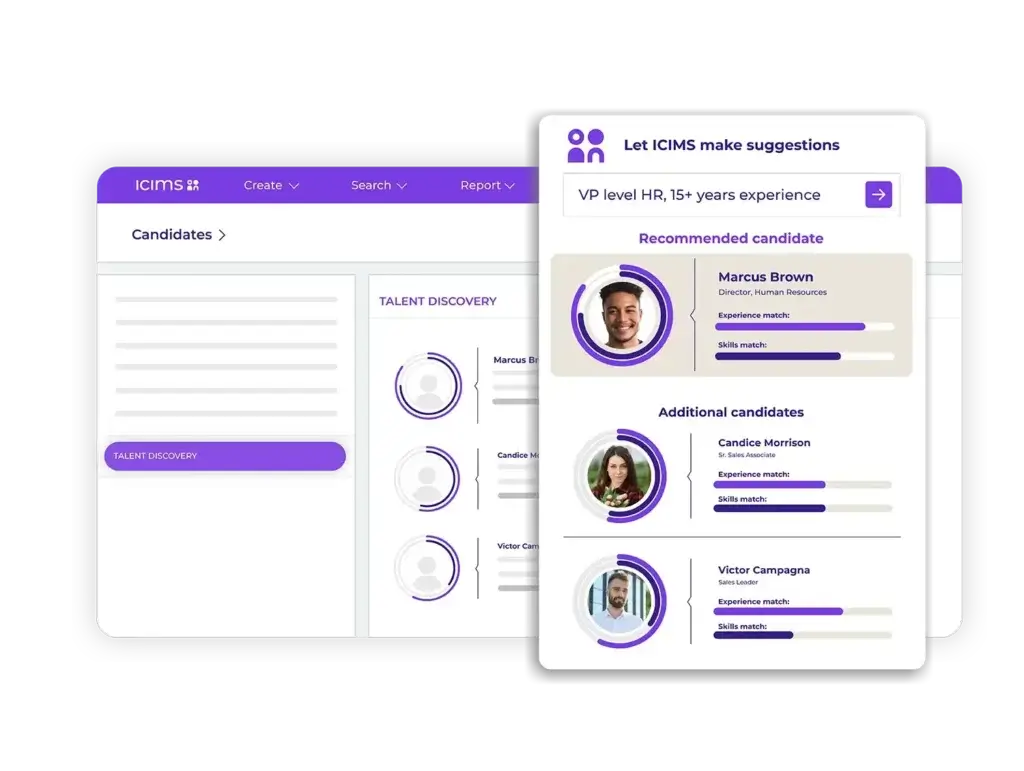
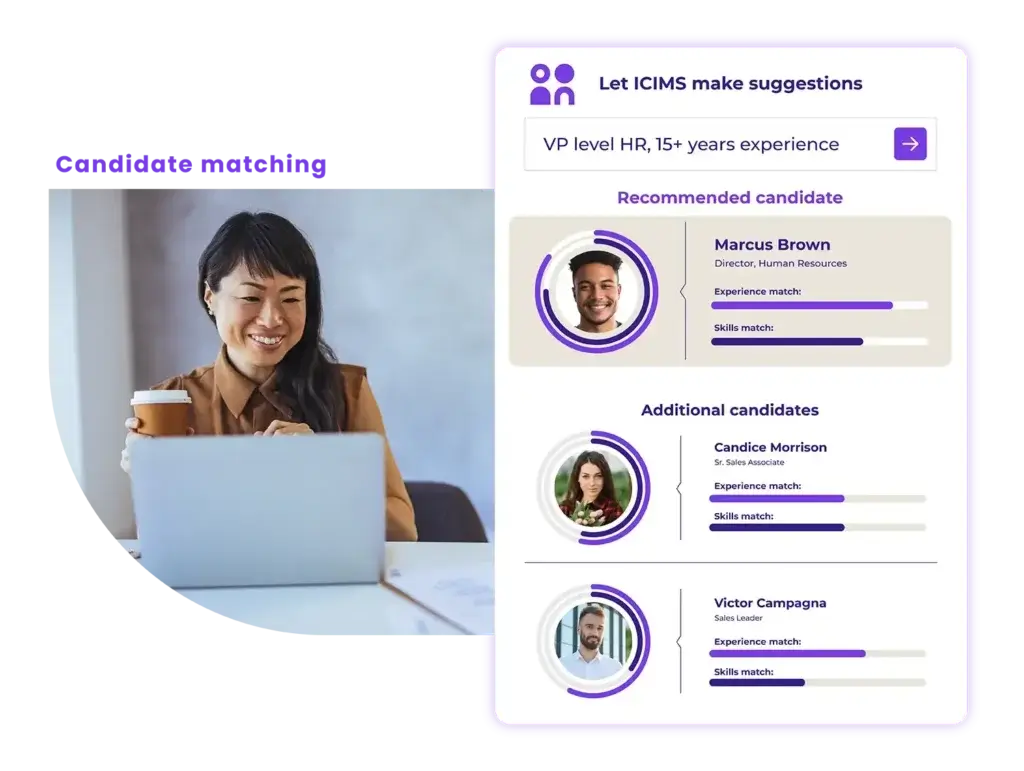
iCIMS Coalesce AI adds AI-powered recruiting support across the hiring journey. Its capabilities include candidate matching, candidate ranking, AI-powered search, job description optimization, AI-assisted communication, chatbot experiences, sourcing support, and interview question generation.
The value of Coalesce AI is strongest when you have enough hiring volume for AI-assisted prioritization to matter. It is less about replacing recruiters and more about helping recruiters find, engage, and move candidates faster while keeping human decision-making in the process.
Integrations and Marketplace
iCIMS has one of the stronger integration ecosystems in the recruiting software market. It connects with HCM platforms, payroll systems, background check providers, assessment tools, job boards, productivity tools, and other recruiting technologies.
This matters for enterprise buyers because recruiting rarely happens inside one system. If you already use systems like Workday, SAP SuccessFactors, ADP, Oracle, UKG, Microsoft Teams, background check vendors, or assessment platforms, integration flexibility becomes a major buying factor.
Business Operations Features
iCIMS Talent Cloud, AI, and Integrations
iCIMS is strongest when you evaluate it as a talent acquisition infrastructure platform. It is not only about tracking applicants. It is about helping your company run recruiting as a measurable, scalable, and connected business function.
Enterprise ATS First, Not a Full HR Suite
iCIMS is deeply focused on talent acquisition. It can support onboarding and internal mobility, but it is not designed to replace your HRIS, payroll system, benefits platform, or employee management system.
This is a strength if you want a specialized recruiting platform. It can also be a limitation if your priority is to consolidate every HR process into one vendor.
High-Volume Hiring Support
iCIMS is a strong fit for companies that hire at scale. The platform supports bulk candidate management, automated communication, text-to-apply campaigns, self-scheduling, branded career sites, and AI-assisted candidate engagement.
This makes it especially relevant for industries like retail, hospitality, healthcare, logistics, manufacturing, and customer service. These hiring environments often require speed, mobile-friendly applications, and high candidate throughput.
Recruitment Marketing and Talent Pipeline Building
With iCIMS Engage, your team can move beyond reactive applicant tracking. You can segment candidates, build talent pools, send nurture campaigns, automate communication, and strengthen your talent pipeline before a role opens.
This is helpful when you recruit for recurring roles, competitive roles, or markets where candidate relationships matter. It also gives iCIMS an advantage over ATS tools that only start working after someone applies.
Candidate Experience Tools
Candidate experience is one of iCIMS’ strongest product themes. The platform supports mobile-friendly applications, text messaging, branded career sites, digital assistant functionality, automated reminders, and self-scheduling.
These features can reduce candidate drop-off. They also help your team create a more consistent experience, which matters when your employer brand is competing for attention across job boards, social media, referrals, and direct applications.
Coalesce AI for Recruiting Efficiency
Coalesce AI is designed to support sourcing, matching, engagement, coordination, and candidate prioritization. It can help recruiters find relevant candidates faster, rank applicants by skills and experience, create better job content, and reduce repetitive manual work.
AI is not the only reason to buy iCIMS, but it does strengthen the platform for teams dealing with high application volume or complex talent pipelines. The most important point is control. Your team should treat AI recommendations as decision support, not as fully automated hiring decisions.
Integration Depth for Complex HR Tech Stacks
iCIMS is particularly strong for companies with complex HR technology environments. Its integrations help connect recruiting workflows with HCM systems, payroll systems, job boards, background checks, assessments, and collaboration tools.
This is a major advantage for enterprise buyers. A recruiting platform can have strong features, but if it cannot exchange data with your HRIS and downstream systems, it quickly becomes another silo.
Pros and Cons
Benefits and Limitations of Using iCIMS
Positive
✅ Strong enterprise ATS
✅ Excellent integrations
✅ Useful candidate engagement
✅ High-volume hiring support
Negative
❌ Pricing is not public
❌ Can feel complex
❌ Setup needs planning
❌ Not a full HRIS
Strengths & Benefits
iCIMS performs best when your hiring operation needs structure, scale, and connectivity. It is not the simplest ATS on the market, but it is one of the more capable platforms for mature recruiting teams.
- Strong enterprise ATS – iCIMS can support complex workflows, approvals, roles, and hiring processes.
- Excellent integrations – The ecosystem is a major advantage for companies with established HR stacks.
- Useful candidate engagement – Text, CRM, career sites, and campaigns help improve candidate communication.
- High-volume hiring support – Automation and mobile-friendly workflows help teams manage large candidate pools.
- AI recruiting capabilities – Coalesce AI can support matching, ranking, sourcing, communication, and job content.
Limitations & Drawbacks
iCIMS is powerful, but its strengths also create some trade-offs. The platform can be more than smaller or less mature hiring teams need.
- Pricing is not public – You need a sales conversation to understand the total cost.
- Can feel complex – Occasional users and hiring managers may need training.
- Setup needs planning – Configuration, workflows, permissions, and integrations require thoughtful implementation.
- Customization has limits – Some teams may still need vendor help or admin expertise for deeper changes.
- Not a full HRIS – iCIMS usually works alongside HR systems rather than replacing them.
Operational Fit
iCIMS User Experience, Support, and Security
Software fit is not only about features. It also depends on usability, implementation effort, support expectations, security requirements, and how well the platform fits your internal hiring maturity.
Ease of Use
iCIMS receives positive feedback for its core recruiting functionality, especially candidate tracking, workflow visibility, and full-cycle recruiting support. Recruiters who work inside the platform daily often value the depth and control it provides.
However, ease of use depends heavily on configuration and training. A well-implemented iCIMS environment can feel organized and efficient. A poorly planned setup can feel bulky, especially for hiring managers who only log in occasionally.
Implementation Experience
Implementation is one of the most important parts of buying iCIMS. Because the platform is configurable, your team should define workflows, roles, approval chains, reporting needs, integrations, candidate communications, and onboarding handoffs before rollout.
This is not the type of system where you should simply turn it on and hope the process improves. iCIMS works best when it reflects a clear recruiting operating model.
Customer Support and Training
iCIMS offers implementation services, customer success resources, training, a knowledge base, community resources, and developer materials. For enterprise teams, this support ecosystem is important because the platform often becomes mission-critical to hiring operations.
Public reviews show mixed but generally useful feedback around support. Some users praise responsiveness and setup help, while others mention support or configuration friction. As with most enterprise software, the experience can vary based on account complexity, internal admin skill, and service expectations.
Security and Compliance
Security is a key consideration for iCIMS buyers because recruiting systems store sensitive candidate and employee data. iCIMS highlights security controls such as encryption in transit and at rest, role-based access, audit trails, GDPR and CCPA support, and trust center documentation.
The company also makes ISO 27001 and ISO 27701 certification information available through its Trust Center. For enterprise buyers, these are important trust signals, especially when recruiting data needs to flow between multiple systems.
AI Governance and Human Control
iCIMS emphasizes responsible AI and recruiter control. Coalesce AI is positioned as a way to assist recruiters with sourcing, matching, candidate ranking, engagement, and coordination, while keeping humans involved in decisions.
This distinction matters. AI in recruiting can improve efficiency, but it also creates risks around bias, transparency, compliance, and over-automation. iCIMS is strongest when your team uses AI to support human judgment rather than replace it.
Pricing
iCIMS Pricing & Plans
iCIMS does not publish standard pricing on its website. Like many enterprise recruiting platforms, pricing is quote-based and depends on your company size, hiring volume, required products, integrations, implementation needs, and contract structure.
How iCIMS Pricing Works
iCIMS is typically sold through a custom sales process. Your final quote may depend on whether you need only the ATS or a broader Talent Cloud package that includes CRM, text recruiting, career sites, onboarding, AI, analytics, and integrations.
This makes direct price comparison difficult. A company using iCIMS only for applicant tracking may see a very different cost structure than a company using iCIMS for high-volume hiring, text campaigns, career sites, onboarding, and complex HCM integrations.
What Affects Total Cost
The total cost of iCIMS can be affected by several factors, including employee count, hiring volume, number of users, number of locations, products included, implementation scope, data migration, integrations, support requirements, and contract length.
You should also consider internal costs. Enterprise recruiting platforms require admin ownership, process design, stakeholder training, and ongoing optimization. The software cost is only one part of total cost of ownership.
What to Ask Before You Buy
Before signing with iCIMS, ask exactly which modules are included, how AI features are priced, whether texting is included or add-on, how onboarding is packaged, what integrations are standard, what requires professional services, and what support level is included.
You should also ask about implementation timeline, data migration, reporting limitations, admin training, API access, renewal terms, and whether pricing changes when your employee count or hiring volume grows.
Pricing Table
The table below gives a practical summary of how iCIMS pricing works for buyers.
| Feature Type | iCIMS | What it means for buyers |
| Pricing model | Custom quote | You need to speak with sales for an exact price |
| Public pricing | Not published | Budget planning requires a demo and quote process |
| Core product | Enterprise ATS | Best for structured and complex hiring workflows |
| Add-on capabilities | CRM, text, onboarding, AI, career sites | Total cost depends on the modules your team needs |
| Implementation | Usually requires planning | Workflow design and integrations affect time to value |
| Best for | Mid-market and enterprise teams | Usually too advanced for very small or occasional hiring teams |
My practical recommendation is simple: evaluate iCIMS based on process value, not just software cost. If it reduces time to fill, improves candidate engagement, gives recruiters better pipeline visibility, and connects cleanly with your HR stack, it can justify a higher investment. If you only need basic applicant tracking, it may feel expensive and unnecessarily complex.
Use Cases
Who Should Use iCIMS?
iCIMS is not designed for every business. It is best for organizations that treat recruiting as a strategic function and need a scalable platform to manage it.
Enterprise Talent Acquisition Teams
iCIMS is a strong fit for enterprise recruiting teams that manage multiple roles, departments, locations, workflows, approvals, and hiring stakeholders. The platform gives you the structure and configurability needed to support complex hiring operations.
High-Volume Hiring Organizations
If your company hires frontline, hourly, seasonal, retail, hospitality, manufacturing, healthcare, or logistics workers, iCIMS can be especially valuable. Text recruiting, automation, self-scheduling, branded career sites, and mobile-friendly candidate workflows can help move candidates faster.
Companies With Complex HR Tech Stacks
iCIMS is a natural fit when recruiting needs to connect with HCM, payroll, background checks, assessment tools, job boards, collaboration systems, and onboarding workflows. The integration ecosystem is one of the platform’s most important strengths.
Recruiting Teams Focused on Candidate Engagement
If you want to improve candidate communication, reduce drop-off, build talent pools, and run recruitment marketing campaigns, iCIMS offers more depth than basic ATS platforms. iCIMS Engage and Text Engagement are particularly relevant here.
When iCIMS Might Not Be Right
iCIMS may not be the best fit if you are a very small business, hire only occasionally, need the cheapest ATS available, or want a simple tool with self-serve pricing. It may also be more platform than you need if your hiring process is straightforward and does not require advanced integrations or recruitment marketing.
User Feedback
iCIMS Customer Reviews
Public iCIMS reviews show a fairly consistent pattern. Users often value the platform’s applicant tracking depth, workflow customization, recruiting efficiency, candidate management, and ability to support full-cycle recruiting.
At the same time, some users mention that iCIMS can feel complex, especially when the platform is not configured cleanly or when occasional users need to complete tasks without much training.
What Users Like Most
Common positives include candidate tracking, workflow flexibility, recruiting visibility, automation, reporting, and the ability to manage full-cycle recruiting. Users also frequently mention that the system can support complex recruiting environments better than simpler tools.
This aligns with the platform’s positioning. iCIMS is most appreciated by teams that need structure and depth, not by teams that only want a minimal applicant pipeline.
Common Complaints
The most common complaints are related to complexity, navigation, learning curve, support inconsistency, and customization friction. Some users also say the system can feel bulky if it is not configured well or if hiring managers do not receive enough training.
These drawbacks are important, but they are not unusual for enterprise software. The larger question is whether the added control, integrations, and scalability justify the additional operational effort.
My Take on the Review Pattern
The review pattern suggests that iCIMS is strongest for mature talent acquisition teams and less ideal for casual hiring needs. When an organization has clear workflows and the internal resources to configure the system properly, iCIMS can become a strong recruiting backbone.
When a company expects a plug-and-play ATS with little setup, iCIMS can feel heavier than expected. The platform is powerful, but it rewards planning.
Competitors
Competitor Alternatives to iCIMS
iCIMS is commonly compared with Greenhouse, Lever, SmartRecruiters, Workday Recruiting, and other recruitment software platforms. The right alternative depends on your hiring complexity, budget, company size, and need for integrations.
| Feature Type | iCIMS | Greenhouse | Lever | Workday Recruiting |
| Core angle | Enterprise talent acquisition cloud | Structured hiring platform | ATS and CRM combined | Recruiting inside HCM |
| Best for | Large and high-volume hiring teams | Scaling teams needing structured hiring | Teams focused on sourcing and CRM | Enterprises already using Workday |
| Candidate engagement | Strong with CRM, text, and career sites | Strong but more hiring-process focused | Strong CRM orientation | Depends on broader Workday setup |
| Integrations | Very strong ecosystem | Strong ecosystem | Solid ecosystem | Strong inside Workday environment |
| Ease of use | Powerful but can feel complex | Generally clean and process-oriented | Modern and approachable | More complex enterprise experience |
| Overall angle | Best for enterprise scale and high-volume recruiting | Best for structured hiring discipline | Best for ATS plus sourcing workflows | Best for HR suite standardization |
Compared with Greenhouse, iCIMS is often stronger when high-volume hiring, text engagement, and enterprise integrations are central to the buying decision. Greenhouse may be more attractive if your main priority is structured interviewing and hiring process discipline.
Compared with Lever, iCIMS is usually better for larger and more complex recruiting operations. Lever may feel more approachable for teams that want ATS and CRM capabilities in a cleaner, more modern interface.
Compared with Workday Recruiting, iCIMS is usually more specialized for talent acquisition. Workday Recruiting is more compelling when recruiting must stay tightly embedded inside a broader Workday HCM environment.
If I had to summarize the comparison simply, iCIMS is one of the better options for organizations that need enterprise recruiting infrastructure, not just applicant tracking.
Best Practices
Getting Started with iCIMS
To get the most value from iCIMS, you should treat implementation as a recruiting transformation project, not just a software rollout.
Define Your Recruiting Workflows First
Before implementation, document your job approval process, hiring stages, interview steps, offer approvals, candidate communication rules, and onboarding handoff. iCIMS works best when your workflow design is clear before configuration begins.
Clean Up Roles and Permissions
Enterprise recruiting software can become messy when user permissions are poorly planned. Define what recruiters, hiring managers, executives, HR operations users, and admins should be able to see and do.
Prioritize Candidate Experience
Do not only configure iCIMS for internal efficiency. Review application length, mobile experience, email templates, text messaging, scheduling steps, and career site content. Candidate experience should be part of the implementation plan.
Connect the Most Important Integrations Early
Start with the integrations that affect core workflows, such as your HCM, payroll, background check provider, assessment tools, calendar system, and job distribution channels. Avoid adding every possible integration at once.
Train Hiring Managers, Not Just Recruiters
Recruiters may use iCIMS every day, but hiring managers often use it only when they need to review candidates, provide feedback, or approve decisions. Short, role-specific training can reduce friction and improve adoption.
Build Reports Around Business Questions
Do not create reports only because data is available. Focus on questions leadership actually asks, such as which sources produce quality candidates, where candidates drop off, how long roles stay open, and which hiring teams create bottlenecks.
Conclusion
Final Thoughts
iCIMS remains one of the stronger recruiting platforms for organizations that need more than basic applicant tracking. Its biggest strengths are enterprise ATS depth, candidate engagement, high-volume hiring support, AI recruiting capabilities, onboarding, reporting, and integrations.
The main drawbacks are also clear. Pricing is not publicly listed, implementation requires planning, and the platform can feel complex for smaller teams or occasional users. iCIMS is not the right choice if you want a simple, low-cost ATS with minimal setup.
Overall, iCIMS is a strong recommendation for mid-market and enterprise companies that need a scalable talent acquisition platform. If your organization hires across multiple locations, manages high candidate volume, relies on a complex HR tech stack, or wants stronger candidate engagement, iCIMS deserves serious consideration.
If your company only needs a basic applicant tracker, a simpler platform may be more cost-effective. But if recruiting is a strategic function and your team needs enterprise-grade workflows, iCIMS is one of the most credible options in the market.
Have more questions?
Frequently Asked Questions
What is iCIMS used for?
iCIMS is used for enterprise recruiting, applicant tracking, candidate relationship management, text recruiting, career sites, offer management, onboarding, AI recruiting, and hiring analytics.
Is iCIMS an ATS?
Yes. iCIMS includes an enterprise applicant tracking system, but the broader iCIMS Talent Cloud also includes candidate engagement, onboarding, employer branding, AI recruiting, and integrations.
How much does iCIMS cost?
iCIMS does not publish standard pricing. Pricing is quote-based and usually depends on company size, hiring volume, selected products, integrations, implementation needs, and contract terms.
Is iCIMS good for small businesses?
iCIMS can work for some smaller organizations with complex hiring needs, but it is generally a better fit for mid-market and enterprise teams than very small businesses.
Does iCIMS support high-volume hiring?
Yes. iCIMS is well suited for high-volume hiring because it offers automation, text recruiting, self-scheduling, mobile-friendly applications, career sites, and AI-supported candidate engagement.
What is iCIMS Coalesce AI?
iCIMS Coalesce AI is the platform’s AI recruiting layer. It supports candidate matching, ranking, sourcing, job description optimization, chatbot experiences, communication assistance, and interview question generation.
Does iCIMS include onboarding?
Yes. iCIMS offers onboarding software that helps automate new-hire tasks, track progress, collect forms, and create a smoother transition after offer acceptance.
Does iCIMS integrate with HR systems?
Yes. iCIMS integrates with many HCM, payroll, background check, assessment, job board, and collaboration systems. This is one of its strongest advantages for enterprise buyers.
What are the main iCIMS alternatives?
Common iCIMS alternatives include Greenhouse, Lever, SmartRecruiters, Workday Recruiting, Ashby, and SAP SuccessFactors Recruiting, depending on your budget and hiring requirements.
Is iCIMS worth it?
iCIMS is worth considering if your organization needs enterprise-grade recruiting workflows, high-volume hiring support, candidate engagement, AI tools, onboarding, and deep integrations. It may be too complex for basic hiring needs.