
Introduction
Scaling SEO content is no longer just about writing one article at a time. To compete effectively, you need topic research, content clustering, internal linking, citations, consistent publishing, and a workflow that does not collapse under volume. That is the gap Machined.ai is trying to fill. Rather than positioning itself as a generic AI writer, Machined.ai is built around automating SEO content clusters, helping users generate researched, interlinked articles and publish them directly to their CMS.
In this Machined.ai review, you will get a detailed look at the platform’s core features, pricing, strengths, limitations, publishing workflow, and best use cases. I will also cover where Machined.ai performs especially well, where it still needs human oversight, and how it compares with other AI SEO content tools in 2026.
Key Features
Machined.ai’s Software Specification
Machined.ai is built around one main promise: helping users create SEO content clusters rather than isolated blog posts. That distinction matters. Many AI writing tools can generate an article, but Machined.ai goes further by combining keyword discovery, clustering, research, internal linking, content generation, citations, and CMS publishing inside one workflow. This makes it especially appealing to affiliate marketers, niche site builders, agencies, and in-house teams trying to scale organic traffic efficiently.
Content Cluster Automation
The platform’s strongest differentiator is cluster-based content generation. Instead of creating one article at a time, Machined.ai is designed to build a primary topic page alongside multiple related supporting articles. This helps create stronger topical coverage and can save a lot of time for teams that usually build content plans manually before drafting.
- Cluster builder: Organize a topic into multiple related articles instead of isolated posts.
- Auto-pilot clusters: Generate broader topic coverage with less manual planning.
- Manual cluster builder: Keep tighter control if you want to choose the structure yourself.
- Anti-cannibalization angle: The platform is clearly built to reduce overlap between related articles.
AI Research and Citations
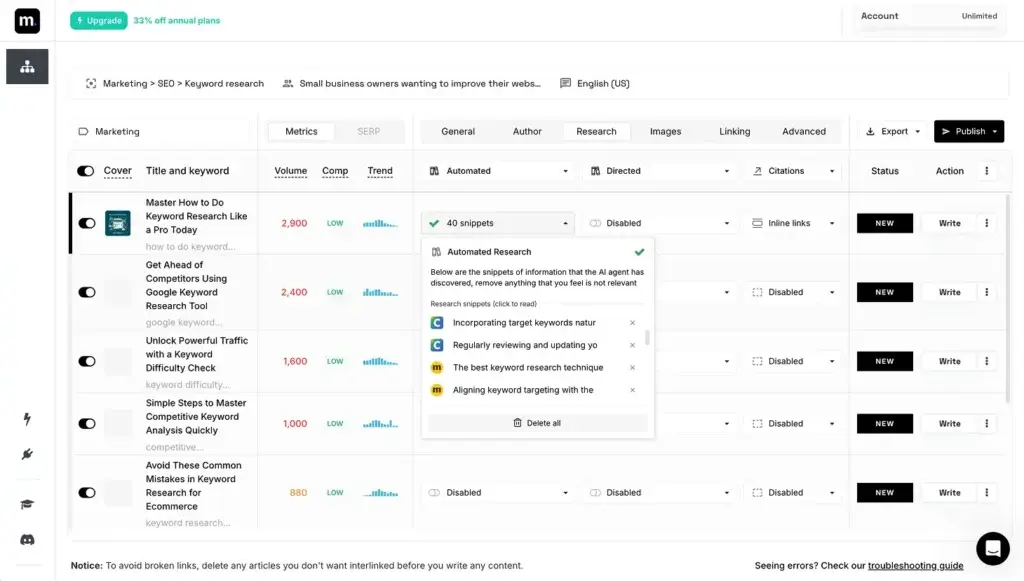
Research is one of Machined.ai’s more compelling features. The platform supports automated research, where it finds relevant sources on its own, and directed research, where you can specify particular URLs to use as context. It can also include citations and references in either inline or footnote style, which is a useful addition for trust and topical authority.
This is important because AI-generated SEO content often becomes weak when it lacks source grounding. Machined.ai does a better job than many lightweight AI writers of making research part of the workflow rather than an afterthought.
Custom Article Types and Outlines
Machined.ai supports multiple built-in content types, including informational articles, listicles, roundups, reviews, comparisons, tutorials, and troubleshooting content. It also supports custom outlines, which is especially helpful if you want your content to follow a very specific editorial structure.
- Review format: Useful for SaaS, software, and product evaluation content.
- Roundup and listicle support: Helpful for “best X” commercial pages.
- Comparison format: Useful for high-intent “X vs Y” content.
- Custom outlines: Lets you impose a clearer structure when you do not want the AI choosing the section flow for you.
Humanized Voice and Customization
Another strength of Machined.ai is its emphasis on customization. The platform includes custom brand voices, custom instructions, outline control, content-length control, and humanized voice options. This gives more flexibility than basic AI blog generators that output fairly generic copy.
For publishers that care about consistency across a site, this matters. It does not remove the need for editing, but it does make the first draft more usable.
Publishing and Automation
Machined.ai supports direct publishing to WordPress and Webflow, as well as webhook automation for tools like Zapier, Make, and n8n. This can significantly reduce workflow friction if your current process still involves copying content manually from an AI tool into a CMS.
The ability to publish clusters as drafts for review is especially useful. It gives teams the efficiency gains of automation without forcing a reckless publish-first workflow.
Internal Linking
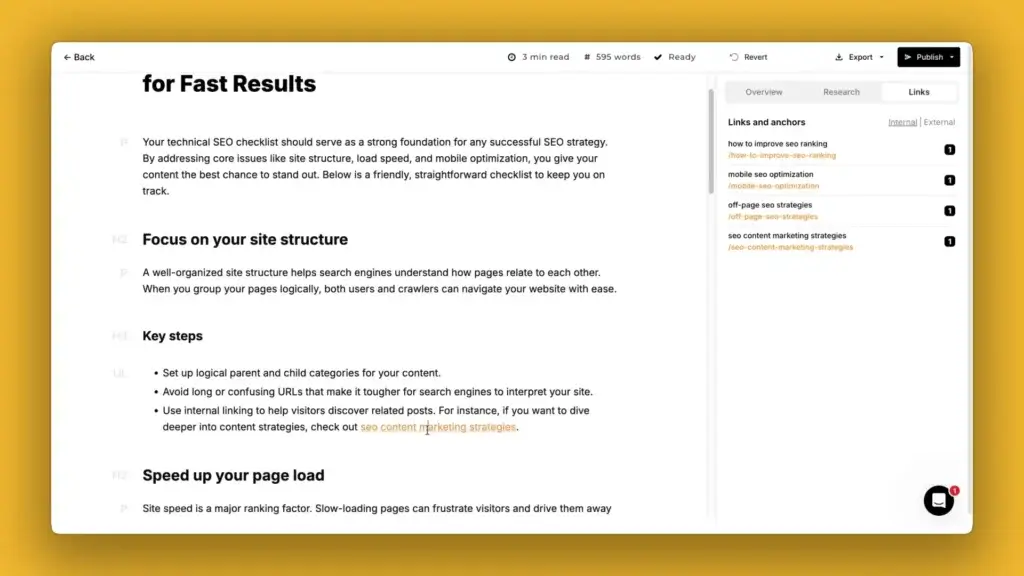
Machined.ai also automates internal linking between articles inside a cluster. In practice, this is one of the platform’s most useful time-saving features, because internal linking is critical for site structure and topical authority but often gets neglected when content is produced at scale.
That said, this is still an AI-driven layer, so it should not be treated as fully hands-off. You still need to review link placement, anchor relevance, and article relationships before publishing.
Pros and Cons
Benefits and Limitations of Machined.ai
Positive
✅ Strong content cluster workflow
✅ Research and citation support
✅ Helpful internal linking automation
✅ Direct WordPress and Webflow publishing
✅ Good flexibility for SEO content formats
✅ BYOK model can be cost-efficient
Negative
❌ Requires your own OpenAI API key
❌ Still needs editorial review
❌ Internal linking can be imperfect
❌ Not a full SEO suite
❌ Less independent review volume than larger platforms
Machined.ai’s biggest advantage is that it compresses a large part of the SEO content production workflow into one platform. For users who publish at scale, that is valuable. Instead of juggling keyword planning, research, drafting, linking, and publishing across different tools, you can handle much more of the process in one place.
✅ Pros
- Strong content cluster workflow: Machined.ai is built around topical clusters, not just one-off article generation.
- Research and citation support: Automated and directed research give it a more credible content workflow than many simple AI writers.
- Helpful internal linking automation: It saves time on an SEO task that often gets skipped.
- Direct WordPress and Webflow publishing: This adds real operational value for teams managing content production at scale.
- Good flexibility for SEO content formats: Reviews, comparisons, tutorials, roundups, and custom outlines make it versatile for commercial and informational content.
- BYOK model can be cost-efficient: High-volume users may appreciate paying OpenAI usage directly rather than absorbing platform markup.
❌ Cons
- Requires your own OpenAI API key: This adds friction for beginners or teams that want a more all-in-one subscription experience.
- Still needs editorial review: It is more advanced than many AI content tools, but it is not truly publish-without-checking software.
- Internal linking can be imperfect: The feature is useful, but it remains AI-driven and should be checked manually.
- Not a full SEO suite: Machined.ai is focused on content production and publishing, not deep technical SEO, backlink intelligence, or rank tracking.
- Less independent review volume than larger platforms: There is less third-party validation than you would see with more established SEO software brands.
User Experience
User Interface and Workflow
Onboarding and Setup
Machined.ai is conceptually simple, but there is one onboarding hurdle that matters: you need to bring your own OpenAI API key. For experienced marketers and SEO teams, that is usually acceptable. For beginners, it adds a setup step that some competing tools avoid.
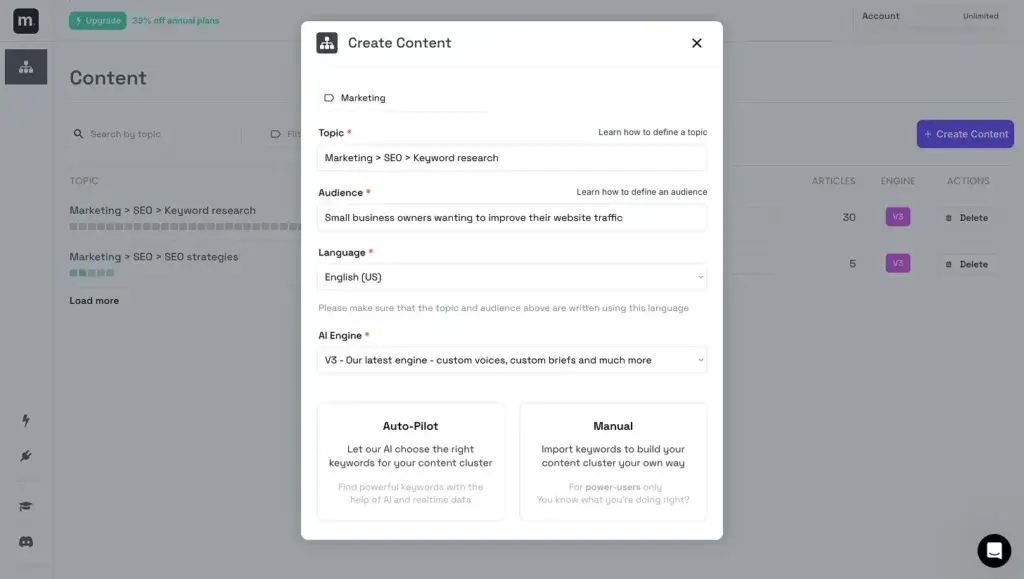
Once that is in place, the workflow is much more straightforward. The product is clearly designed around topics, clusters, research settings, article configuration, and publishing rather than around a blank document editor.
Daily Workflow
The platform feels most useful when you think in terms of systems rather than individual posts. You start with a topic, generate or refine the cluster, configure research and structure, create the content, review it, and then publish to your CMS. That flow is much more practical for SEO-driven publishers than the traditional “prompt and generate” model used by many AI tools.
Editorial Control
Machined.ai gives you more control than entry-level AI writers, especially through content types, custom instructions, custom brand voice, and outlines. However, it is still a balance. It saves a great deal of time, but it is not a substitute for editorial judgment, fact-checking, or manual improvement where nuance matters.
Best Experience for Power Users
The product is best suited to users who already understand SEO publishing. If you know what content clusters, internal linking, and topical authority are supposed to accomplish, Machined.ai feels much more compelling. If you are completely new to SEO, it may still be useful, but you are less likely to get the platform’s full value.
Pricing and Plans
How Much Does Machined.ai Cost?
Machined.ai currently offers four plans, Free, Starter, Professional, and Unlimited. One very important point is that all plans require you to use your own OpenAI API key, so the subscription cost is separate from the AI generation cost itself.
| Plan | Starting Price | Main Limits and Features |
| Free | Free forever | 10 articles per month, 5 content clusters, no CMS connections, no webhook automations, research tools, custom outlines, cluster builder |
| Starter | $29/month, or $20/month billed yearly | 30 articles per month, 1 CMS connection, AI images, research tools, cluster builder, custom outlines, no webhook automations |
| Professional | $49/month, or $33/month billed yearly | 300 articles per month, 3 CMS connections, 3 webhook automations, custom brand voice, AI images, research tools, internal and external linking |
| Unlimited | $99/month, or $66/month billed yearly | Unlimited article generations, unlimited CMS connections, unlimited webhooks, custom brand voice, full publishing flexibility, advanced automation support |
Machined.ai also estimates separate OpenAI usage costs, with pricing varying depending on the settings and models you use. This BYOK approach can be a real advantage for experienced users who want more cost transparency, but it is less beginner-friendly than a single bundled subscription.
For solo publishers, the Starter plan is the most realistic entry point if direct CMS publishing matters. For agencies or larger content teams, the Professional plan looks like the most practical tier because it adds webhook automation and more CMS connections. The Unlimited tier makes the most sense for teams publishing content at serious volume.
Use Cases & Suitable Users
Who Should Use Machined.ai
Machined.ai is best suited for users who care about publishing SEO content at scale while keeping a clearer cluster-based strategy. It is particularly strong for the following audiences:
- Affiliate marketers: Useful for building topic clusters around commercial keywords, comparisons, and reviews.
- Niche site owners: A strong option if you want to cover topics more systematically and improve internal linking.
- SEO agencies: Helpful for teams producing recurring blog content for multiple clients and looking to reduce manual workflow overhead.
- In-house content teams: Valuable for brands that want to scale blog production without adopting a full enterprise SEO stack.
- Founders and lean marketing teams: Useful when time is limited, and content production needs to be operationalized quickly.
Machined.ai is less ideal for publishers in highly sensitive niches who need heavy editorial scrutiny on every paragraph, or for teams looking for a comprehensive SEO platform with technical audits, backlink analysis, and deep rank monitoring.
Comparison with Alternatives
How Machined.ai Compares to Alternatives
Machined.ai sits in a very specific category position. It is more workflow-focused than a generic AI writer, but narrower in scope than a full SEO suite. That creates both its strengths and its limitations.
Machined.ai vs Byword
Byword is often discussed as a bulk AI SEO writing tool, but Machined.ai feels more deliberately structured around cluster creation, research, and internal linking. If your priority is generating large numbers of articles with some SEO workflow logic around them, Machined.ai is the more strategic option. If you simply want fast article output, Byword may feel more lightweight.
Machined.ai vs Journalist AI
Journalist AI is attractive for automation-heavy publishing, but Machined.ai has a stronger positioning around clusters, research depth, internal linking, and content structure control. In my view, Machined.ai is the better choice when your strategy depends on topical authority rather than just publishing volume.
Machined.ai vs Surfer AI
Surfer AI is stronger when your workflow revolves around content optimization and on-page scoring inside a broader Surfer ecosystem. Machined.ai is more compelling when your main challenge is turning a topic into a publishable cluster with research, citations, and built-in linking. If you already live inside Surfer, Surfer AI may fit better. If you want cluster automation, Machined.ai has the clear advantage.
Machined.ai vs MarketMuse
MarketMuse is much stronger for content strategy, topic authority planning, and deep optimization insights, but it also comes with more complexity and usually a very different budget expectation. Machined.ai is the better fit if you want a faster operational workflow from topic to published article cluster. MarketMuse is stronger for planning depth, while Machined.ai is stronger for execution speed.
Machined.ai vs Writesonic
Writesonic is broader as an AI content marketing platform, but Machined.ai is more focused on SEO content clusters and structured blog publishing. If your priority is general marketing content, Writesonic may be more flexible. If your priority is scalable SEO blog production, Machined.ai is the more specialized tool.
Best Use Tips
Tips & Best Practices When Using Machined.ai
To get the most value from Machined.ai, you should use it as a workflow accelerator, not as a replacement for editorial judgment. The platform performs best when it is guided by a clear SEO strategy and followed by strong review before publication.
- Start with topic clusters, not random keywords: Machined.ai is strongest when you build related topical coverage deliberately.
- Use directed research for higher-stakes articles: This gives you more control over the sources and context behind the generated content.
- Check every citation and link: Research and internal linking are helpful, but they still need verification.
- Use custom outlines for review and comparison content: This helps maintain a stronger editorial structure for commercial-intent pages.
- Publish to draft first: The direct CMS integration is useful, but editorial review should happen before anything goes live.
- Refine voice and instructions over time: The output improves when you treat brand voice setup as an ongoing optimization process.
Conclusion
Final Thoughts
Machined.ai is one of the more focused AI SEO content platforms currently available, and that focus is exactly what makes it interesting. It is not trying to be a full SEO suite, and it is not just another prompt-based AI writer either. Its real value lies in helping publishers turn a topic into a researched, interlinked content cluster that can move into WordPress or Webflow much faster than a manual workflow would allow.
Its best audience is clear: affiliate marketers, niche site operators, agencies, and in-house content teams that need more structure than a generic AI writer can provide. The platform becomes especially compelling when internal linking, citation support, cluster planning, and direct publishing all matter to your workflow.
That said, Machined.ai should still be treated as an efficiency tool, not a fully autonomous content engine. You still need human review, especially around factual accuracy, link placement, brand fit, and commercial-intent quality. If you want a platform for scalable SEO content production with a more specialized workflow than most AI writers offer, Machined.ai is a strong option worth considering.
Have more questions
Frequently Asked Questions
What is Machined.ai?
Machined.ai is an AI-powered SEO content platform built around content clusters, research-backed article generation, internal linking, and direct CMS publishing.
Is Machined.ai just another AI writer?
No. While it does generate content, its real differentiation is the cluster workflow, research support, internal linking, and publishing automation rather than simple prompt-based writing.
Does Machined.ai include citations?
Yes. The platform supports research-backed content and can include citations or references in inline or footnote style, depending on your configuration.
Does Machined.ai support WordPress?
Yes. Machined.ai supports direct publishing to WordPress and lets you publish content as draft, private, or published depending on your workflow.
Does Machined.ai support Webflow?
Yes. It also supports direct Webflow publishing, which is useful for publishers running content sites or CMS-based marketing pages in Webflow.
Do I need my own OpenAI API key?
Yes. Machined.ai uses a bring-your-own-key model, so you pay the platform subscription separately from OpenAI usage costs.
Is Machined.ai good for affiliate marketing?
Yes, especially if your strategy depends on publishing topic clusters, reviews, comparisons, and long-tail supporting content around commercial keywords.
Is the content publish-ready without editing?
Not reliably. Machined.ai can save a great deal of time, but the content should still be reviewed for accuracy, tone, internal links, and overall editorial quality before publication.
Is Machined.ai a full SEO suite?
No. It is focused on content production, research, clustering, linking, and publishing. It is not positioned as a full replacement for technical SEO, backlink analysis, or rank tracking platforms.
Who is Machined.ai best for?
Machined.ai is best for affiliate marketers, niche site builders, SEO agencies, and content teams that want a more structured way to scale SEO content production.