Introduction
Obsidian Security is an enterprise SaaS and AI security platform designed to protect the applications, identities, integrations, data flows, and autonomous agents that traditional network and endpoint controls often struggle to see. It combines SaaS Security Posture Management, Identity Threat Detection and Response, shadow SaaS discovery, integration risk management, compliance automation, and AI security within a single operating layer.
Obsidian is not a lightweight inventory tool or configuration scanner. It is built for teams that need to understand what happens inside and between critical applications such as Microsoft 365, Google Workspace, Salesforce, ServiceNow, Snowflake, Workday, GitHub, Okta, and AI platforms.
This Obsidian Security review examines how the platform works, where it provides the most value, what its pricing model includes, which limitations matter during implementation, and how it compares with AppOmni, Grip Security, and Push Security. The goal is to help you decide whether Obsidian can reduce meaningful SaaS risk in your environment or whether a narrower tool would be easier to justify.
What Is Obsidian Security?
Obsidian Security is a cybersecurity platform focused on protecting third-party SaaS applications and AI systems. It continuously connects configuration, identity, activity, browser, integration, and threat data to show who or what has access, how that access is being used, and which relationships create the greatest exposure.
The platform is a SaaS security control layer, not a replacement for your identity provider, SIEM, endpoint protection, or secure web gateway. It adds application context such as OAuth permissions, service-account actions, configuration risk, and movement between connected SaaS services.
Its current platform spans four closely related areas:
- SaaS Security Posture Management for settings, privileges, compliance, and configuration drift
- Identity Threat Detection and Response for account takeover, token abuse, insider risk, and anomalous behavior
- SaaS supply chain protection for OAuth apps, APIs, service accounts, integrations, and non-human identities
- AI security for shadow AI, prompt data exposure, AI agents, runtime behavior, and agent-to-SaaS access
This combination makes Obsidian particularly relevant to SaaS-first enterprises where critical business data lives across interconnected cloud applications rather than behind a single network perimeter.
Platform Overview
Key Obsidian Security Capabilities
Obsidian brings several security categories into one platform. The practical value comes from how these capabilities share identity and activity context rather than operating as unrelated modules.
1. SaaS Security Posture Management
Obsidian continuously evaluates the security configuration of connected SaaS applications. It can identify risky settings, weak authentication controls, excessive administrative privileges, dormant accounts, public sharing, unsafe integrations, and changes that move an application away from an approved baseline.
The important distinction is prioritization. Obsidian adds identity, usage, and activity context so your team can focus on findings affecting sensitive users, important data, privileged roles, or connected systems.
What does SSPM help you manage?
- Misconfigurations and insecure application settings
- Privilege drift and unnecessary administrative access
- Dormant, unowned, or poorly governed accounts
- Configuration changes that affect compliance controls
- Risky third-party applications and integrations
This is useful when SaaS administration is distributed across application owners. The security team can define policy centrally, monitor drift, and assign remediation without needing to become the administrator of every application.
2. Identity Threat Detection and Response
Obsidian extends identity threat detection into the SaaS layer. It monitors human and non-human identities for suspicious behavior such as unusual logins, session hijacking, OAuth misuse, token compromise, insider activity, unexpected data access, and abnormal service-account actions.
A stolen token or hijacked session may appear legitimate to the identity provider. Obsidian evaluates what happens after authentication, including records accessed, permissions used, behavioral anomalies, and movement across applications.
The platform includes prebuilt detections, machine-learning models, investigation context, remediation guidance, and integrations with SIEM and SOAR tools. Security teams can search normalized SaaS activity and pivot across users, IP addresses, locations, applications, events, and connected identities during an investigation.
3. Shadow SaaS and Shadow AI Discovery
Obsidian discovers applications that may not appear in procurement records, single sign-on, or an approved software inventory. It correlates browser activity, identity-provider data, email signals, and SaaS integrations to identify sanctioned apps, unfederated accounts, browser extensions, shadow AI tools, and app-to-app connections.
Obsidian adds ownership and activity context, helping you determine who introduced an application, whether authentication is federated, what access it holds, and whether it interacts with sensitive systems.
You can then classify the application, move it behind the identity provider, restrict access, remove an integration, or apply browser controls. This makes the platform valuable for security and IT teams that want to reduce both unmanaged risk and unnecessary SaaS spending.
4. SaaS Supply Chain and Integration Security
Modern SaaS environments behave like supply chains. A single application may connect to dozens of other services through OAuth grants, API keys, service accounts, webhooks, marketplace apps, automation tools, and AI agents. Each connection can expand the blast radius of a compromised vendor or token.
Obsidian inventories these relationships and evaluates more than the requested permission scope. It adds ownership, last activity, actual behavior, data access, connected identities, and downstream reach. This helps your team distinguish between an integration that technically holds broad access but is inactive and one that is actively moving sensitive data across several systems.
During an incident, analysts can use this relationship map to trace a compromised integration, the records it accessed, the users or agents involved, and where activity continued.
5. AI Application and AI Agent Security
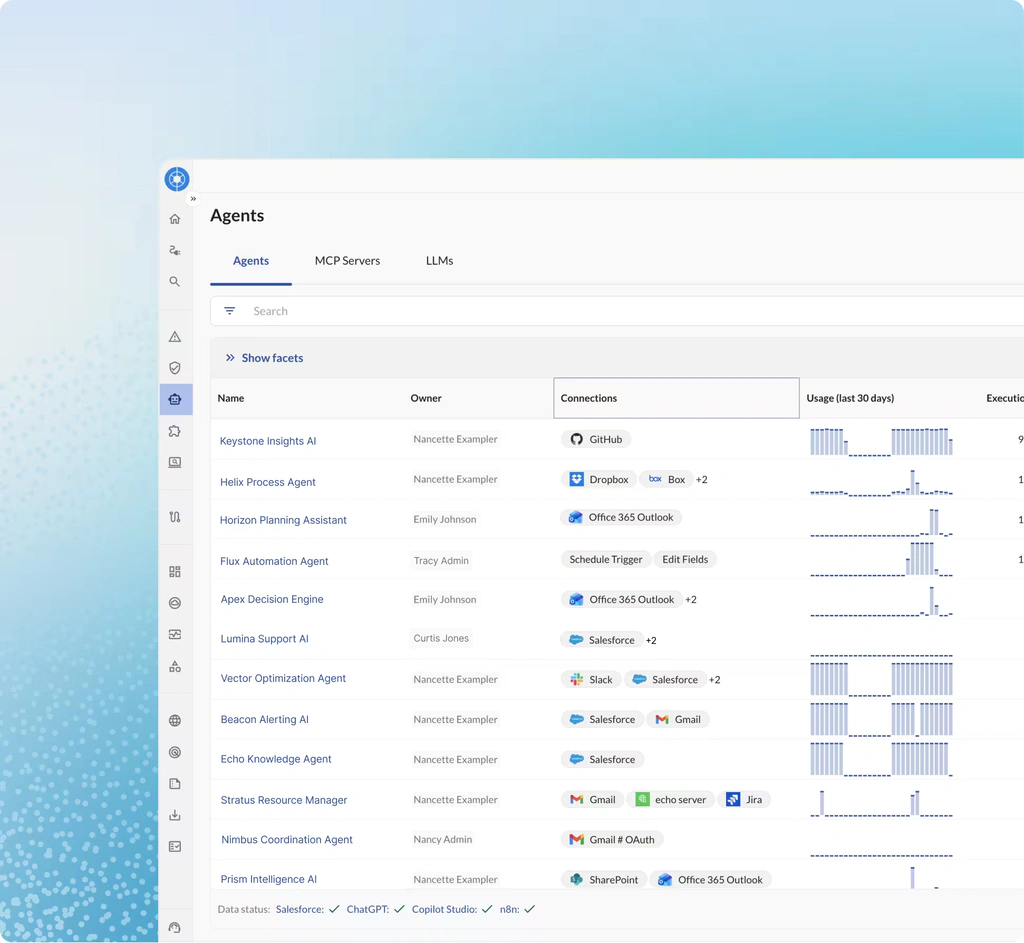
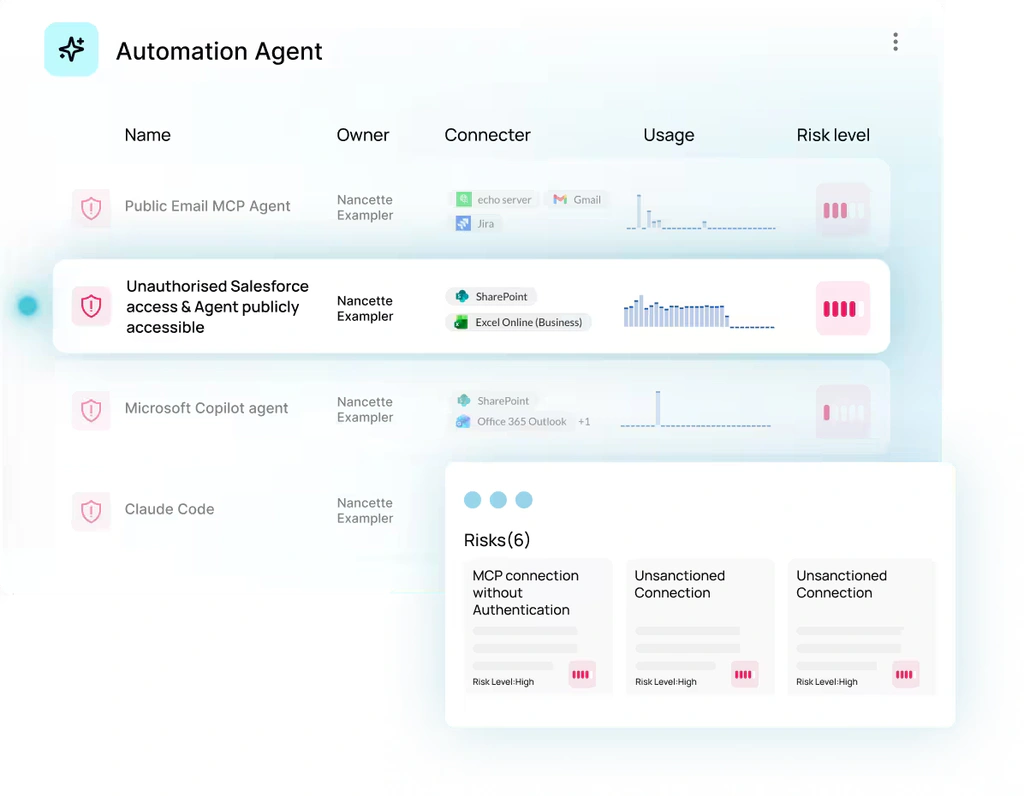
Obsidian has expanded beyond shadow AI discovery into AI posture and runtime protection. It can identify generative AI applications, browser extensions, embedded AI features, low-code agents, autonomous workflows, and agent connections to enterprise SaaS data.
For employee-facing generative AI, the browser layer can provide prompt-level visibility and controls. Policies can restrict unapproved tools, identify sensitive data in prompts, redact restricted content, and control integrations without banning all AI use.
For autonomous agents, Obsidian focuses on identity, privilege, ownership, connections, and actions. It can help you answer which agent exists, who owns it, what applications it can reach, whether its permissions are excessive, how its behavior changes, and whether it is moving data in a way that violates policy.
This is relevant to organizations deploying Microsoft Copilot, Salesforce Agentforce, OpenAI, Claude, Amazon Bedrock, Google Vertex AI, n8n, and similar environments. Buyers should still validate enforcement depth because discovery, prompt controls, and runtime response vary by connector.
6. Compliance Automation and Access Governance
Obsidian maps SaaS controls to common frameworks such as SOC 2, ISO 27001, CIS, and NIST. It can monitor control status, collect evidence, track remediation, collaborate with application owners, and generate audit-ready reports.
The platform also supports privilege minimization and access governance. Teams can identify dormant access, excessive roles, unowned agents, stale integrations, and accounts that bypass the identity provider. This makes compliance more continuous and less dependent on periodic spreadsheets or manual screenshots from every admin console.
Obsidian does not replace a full GRC platform, but it can improve the quality and freshness of SaaS evidence sent into GRC, ticketing, CMDB, and risk-management workflows.
7. Knowledge Graph and AI Assistant
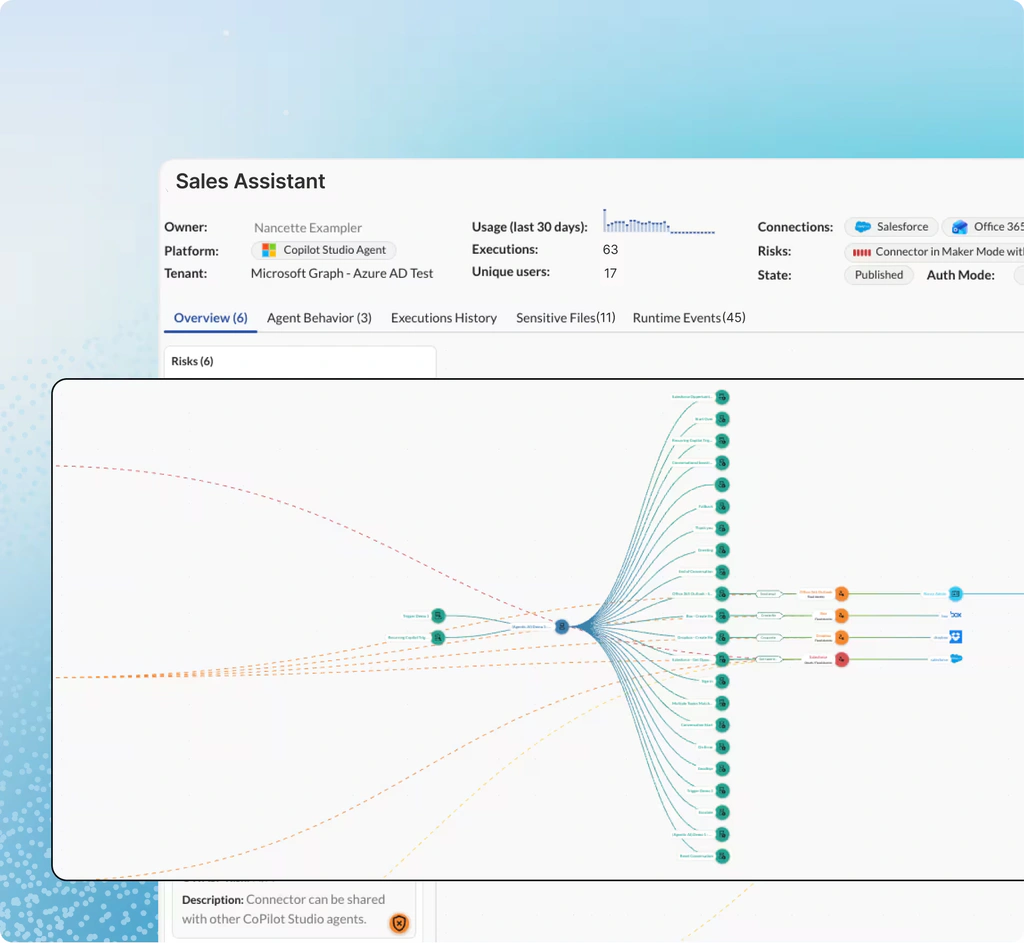
The Obsidian Knowledge Graph connects users, applications, permissions, integrations, devices, sessions, agents, and activity into a living relationship map. This shared data model is central to the platform because it helps correlate a posture issue with the identity and behavior that make it dangerous.
The Obsidian AI Assistant helps analysts explain rules, investigate threats, manage exceptions, and identify remediation steps. Your team should still verify AI-generated recommendations before changing production systems.
Pros and Cons
Advantages and Disadvantages
Obsidian Security provides unusually broad coverage across SaaS posture, identity, integrations, threats, and AI. That breadth can reduce tool fragmentation, but it also creates implementation and licensing decisions that smaller teams may find difficult to manage.
Positive
✅ Combines posture, identity, threat, and AI security
✅ Provides deep cross-application context
✅ Strong integration and non-human identity visibility
✅ Supports browser, API, and SaaS telemetry
✅ Offers modular adoption and a free entry tier
✅ Mature enterprise security and regional hosting
Negative
❌ Paid pricing requires a custom quote
❌ Broad scope can create implementation complexity
❌ Connector depth varies by application
❌ May overlap with SSPM, ITDR, CASB, and browser tools
❌ Best value requires mature security ownership
👍 Pros
✅ Combines several SaaS security disciplines
Obsidian can reduce separate tooling for SSPM, SaaS ITDR, shadow SaaS discovery, OAuth risk, AI governance, and agent security. Its shared data model is more useful than disconnected dashboards.
✅ Provides deep identity and activity context
The platform does not stop at listing an account or integration. It connects ownership, privilege, behavior, data access, sessions, and downstream relationships, helping analysts determine which finding creates real exposure and which one is low priority.
✅ Strong SaaS supply chain visibility
Obsidian is especially relevant when OAuth apps, service accounts, automation platforms, and AI agents connect multiple systems. Its relationship map supports governance and incident containment.
✅ Useful coverage for human and non-human identities
Many identity tools are built mainly around employees. Obsidian also evaluates service accounts, tokens, integrations, and agents, which are increasingly important as companies automate workflows and deploy autonomous systems.
✅ Flexible entry and expansion model
The published pricing structure includes a free tier for up to 1,000 users, followed by Foundations and Advanced packages. This gives organizations a way to begin with discovery and phishing visibility, then expand into governance, detection, runtime protection, and incident response.
✅ Enterprise-ready security controls
Obsidian publishes information about role-based access control, audit logging, data segregation, regional hosting, independent testing, compliance certifications, and operational resilience. These controls make it more suitable for regulated and global enterprises than many newer point solutions.
👎 Cons
❌ Paid pricing is not publicly transparent
Foundations and Advanced require a quote. Confirm whether cost depends on employees, identities, applications, modules, data volume, or browser users. Include implementation, support, connector development, and expansion in a three-year proposal.
❌ Broad coverage can make deployment complex
Connecting applications is only the first step. Your team must define ownership, thresholds, policies, escalation paths, and remediation permissions. Without an operating model, the platform may surface more findings than you can resolve.
❌ Connector quality may differ
Obsidian advertises hundreds of ready-to-use and community connectors, but the depth of configuration checks, activity telemetry, remediation actions, and AI controls can vary. Buyers should test their most important applications rather than relying on connector counts alone.
❌ There may be significant tool overlap
Organizations may already own SSPM through another vendor, identity threat detection through an XDR platform, shadow SaaS discovery through a browser tool, and compliance reporting through GRC software. Obsidian can consolidate some of that work, but the business case depends on retiring or reducing overlapping products.
❌ Smaller teams may not use the full platform
Obsidian is most valuable when a security team has enough SaaS complexity and operational maturity to act on cross-application findings. A small business using a limited number of cloud tools may gain more from a focused browser-security or SaaS-discovery product.
User Experience
Deployment and Daily Operations
Obsidian can collect data through direct SaaS connectors, identity-provider integrations, browser telemetry, email signals, and integrations with existing security tools. The deployment model depends on the capabilities you purchase and the applications you need to protect.
Begin with a limited group of high-value applications. Connect one identity provider, several critical SaaS platforms, and your main SIEM or ticketing system. Then measure inventory quality, actionable findings, detection accuracy, and remediation effort.
Recommended Proof-of-Value Process
- Connect the identity provider and two or three critical SaaS applications
- Validate identities, tenants, integrations, ownership, and activity data
- Test posture findings against native application settings
- Simulate an investigation involving a token, service account, or OAuth app
- Measure false positives, investigation time, and remediation effort
- Confirm which actions can be automated safely
The interface is designed to present findings in prioritized views rather than exposing raw application logs alone. Independent review platforms generally report strong satisfaction with visibility, incident triage, and support, although the available public review volume is still smaller than that of larger security vendors.
Security Ecosystem
Integrations and Application Coverage
Obsidian supports major enterprise applications and identity systems, including Microsoft 365, Google Workspace, Salesforce, ServiceNow, Snowflake, Workday, GitHub, Okta, Databricks, and other SaaS platforms. Its AI ecosystem includes services such as OpenAI, Anthropic Claude, Microsoft Copilot, Amazon Bedrock, Google Vertex AI, Microsoft Foundry, Salesforce Agentforce, and n8n.
The platform also provides hundreds of ready-to-use connectors and a framework for building custom or community connectors. This is useful when your organization relies on industry-specific or internally developed SaaS applications that are not covered by standard enterprise integrations.
Evaluate connector depth, not only availability. Confirm collected data, refresh frequency, multi-tenant support, detections, remediation actions, and how API changes are maintained.
Plans and Cost Structure
Obsidian Security Pricing
Obsidian publishes a modular pricing structure but does not list fixed prices for its paid packages. The Free plan costs $0 per month for up to 1,000 users and includes SaaS and AI discovery plus spear-phishing detection. Foundations and Advanced require a custom quote.
| Plan | Published Cost | Main Coverage |
| Free | $0/month for up to 1,000 users | Shadow SaaS and AI discovery, spear-phishing detection |
| Foundations | Custom quote | Discovery, governance, privilege minimization, compliance, agent and integration access optimization |
| Advanced | Custom quote | Threat detection, runtime guardrails, AI controls, incident response, audit, and forensics |
Request a pricing schedule covering users, identities, applications, browser deployments, AI modules, retention, connectors, implementation, support, and overages. Ask whether new applications and agents increase the license automatically.
The free tier is a useful way to test discovery and phishing visibility, but it should not be confused with the complete platform. Most enterprise posture, governance, detection, response, and AI-agent controls sit in the paid packages.
Security and Privacy
How Secure Is Obsidian Security?
A SaaS security platform receives extensive visibility into identities, configurations, activity, integrations, and potentially browser behavior. That makes the vendor’s own security controls an important part of the buying decision.
Obsidian states that it provides granular role-based access control, audit logging, per-customer storage buckets, dedicated database schemas, encryption, independent security testing, regional data hosting, automated failover, and formal compliance programs. Its published certifications and attestations include SOC 2 Type 2, ISO 27001, ISO 27701, and IRAP.
Key Enterprise Security Controls
- Granular RBAC and full audit logging
- Logical and resource-level customer data segregation
- Regional hosting in the United States, Germany, Australia, and Saudi Arabia
- Annual independent audits, penetration tests, and red-team exercises
- Published system status and historical availability information
Security Questions to Ask Before Deployment
Review connector permissions, browser data collection, retention, subprocessors, encryption options, incident notification, deletion, administrator access, and community connector validation.
For regulated environments, confirm that the selected hosting region applies to all telemetry and backups, not only the primary database. You should also review how data is handled when investigations or support cases require access across regions.
Who It’s Best For
Where Obsidian Security Adds Value
Obsidian is best suited to organizations where SaaS applications, third-party integrations, and AI tools are part of the critical attack surface.
| Organization Type | Fit | Why |
| Large SaaS-first enterprise | Excellent | Deep cross-application identity, posture, activity, and integration visibility |
| Regulated organization | Excellent | Continuous controls, audit evidence, regional hosting, and formal certifications |
| Company deploying AI agents | Strong | Agent discovery, ownership, privilege, access, behavior, and runtime governance |
| Security team facing OAuth or token risk | Strong | Integration mapping, non-human identity monitoring, and activity-based detection |
| Mid-sized cloud-first company | Good | Free entry tier and modular expansion, but operational ownership is still required |
| Small business with limited SaaS use | Limited | A focused browser, identity, or SaaS inventory tool may be easier to operate |
The strongest business case appears when Obsidian can replace overlapping tools, reduce investigation time, improve audit evidence, and prevent integration or identity incidents that existing controls cannot see. It is less compelling when the organization needs only a basic SaaS inventory or a simple browser-based phishing control.
Compare with Others
Best Obsidian Security Alternatives
AppOmni
AppOmni is one of the closest alternatives for enterprise SaaS security. It is particularly strong in deep application-specific posture management, configuration analysis, data exposure, permissions, compliance, connected applications, and threat monitoring.
Choose AppOmni when your main priority is detailed security posture across a defined set of critical SaaS platforms. Obsidian may be stronger when identity-linked activity, SaaS supply chain risk, cross-application investigations, and AI-agent runtime context are more important. Read our full AppOmni review for a detailed comparison.
Grip Security
Grip Security focuses on SaaS and AI discovery, identity risk, application ownership, access governance, credential hygiene, posture, and automated remediation. It is a strong option when the largest problem is the unmanaged long tail of applications and accounts.
Choose Grip when broad identity-based discovery and SaaS governance are the primary goals. Obsidian goes further into application activity, behavioral threat detection, integration compromise, incident forensics, and runtime protection. See our Grip Security review for more details.
Push Security
Push Security is a browser-native security platform for phishing defense, session and credential threats, SaaS identity visibility, shadow applications, risky browser extensions, and AI usage controls.
Choose Push Security when you need real-time browser detection and enforcement without deploying a replacement enterprise browser. Obsidian is a broader platform with deeper SaaS posture, integration, compliance, and cross-application threat context. Read the complete Push Security review to compare the approaches.
| Platform | Best For | Main Difference |
| Obsidian Security | Unified SaaS, identity, integration, and AI security | Broad activity-based coverage across applications, agents, and supply chains |
| AppOmni | Deep SaaS posture management | Strong application-specific configuration and exposure analysis |
| Grip Security | Shadow SaaS and identity governance | Broad discovery and ownership across managed and unmanaged apps |
| Push Security | Browser phishing and SaaS identity protection | Real-time browser-native detection and enforcement |
Conclusion
Is Obsidian Security Worth It?
Obsidian Security is worth evaluating when your organization depends on a large, interconnected SaaS environment and traditional security tools cannot provide enough visibility inside applications. Its main strength is the way it combines posture, identity, behavior, integrations, compliance, browser telemetry, AI applications, and agents into one contextual platform.
The product is particularly compelling for enterprises concerned about token compromise, OAuth abuse, SaaS supply chain incidents, excessive privileges, shadow AI, non-human identities, and autonomous agents. It can help your security team move from a static inventory of findings to a more operational understanding of who or what acted, which data was reached, and where the activity spread.
Run a proof of value with your most important applications. Compare connector depth, false positives, investigation speed, remediation workflows, and which existing tools can realistically be reduced or retired.
For a mature SaaS-first security program, Obsidian can become a central control and investigation layer. For a smaller company with a narrow requirement, AppOmni, Grip Security, Push Security, or another focused product may provide a simpler path to measurable value.
Frequently Asked Questions
Have more questions?
What does Obsidian Security do?
Obsidian Security protects enterprise SaaS and AI environments. It monitors application configurations, identities, integrations, activity, browser use, AI agents, and data access to help prevent misconfigurations, account compromise, token abuse, shadow SaaS, and supply chain incidents.
Is Obsidian Security an SSPM platform?
Yes. Obsidian includes SaaS Security Posture Management, but it also extends into Identity Threat Detection and Response, shadow SaaS discovery, integration security, compliance automation, AI security, and incident investigation.
How much does Obsidian Security cost?
Obsidian offers a free plan for up to 1,000 users. The paid Foundations and Advanced packages use custom pricing, so organizations must request a quote based on their users, applications, modules, coverage, and implementation requirements.
Does Obsidian Security offer a free plan?
Yes. The published Free plan costs $0 per month for up to 1,000 users and includes discovery of SaaS sprawl, shadow SaaS, and unsanctioned AI, plus spear-phishing detection. Advanced governance and threat-response features require paid plans.
Can Obsidian Security discover shadow SaaS?
Yes. Obsidian combines browser, email, identity-provider, and SaaS integration signals to identify sanctioned and unsanctioned applications, unfederated accounts, browser extensions, shadow AI tools, and app-to-app connections.
Does Obsidian Security protect AI agents?
Obsidian can discover and govern AI agents, map their owners and SaaS connections, identify excessive privileges, monitor actions, and apply runtime controls. Buyers should confirm the exact depth available for each AI platform and agent framework.
Does Obsidian Security replace a SIEM or identity provider?
No. Obsidian complements SIEM, SOAR, XDR, identity providers, endpoint security, GRC, and ticketing tools. It adds SaaS-specific configuration, identity, integration, behavior, and AI context that these systems may not collect directly.
Which applications integrate with Obsidian Security?
Supported platforms include Microsoft 365, Google Workspace, Salesforce, ServiceNow, Snowflake, Workday, GitHub, Okta, Databricks, OpenAI, Anthropic Claude, Microsoft Copilot, Amazon Bedrock, Google Vertex AI, Salesforce Agentforce, and many others.
Is Obsidian Security suitable for small businesses?
The free tier can help a smaller company discover SaaS and AI use, but the complete platform is best suited to mid-sized and large organizations with complex SaaS estates, regulated data, dedicated security ownership, and meaningful identity or integration risk.
What are the best Obsidian Security alternatives?
Leading alternatives include AppOmni for deep SaaS posture management, Grip Security for shadow SaaS and identity governance, and Push Security for browser-native phishing, session, credential, and SaaS identity protection.