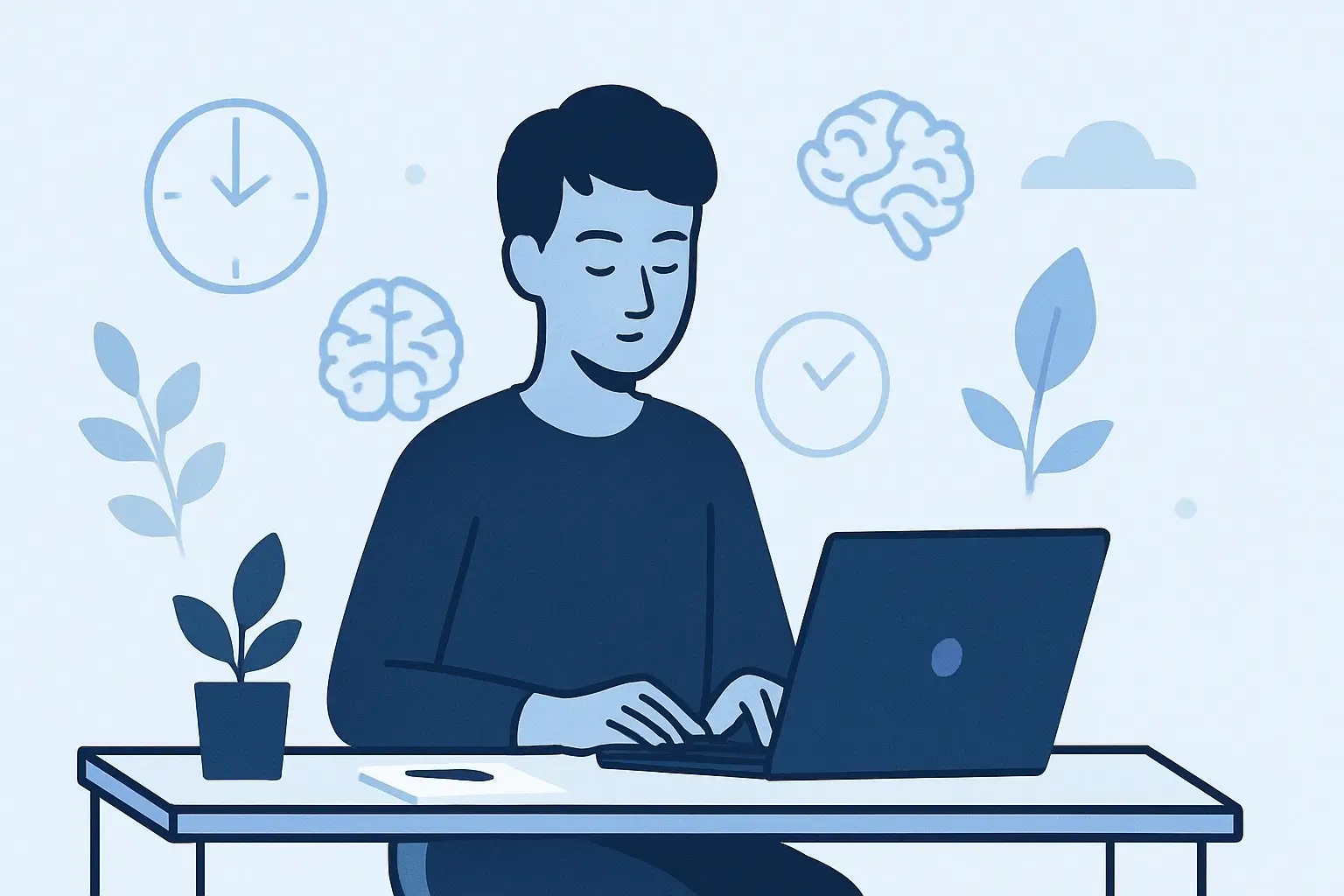
Do you ever feel like your attention span is shrinking?
You’re not imagining it, and the science of focus proves it. In 2026, our minds are constantly pulled in every direction by notifications, multitasking, and digital overwhelm. A Microsoft study found that average attention spans have dropped to just 47 seconds. That’s barely enough time to finish reading a short paragraph, let alone complete something meaningful.
But here’s the good news: focus is a trainable skill.
Understanding the science of focus gives you the tools to retrain your brain, rebuild your attention span, and protect your most valuable resource, your time and mental clarity.
In this guide, you’ll explore what’s really happening to your attention, why deep work is harder than ever, and how platforms like FLOWN and other cognitive strategies can help you rebuild your focus in a sustainable, science-backed way.
Why Focus Still Matters in a Fast World
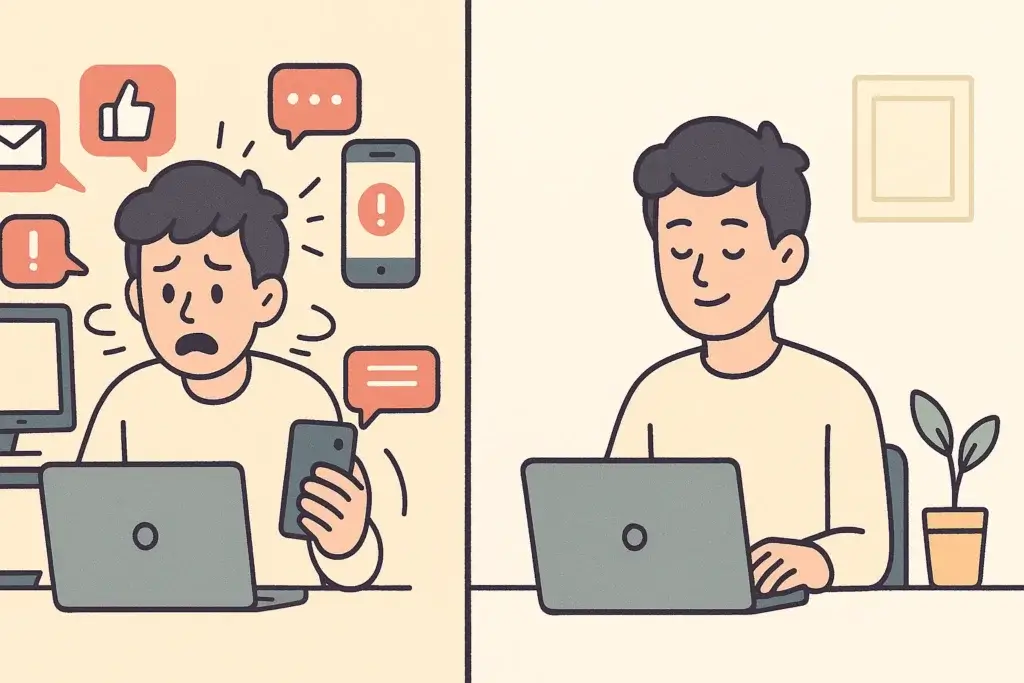
You live in a world of constant interruptions. Notifications buzz, emails pile up, and context switching is the norm. Yet, the ability to focus deeply is what sets apart those who truly move the needle.
Whether you’re a creative, a remote worker, or someone managing multiple responsibilities, focus determines:
- Your ability to solve complex problems
- How effectively you complete deep work
- The quality of your decisions
- Even your long-term mental well-being
The psychologist Mihaly Csikszentmihalyi called it the flow state, that magical zone where time fades and productivity skyrockets. But getting into flow requires long stretches of uninterrupted concentration, something most people struggle to achieve in 2026.
Platforms like FLOWN have tapped into this challenge by offering virtual coworking rooms and focus sessions designed to help you get into flow, stay accountable, and minimize distractions. While tools help, the real transformation comes when you understand how your attention system works and how to train it.
What’s Really Happening to Your Attention in 2026?
Your attention wasn’t built for this environment.
Instead of focusing on one thing at a time, your brain is now conditioned to jump rapidly between tasks, tabs, and tools. This behavior is called continuous partial attention, where you’re never fully focused, but never fully disengaged either.
The Rise of “Popcorn Brain”
Coined by behavioral experts, popcorn brain describes how overexposure to fast, digital media reshapes your ability to process slower, more complex tasks.
Your brain gets used to quick hits of stimulation, think Reels, emails, or chat messages, and begins to expect constant novelty. As a result, when you sit down to work on something meaningful, your focus feels jittery, fragmented, or flat-out unavailable.
📌 Quick stat: A UC Irvine study found that it takes about 23 minutes to refocus after a digital interruption.
Task Switching Comes with a Cognitive Cost
You might think multitasking is efficient, but science says otherwise. Every time you switch tasks, your brain experiences something called attention residue. Part of your mind lingers on the previous task, reducing your capacity to fully engage with the new one.
This adds up. One study from the American Psychological Association revealed that frequent task switching can reduce productivity by as much as 40%.
The Trap of Digital Distraction
The apps on your phone and laptop aren’t neutral, they’re designed to grab your attention and hold it hostage. Push notifications, endless scrolling, and open-ended feeds keep you in a cycle of reactive behavior.
You might not notice it at first, but over time, this damages your brain’s ability to regulate attention independently.
Science‑Backed Strategies to Rebuild Your Focus
You can’t fix a broken attention span overnight, but you can retrain your brain, one small shift at a time.
The good news? Neuroscience shows that focus is a skill you can rebuild. Below are proven strategies grounded in cognitive science, behavioral psychology, and productivity research that will help you sharpen your attention and create space for deep work.
Let’s break it down:
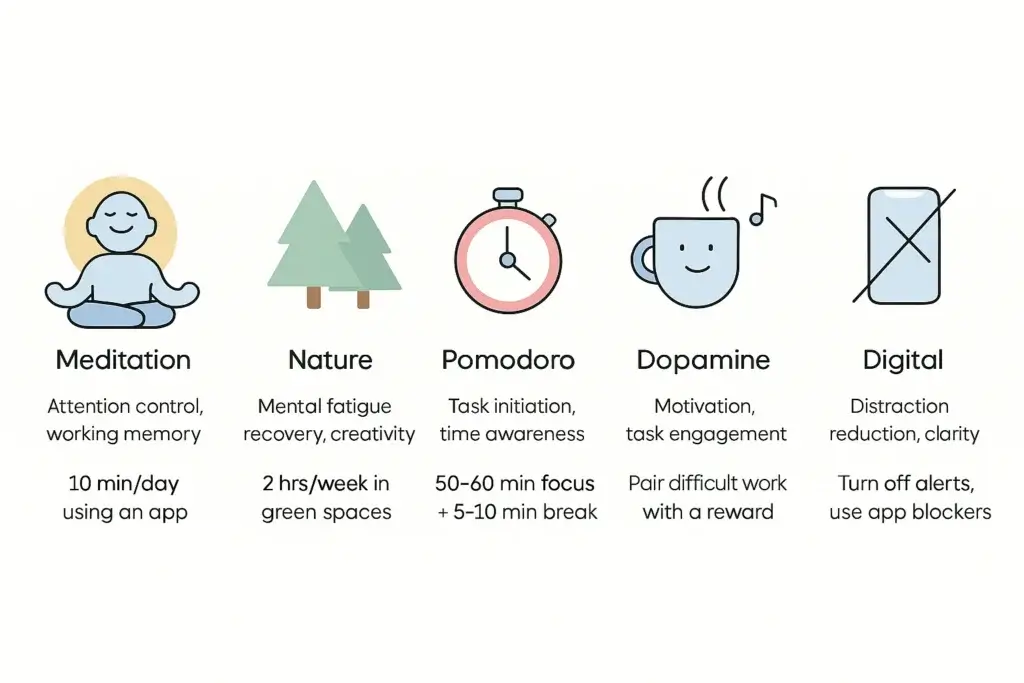
| Strategy | What It Improves | How to Start |
| Mindfulness Meditation | Attention control, working memory | 10 min/day using an app like Headspace |
| Nature Breaks | Mental fatigue recovery, creativity | 2 hrs/week in green spaces |
| Pomodoro Technique | Task initiation, time awareness | 50–60 min focus + 5–10 min break |
| Dopamine Anchoring | Motivation, task engagement | Pair difficult work with a reward |
| Digital Hygiene | Distraction reduction, clarity | Turn off alerts, use app blockers |
🧘♂️ Practice Mindfulness for Attention Control
If you’re constantly distracted, your brain’s “executive function” may be struggling to regulate what deserves focus.
Mindfulness meditation helps you strengthen your prefrontal cortex, the area responsible for attention and self-control. Just 10 minutes a day of focused breathing or body scanning can dramatically improve your cognitive control.
Studies published in journals like Cognitive, Affective, & Behavioral Neuroscience show that regular meditation leads to:
- Better sustained attention
- Improved working memory
- Lower stress-induced distraction
You don’t need to become a monk. Use beginner-friendly apps like Headspace, Waking Up, or Insight Timer, and just commit to starting small.
🌳 Use Nature to Reset Your Brain
When your mind is overstimulated, nature offers a powerful reset.
Attention Restoration Theory suggests that time in natural settings, like a park, trail, or even a balcony with greenery, helps your brain recover from cognitive fatigue. This is especially relevant in 2026, when remote workers spend more time indoors than ever.
Try this:
- Aim for at least 120 minutes of nature exposure per week
- Take a 10-minute “green break” between work blocks
- Swap your phone for a nature walk at lunch
Even a desktop plant or nature wallpaper can act as a soft visual anchor for your attention.
⏲️ Upgrade Your Pomodoro Routine
You probably know the Pomodoro Technique: 25 minutes of work, 5-minute break. But to support real focus, you’ll want to make some strategic upgrades.
Researchers suggest:
- Extending work blocks to 50–60 minutes for deep tasks
- Taking structured breaks to stretch, hydrate, or breathe
- Avoiding social media or phone use during the break
Tools like FLOWN offer built-in focus sessions with group accountability, some based on Pomodoro rhythms, others customized to your attention cycle.
This combination of structured time + social presence has been shown to dramatically reduce procrastination.
🎯 Try Dopamine Anchoring to Stay Motivated
Here’s a clever technique: pair boring tasks with small hits of dopamine.
This is known as dopamine anchoring, and it works by rewiring your brain’s reward system. When you associate a hard task (e.g., writing a report) with something enjoyable (e.g., favorite music or a latte), it makes the task feel more approachable.
Ideas to try:
- Play a specific focus playlist only during deep work
- Light a scented candle before every big task
- Reward yourself with a break, treat, or walk after 45 focused minutes
These mini-rewards help you build momentum, especially on low-energy days.
🔒 Improve Your Digital Hygiene
Let’s face it: your devices are one of the biggest obstacles to focus.
Digital hygiene means reducing friction caused by apps, pings, and platforms designed to hijack your attention.
To start, try this 3-step approach:
- Silence all non-essential notifications (yes, even Slack)
- Use full-screen mode or app blockers like Freedom or Cold Turkey
- Put your phone in another room during deep work blocks
You can also schedule your most focused work during energy peak times, often mid-morning or just after lunch. Tools like Motion or Notion Calendar can help you block these into your daily rhythm.
Structuring Deep Work Sessions That Actually Stick
You’ve probably experienced this before: you sit down with the best intentions to focus, but somehow, two hours disappear into emails, tabs, and task switching.
This isn’t a willpower problem. It’s a structural problem.
If you want to consistently get into a deep work state, you need more than just silence. You need a routine, clear boundaries, and accountability, both internal and external.
Here’s how to build a focus structure that supports your brain, not fights it:
🧱 Build a Deep Work Ritual
Just like athletes warm up before competition, your brain needs cues that it’s time to switch into “focus mode.”
Creating a ritual, even a simple one, helps signal that transition.
Try stacking 2–3 of these elements:
- A consistent start time (e.g., 9:00 AM daily)
- A short breathing or journaling session before starting
- A specific location or work setup (headphones, lighting, posture)
- A dedicated focus playlist you only use during deep work
When done regularly, this routine creates a mental shortcut, making it easier to drop into flow.
⏳ Use Time Blocking to Protect Your Attention
One of the most effective strategies for protecting your attention span in 2026 is time blocking, scheduling your deep work like an unmissable meeting.
Instead of having a vague intention to “work on that big task,” your calendar should reflect when, how long, and what you’ll work on.
Here’s a simple formula to follow:
- 1–2 deep work blocks per day, each 60–90 minutes
- Book them during your mental peak (often 10 AM–12 PM or 2 PM–4 PM)
- Add buffer time before and after to reduce context switching
Tools like Google Calendar, Notion Calendar, and Motion make this visual and friction-free.
You can even automate reminders or auto-scheduling to keep the habit consistent.
Here’s an example of what a typical weekly focus schedule might look like if you’re time-blocking 2 deep work sessions each day:
| Day | Focus Block 1 | Focus Block 2 |
| Monday | 10:00–11:30 AM | 2:00–3:30 PM |
| Tuesday | 9:30–11:00 AM | 3:00–4:00 PM |
| Wednesday | 10:00–11:00 AM | 2:00–3:00 PM |
| Thursday | 10:00–11:30 AM | 3:00–4:00 PM |
| Friday | 9:00–10:30 AM | Optional light tasks |
👥 Add Accountability with Virtual Coworking
Let’s be real, sometimes knowing someone else is watching makes all the difference.
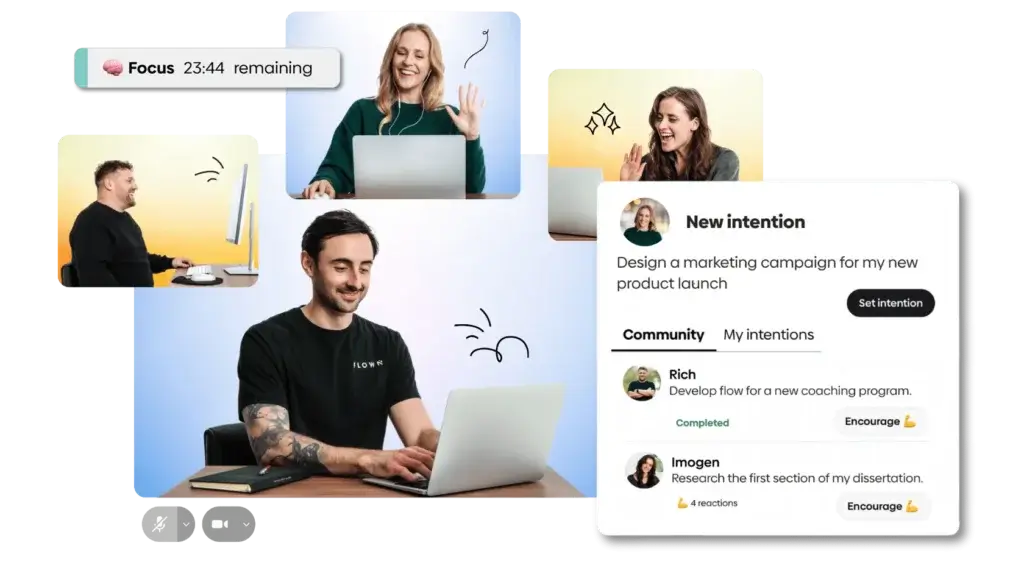
That’s where virtual coworking platforms like FLOWN come in. Their guided focus sessions provide structure, light social pressure, and regular check-ins to help you stay on track.
Why it works:
- You start sessions with a clear goal
- You’re gently held accountable by others in the room
- The scheduled format nudges you to show up, even when motivation dips
This taps into a psychological principle called pre-commitment, the idea that you’re more likely to follow through if you’ve committed to others ahead of time.
It’s not just for remote teams, either. Solo freelancers, students, and creatives use FLOWN to boost consistency and build long-term focus habits.
Measuring Progress & Staying Consistent
Building your focus is one thing. Keeping it sustainable? That’s the real challenge.
If you want lasting improvements, it’s important to track your focus like you would any performance metric. By observing how your attention changes over time, you can spot patterns, double down on what works, and adjust before burnout creeps in.
Here’s how to turn focus into a habit and keep your progress going in 2026:
📈 Track Your Focus with Simple Metrics
You don’t need a fancy system. Just a few basic signals can help you stay aware of your focus patterns.
Try journaling or logging the following:
- Session duration: How long did you stay focused?
- Distractions: What pulled you away? (phone, email, noise)
- Mood or energy: Were you tired, calm, restless?
- Focus quality: Rate your session from 1–10
You can use tools like Notion, Daylio, or a simple Google Sheet to keep this lightweight and consistent.
Over time, you’ll notice trends, like which time of day gives you peak focus or which environments help you concentrate best.
🔁 Review and Reflect Weekly
Once a week, look back at your logs and ask yourself:
- What helped me focus most this week?
- What consistently distracted me?
- What do I want to try or change next week?
This process is called metacognition, thinking about your thinking. It’s one of the most powerful ways to develop self-awareness and focus resilience.
Block 15–20 minutes on Fridays or Sundays for this reflection. Consider it your “focus review” to close out the week.
🎯 Set Small, Realistic Goals
Instead of chasing perfection, aim for small wins.
Here are a few examples:
- “Complete 2 deep work sessions per day this week”
- “Meditate for 5 minutes before starting work”
- “Track distractions for 3 consecutive days”
Each small goal builds your confidence and helps train your attention system like a muscle.
As you progress, you can layer in more strategies, longer sessions, more challenging tasks, or join live focus sessions like those offered by FLOWN to boost accountability.
🔄 Flow Isn’t Linear – and That’s OK
Some days, your mind will wander no matter what you try. That’s natural.
Don’t beat yourself up. Focus, like physical fitness, fluctuates. The goal is not perfection, it’s resilience. The ability to come back, again and again, is what matters most.
Conclusion: Your Next Focus Boost Starts Small
In a world wired for distraction, your ability to focus is your most valuable asset.
You’ve seen how your attention span is under siege in 2026, fragmented by notifications, drained by context switching, and reshaped by digital environments that demand too much, too often. But here’s the truth: your brain can bounce back.
By applying science-backed strategies like:
- Practicing mindfulness
- Taking intentional nature breaks
- Structuring deep work with rituals and time blocks
- Using tools like virtual coworking for accountability
- Tracking your focus sessions and learning from the data
You can rebuild your attention span, day by day, session by session.
Tools like FLOWN aren’t magic bullets, but they do offer a framework to help you protect your time, access flow states, and stay consistent, especially when motivation wavers. Use them as part of your larger system, not your only solution.
📌 Remember: You don’t need to master everything at once. Just pick one tactic from this guide to try this week. Then build from there.
If you’re curious about how to level up your work habits even further, check out our curated list of top deep work and productivity tools to support your journey.
Your focus is worth fighting for, because it shapes your work, your creativity, and your peace of mind.
FAQs
What is the science of focus?
The science of focus studies how your brain controls attention, filters distractions, and sustains concentration. It combines neuroscience, psychology, and productivity research to explain why focus breaks down and how you can rebuild it through better habits, environment design, and structured deep work.
How can I rebuild my attention span?
You can rebuild your attention span by reducing digital distractions, practicing mindfulness, scheduling deep work blocks, taking restorative breaks, and tracking your focus habits. Start with short sessions and gradually increase the time you spend on focused work.
Why is it harder to focus in 2026?
It is harder to focus in 2026 because your attention is constantly pulled by notifications, social feeds, emails, chat apps, and frequent task switching. These interruptions create attention residue, making it harder to stay engaged with deep, meaningful work.
What is attention residue?
Attention residue happens when part of your mind remains stuck on a previous task after you switch to something new. This makes it harder to fully concentrate, especially when you move quickly between emails, meetings, messages, and complex work.
Does mindfulness improve focus?
Yes. Mindfulness can improve focus by training your brain to notice distractions and return attention to the present task. Even short daily practices, such as breathing exercises or body scans, can support better attention control over time.
How does nature help restore attention?
Nature helps restore attention by giving your brain a break from high-effort concentration. Green spaces, outdoor walks, and natural views can reduce mental fatigue and support better clarity before your next focus session.
What is digital hygiene?
Digital hygiene means organizing your devices and apps so they support focus instead of interrupting it. This can include turning off notifications, blocking distracting websites, using full-screen mode, and keeping your phone away during deep work.
Does virtual coworking help with focus?
Yes. Virtual coworking can help with focus by adding structure, accountability, and social presence to your work sessions. Platforms like FLOWN make it easier to set intentions, join guided focus sessions, and stay committed to deep work.
How long should a deep work session be?
A deep work session usually works best between 50 and 90 minutes, depending on your energy and the task. If you are rebuilding your focus, start with shorter sessions and increase the duration as your attention improves.
How do I know if my focus is improving?
You can tell your focus is improving by tracking session length, distraction frequency, task completion, and how mentally clear you feel after work blocks. If you can stay with difficult tasks longer and recover faster after interruptions, your attention span is improving.