
Introduction
SEO research is no longer just about finding keywords and tracking rankings. You also need to understand where competitors get their traffic, which channels are driving growth, how markets shift over time, and how search behavior changes across both traditional search engines and AI-driven discovery. That is where Similarweb stands out.
In this Similarweb review, you will get a detailed look at the platform’s SEO capabilities, competitive intelligence features, pricing structure, strengths, limitations, and the types of users who will benefit most from it. By the end, you should have a clear understanding of whether Similarweb is the right fit for your workflow, your goals, and your budget.
What Is Similarweb?
Similarweb is a digital intelligence platform that helps you analyze websites, competitors, search performance, market trends, audience behavior, and traffic sources. While many marketers know it as a website traffic checker, the platform has evolved into a much broader solution for SEO, competitive research, paid media analysis, and digital market intelligence.
It is especially useful when you need to move beyond basic keyword data and understand the bigger picture. Instead of only showing rankings and backlinks, Similarweb helps you see how competitors acquire traffic, which channels contribute most to growth, how market share changes over time, and where new search opportunities exist.
Background and Evolution
Similarweb was founded in 2007 and has grown from a traffic intelligence company into a much broader digital data platform. In 2026, it positions itself as a solution for Web Intelligence, SEO, AI search visibility, app intelligence, sales intelligence, and market analysis. That broader positioning is important because it explains why Similarweb feels different from traditional SEO tools.
Target Users and Use Cases
Similarweb is suitable for several types of users:
- SEO specialists and content teams – You can use it for keyword research, rank tracking, site audits, backlink analytics, and competitor search analysis.
- Growth marketers and demand teams – Traffic source analysis, channel benchmarking, and competitor monitoring make it useful well beyond organic SEO.
- Agencies and consultants – The platform works well for benchmarking clients against competitors and identifying market opportunities.
- Research and strategy teams – Similarweb is particularly strong when you need a wider market view, not just page-level SEO data.
If your goal is to understand both SEO performance and the wider digital competitive landscape, Similarweb is one of the strongest tools in this category. If you only need traditional SEO workflows, however, a more SEO-focused platform may sometimes be the better fit.
Key Features
How Does Similarweb Work?
Similarweb combines classic SEO workflows with broader competitive intelligence. Below are the core capabilities that define the platform.
Website Traffic and Competitive Analysis
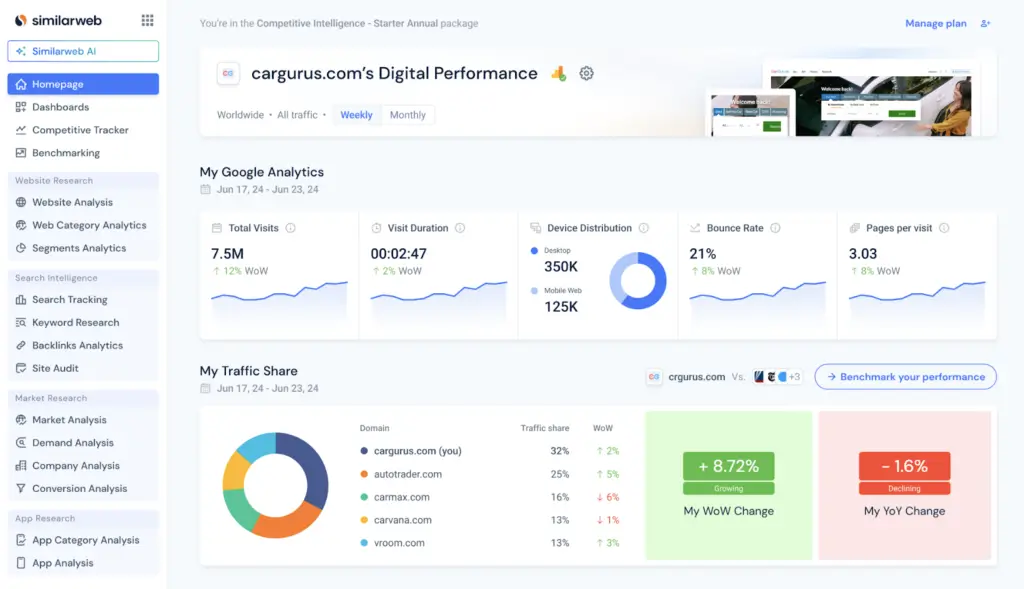
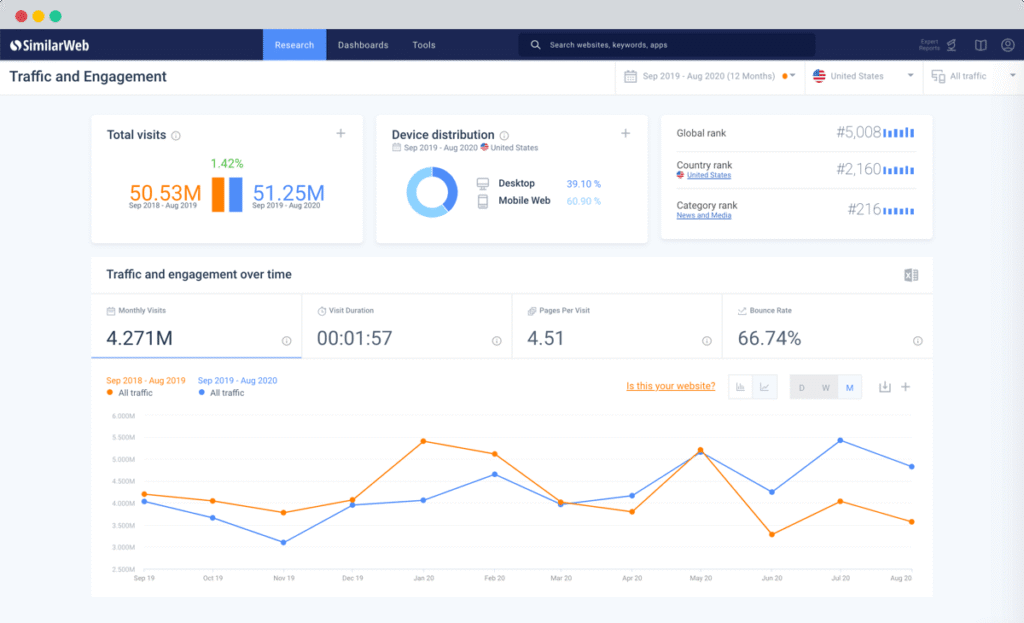
This is the area where Similarweb is strongest. You can enter your own domain or a competitor’s domain and quickly review estimated traffic, engagement metrics, channel mix, geography, referrals, audience behavior, and top competitors. That gives you a fast way to understand who is growing, where their traffic is coming from, and which channels matter most in your niche.
For marketers working in competitive SaaS, publishing, ecommerce, or lead generation, this broader view is valuable because it goes beyond simple rankings. You are not only seeing whether a competitor ranks, you are seeing whether search is actually a meaningful growth engine for them compared to direct, paid, social, referrals, or display.
Keyword Research and Search Intelligence
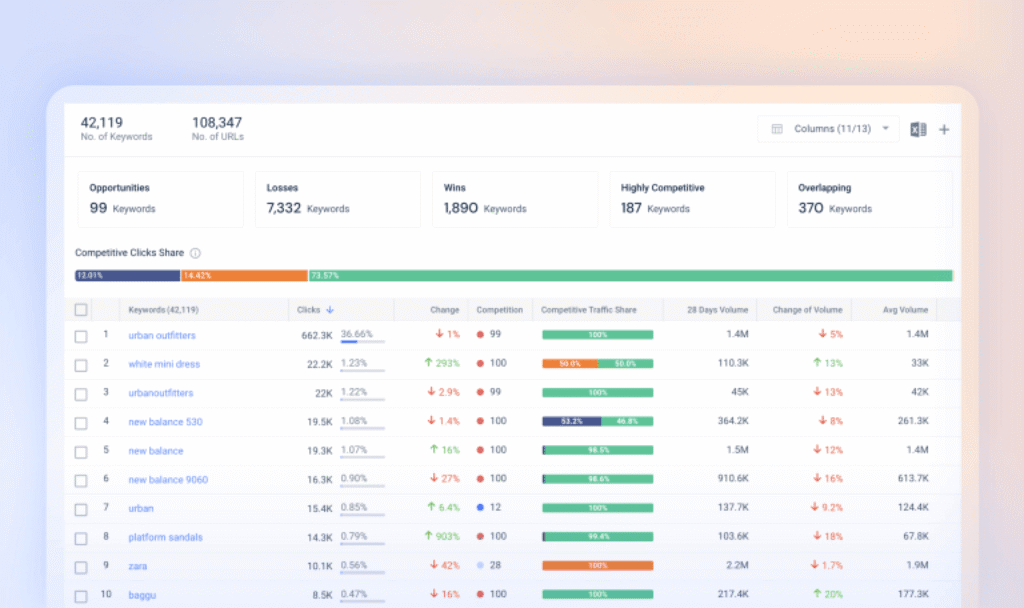
Similarweb includes keyword research tools that help you discover search demand, evaluate keyword opportunities, and compare your visibility against competitors. The platform combines keyword data with click and traffic intelligence, which can make the research feel more commercially useful than simple search-volume estimates alone.
Its keyword research workflows are especially helpful when you want to understand not just what people search for, but which terms are actually sending traffic to competing domains. That makes Similarweb a strong fit for content strategy, topic selection, and competitor-driven SEO research.
Keyword Gap and Competitor Search Analysis
One of Similarweb’s biggest SEO strengths is its ability to connect search analysis with competitor benchmarking. You can identify keywords your competitors rank for, measure overlap, and find opportunities where other sites are capturing traffic that you are missing. This is useful when building new content clusters, refreshing commercial pages, or trying to close visibility gaps in a crowded market.
Rank Tracking and SERP Monitoring
Similarweb’s rank tracker lets you monitor daily keyword movements, competitor rankings, visibility trends, and SERP features over time. It supports tracking by location and device, which matters if your SEO strategy includes local search or multiple markets.
The platform also highlights AI Overviews and other SERP features, which is increasingly important as search results become more complex. Instead of looking only at blue-link rankings, you can better understand how much visibility you own across the broader search results page.
Site Audit and Technical SEO
Similarweb also includes a site audit tool for technical SEO. You can use it to find crawl issues, broken links, duplicate content, indexation concerns, and other problems that may affect organic visibility. While Similarweb is not usually the first name marketers mention for technical SEO, the site audit capability makes it more complete than many people assume.
Backlink Analytics
Backlink analysis is included as part of the SEO toolkit, giving you visibility into referring domains, backlink trends, and competitor link profiles. This is useful for evaluating domain authority trends and identifying link-building opportunities. That said, if backlinks are your number one priority, many SEO professionals still prefer Ahrefs for deeper link-centric workflows.
AI Search and Emerging Discovery
One of Similarweb’s newer strengths is its focus on AI-driven discovery. The platform now includes AI traffic, AI brand visibility, prompt analysis, and related AEO-focused capabilities. This gives you a way to monitor how your brand appears in AI-generated environments and whether competitors are gaining visibility there.
This area is still evolving, but it is a meaningful addition because discovery is no longer limited to Google’s traditional results. If your brand is actively thinking about AI search visibility, Similarweb is ahead of many traditional competitors in this area.
Market Intelligence Beyond SEO
Unlike many SEO tools, Similarweb can also function as a market intelligence platform. You can use it to benchmark industries, track category leaders, analyze channel mix, explore audience behavior, and understand how markets shift over time. This is the main reason Similarweb often appeals to strategic marketing teams and executives, not just hands-on SEO practitioners.
Pros and Cons
Benefits and Limitations of Using Similarweb
Positive
✅ Excellent traffic intelligence
✅ Strong competitor benchmarking
✅ Useful SEO plus market insights
✅ Good AI search visibility direction
Negative
❌ Pricing can be difficult for smaller teams
❌ Some estimates are directional
❌ Not the deepest pure SEO platform
❌ Interface can feel broad at first
Strengths and Benefits
Similarweb’s biggest strength is that it gives you a wider strategic view than most traditional SEO suites. Instead of focusing only on search rankings, it helps you understand the entire competitive landscape around traffic, channels, audience behavior, and market movement.
- Excellent traffic intelligence – Similarweb is one of the strongest tools for understanding estimated traffic, engagement, and channel distribution across competitor sites.
- Strong competitive benchmarking – It is particularly effective when you want to compare your performance against several competitors at once.
- Useful blend of SEO and market research – The combination of keyword research, rank tracking, and market intelligence makes it more strategic than many SEO-only tools.
- Good AI search visibility direction – AI traffic and AI visibility features give it a modern edge as discovery expands beyond traditional search engines.
- Helpful for cross-functional teams – SEO, growth, PPC, content, and strategy teams can all find value in the same platform.
Limitations and Drawbacks
Similarweb is powerful, but it is not the perfect fit for every workflow.
- Pricing can be difficult for smaller teams – The platform is clearly positioned as a premium intelligence solution.
- Some estimates are directional – Like any third-party intelligence platform, Similarweb should be used as directional competitive data, not as a replacement for first-party analytics.
- Not the deepest pure SEO platform – If your entire workflow revolves around backlinks, technical SEO, and rank tracking, Ahrefs or Semrush may feel more specialized.
- Interface can feel broad at first – Because Similarweb spans multiple workflows, it can feel less straightforward than narrower SEO tools during onboarding.
Competitors
Competitor Alternatives to Similarweb
Similarweb competes with several well-known SEO and competitive intelligence platforms. The most relevant alternatives for this review are Semrush and Ahrefs, because each one overlaps with Similarweb in different ways.
| Feature Type | Similarweb | Semrush | Ahrefs |
| Core focus | Traffic intelligence, market analysis, SEO | All-in-one SEO and marketing suite | SEO and backlink intelligence |
| Best for | Competitive benchmarking and traffic analysis | Broad SEO, PPC, and content workflows | SEO teams focused on backlinks and content research |
| Traffic intelligence | Excellent | Strong | More limited overall |
| Keyword research | Strong | Excellent | Excellent |
| Rank tracking | Strong | Strong | Strong |
| Site audit | Good | Very strong | Strong |
| Backlink tools | Good | Very good | Excellent |
| AI search features | Strong direction | Growing focus | Less central to product story |
| Pricing feel | Premium | Premium | Premium |
Choose Similarweb if your biggest need is understanding the wider digital market, competitor traffic, audience trends, and channel mix. Choose Semrush if you want a broader all-in-one SEO and marketing toolkit with especially strong content and PPC workflows. Choose Ahrefs if your top priority is backlink intelligence and a more SEO-focused research experience.
Pricing
Similarweb Pricing and Plans
Similarweb uses a mixed pricing model. Some packages are self-serve and clearly priced, while broader business-focused Web Intelligence packages are customized through sales. That means the real cost depends on whether you need standard SEO workflows, AI search visibility, competitive intelligence at scale, or more advanced enterprise data access.
Self-Serve SEO and AI Search Packages
At the time of writing, Similarweb publicly lists self-serve AI Search Intelligence pricing with an entry-level plan, a mid-tier package that combines AEO, SEO, and competitive intelligence, and a higher package aimed at performance marketers. These are single-user plans and are more transparent than the custom business packages.
Custom Business Packages
For broader Web Intelligence use cases, Similarweb often routes teams through a sales-led process. This makes sense because larger companies usually need more historical depth, more countries, broader reporting, custom dashboards, API access, or dedicated support. The downside is that pricing can be less straightforward for buyers in the early research stage.
Pricing Table
Below is a simplified overview of how Similarweb’s pricing is currently positioned.
| Plan | Best For | Main Value |
| Entry self-serve | Individual researchers and lighter AEO use | Basic AI search and competitive visibility data |
| Mid-tier self-serve | SEO managers and marketers | SEO tools plus competitive intelligence |
| Higher self-serve | Performance teams | Broader SEO, AI, ads, and competitor workflows |
| Custom business packages | Agencies and larger teams | Scalable market intelligence and tailored access |
Similarweb offers strong value when you actively use both the SEO toolkit and the traffic intelligence layer. If you only need a keyword tool or backlink checker, however, the cost can feel hard to justify compared to more focused alternatives.
Use Cases
Who Should Use Similarweb?
Similarweb can be extremely valuable, but the right fit depends on how strategic your needs are.
SEO Teams That Need More Than Rankings
If you want to understand not only where you rank but also how traffic behaves across your market, Similarweb is a very attractive option. It works especially well for teams that build strategy around search opportunity, traffic share, competitive gaps, and content prioritization.
Agencies and Competitive Research Teams
Similarweb is particularly strong for agencies, consultants, and market intelligence teams because it provides fast benchmarking across domains, channels, and geographies. It can help you build stronger strategic narratives for clients, not just deliver isolated SEO metrics.
Growth and Performance Marketers
Because Similarweb includes channel and traffic intelligence, it is useful for teams that manage both organic and paid growth. You can see where competitors invest, how their traffic mix changes, and whether SEO is truly driving growth for them.
When Similarweb Might Not Be the Right Fit
Similarweb may not be ideal if your budget is tight and you only need day-to-day SEO execution. In those cases, tools like Ahrefs, Semrush, or even lighter SEO platforms may offer a better return. It may also feel like overkill if your main goal is simply checking rankings and finding a handful of keywords each month.
Best Practices
Getting Started with Similarweb
To get the most value from Similarweb, follow these best practices:
Start With Competitor Benchmarking
Do not begin with keyword exports alone. Start by comparing your domain against direct competitors to understand traffic scale, channel mix, geographic strength, and audience behavior. That high-level view will make the rest of your SEO work more targeted.
Use Search Data in Context
Similarweb becomes more useful when you connect keyword research to traffic potential and competitor performance. Instead of targeting keywords only because they have volume, evaluate whether those terms are actually contributing to meaningful traffic in your market.
Build a Repeatable Reporting Workflow
Create a regular workflow for checking market shifts, rising competitors, channel changes, and search trends. Similarweb is at its best when used as an ongoing intelligence source, not as a one-time research tool.
Validate With First-Party Analytics
Use Similarweb for competitive direction and market insight, but continue validating performance decisions with your own analytics platforms. This helps you make the most of the platform without treating third-party estimates as exact internal data.
Focus on the Features That Match Your Goals
Because Similarweb covers a wide range of use cases, it is easy to get distracted. Start with the workflows that matter most to you, such as competitor benchmarking, keyword research, and rank tracking, then expand into AI visibility and market analysis as needed.
Conclusion
Final Thoughts
Similarweb is one of the most compelling platforms for marketers who want more than a traditional SEO tool. Its biggest strength is the way it combines keyword research, rank tracking, technical SEO capabilities, and backlink analysis with traffic intelligence, channel benchmarking, and wider competitive research. That broader view makes it especially valuable for SaaS marketers, agencies, publishers, and growth teams that need strategic insight, not just tactical SEO data.
At the same time, Similarweb is not the best fit for every buyer. It is a premium platform, its traffic data is still directional rather than first-party, and pure SEO specialists may still prefer a more focused tool for backlink-heavy or technical workflows. Still, if your goal is to understand search performance in the context of the full digital market, Similarweb is one of the strongest options available in 2026.
Have more questions?
Frequently Asked Questions
1. What is Similarweb mainly used for?
Similarweb is mainly used for website traffic analysis, competitor benchmarking, keyword research, market intelligence, rank tracking, and broader digital performance analysis.
2. Is Similarweb an SEO tool?
Yes, but it is not only an SEO tool. Similarweb includes keyword research, rank tracking, site audit, and backlink analytics, while also offering traffic intelligence and market-level competitor analysis.
3. Is Similarweb accurate?
Similarweb is useful for directional competitive analysis, but its traffic data is still based on external estimation and modeled intelligence. It should be used alongside your own first-party analytics.
4. Is Similarweb better than Semrush?
It depends on your goals. Similarweb is generally stronger for market intelligence and traffic benchmarking, while Semrush is often stronger as a broader all-in-one SEO, content, and PPC execution platform.
5. Is Similarweb better than Ahrefs?
Similarweb is usually better for traffic intelligence and broader competitive research, while Ahrefs is often the stronger choice for backlink analysis and SEO-focused workflows.
6. Does Similarweb offer rank tracking?
Yes. Similarweb includes rank tracking with daily updates, competitor visibility analysis, local tracking options, and monitoring for SERP features such as AI Overviews.
7. Does Similarweb help with competitor analysis?
Yes. Competitor analysis is one of Similarweb’s biggest strengths. It helps you compare traffic, channels, audience patterns, keyword visibility, and market position across multiple domains.
8. Is Similarweb good for agencies?
Yes. Agencies can use Similarweb for market research, client benchmarking, SEO opportunity analysis, competitor tracking, and strategic reporting.
9. Is Similarweb worth it for small businesses?
It can be, but only if competitive intelligence and search visibility are major growth priorities. For smaller teams with basic SEO needs, it may be more expensive than necessary.
10. Who should not choose Similarweb?
You may want to skip Similarweb if you only need a lightweight SEO tool, have a limited budget, or want a platform focused almost entirely on backlinks or technical SEO execution.