Introduction
HR software has become the operational backbone of modern people teams. The best platforms help you centralize employee records, automate onboarding, simplify payroll, improve compliance, support hiring, and give employees better self-service tools. The right system can save your HR team hours of manual work while also improving the employee experience across the full lifecycle.
In this guide, I compare nine leading HR software platforms: HiBob, Deel, BambooHR, Leapsome, Greenhouse, Shapes, Paylocity, Workday, and Rippling. Some are broad HR suites, while others are especially strong in global hiring, payroll, recruiting, performance management, or enterprise workforce planning. Your ideal choice depends on your company size, hiring model, geographic footprint, and the level of complexity you need.
If you want a quick summary, HiBob is one of the strongest overall HR platforms for modern growing companies, BambooHR remains a leading option for small businesses, Deel stands out for global hiring and international payroll, Rippling is excellent if you want HR and IT in one system, and Workday is still one of the top enterprise choices.
How to Evaluate HR Software
Before comparing the platforms, it helps to define what matters most for your business. HR software varies widely in scope, usability, and pricing model. Some vendors focus on core HR and payroll, while others add recruiting, performance, compensation, analytics, and workforce planning.
Core HR and employee records
Your HR software should serve as a reliable source of truth for employee data. That includes employee profiles, org charts, document storage, workflows, permissions, approvals, and time-off tracking. If the core HR layer is weak, the rest of the platform usually feels fragmented.
Payroll and compliance
Payroll is one of the most valuable areas to automate. Look at payroll accuracy, tax handling, benefits support, integrations, and country coverage. If you hire internationally, global payroll and compliance become even more important.
Hiring and onboarding
If your company is growing quickly, hiring workflows matter a lot. Evaluate applicant tracking, interview pipelines, offer management, preboarding, and onboarding automation. A strong hiring and onboarding process can reduce friction for both HR teams and new employees.
Performance and employee development
Many HR teams now want more than administration. Features like performance reviews, goals, surveys, compensation planning, feedback, and learning tools can make a major difference if your business is investing in retention and development.
Ease of use and scalability
The best HR platform is not always the most feature-rich one. It is the platform your HR team, managers, and employees will actually use. A clean interface, strong automations, and the ability to scale without constant reconfiguration matter just as much as feature depth.
HiBob
Features & Benefits
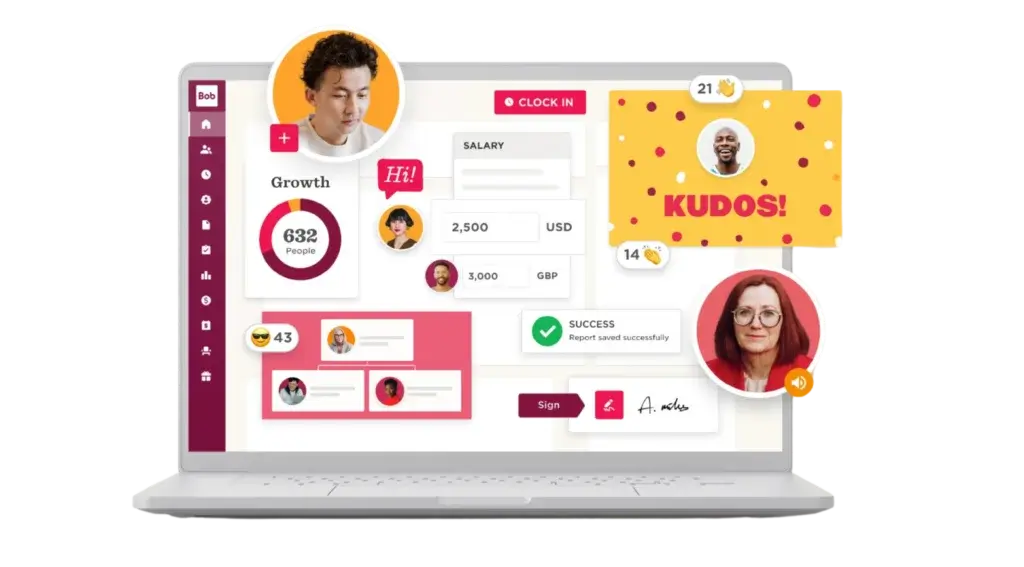
HiBob is one of the most balanced HR platforms in this category. It gives you strong core HR capabilities for employee records, workflows, onboarding, time tracking, compensation support, and people operations, while also putting more emphasis on employee experience than many traditional HR systems. That balance makes it especially appealing for mid-sized businesses that want more sophistication than entry-level HR tools without moving into the full complexity of enterprise HCM software.
The platform is well suited to companies that want a modern interface, better manager adoption, and stronger employee engagement features built alongside HR administration. Compared with more basic tools, HiBob feels more scalable and strategic. Compared with heavier enterprise suites, it is usually easier to roll out and maintain.
Pricing & Plans
HiBob uses quote-based pricing rather than publishing fixed plans. That means you need to contact sales for a custom quote based on company size, modules, and requirements.
Pros & Cons
Pros
- Strong mix of core HR and employee experience tools
- Modern interface that is easier to adopt than many legacy systems
- Good fit for growing and multi-country businesses
- Useful workflows, onboarding, and compensation support
Cons
- Pricing is not publicly transparent
- May be too advanced for very small teams
- Not as deep as Workday for enterprise-scale complexity
Deel

Features & Benefits
Deel started as a global hiring platform and has expanded into a broader HR solution. It is particularly strong for businesses managing employees and contractors across multiple countries. You can use it for international hiring, payroll, compliance, onboarding, contractor management, and employer of record services, all from one system.
This makes Deel one of the best choices for remote-first companies, distributed teams, and organizations growing internationally. Compared with more domestic HR systems, Deel has a much stronger global employment infrastructure. If international complexity is your main concern, Deel is one of the most practical platforms in this list.
Pricing & Plans
Deel has more transparent pricing than most HR vendors. Public pricing includes HR and payroll-related offerings, with employer of record plans starting at $599 per employee per month and modular pricing across other services.
Pros & Cons
Pros
- Excellent for global employees and contractors
- Strong payroll and compliance infrastructure
- More pricing transparency than most competitors
- Ideal for remote and international organizations
Cons
- Can be more than domestic-only companies need
- EOR costs add up quickly at scale
- Less focused on culture and engagement than HiBob
BambooHR


Features & Benefits
BambooHR remains one of the most popular HR software choices for small businesses. Its biggest strength is usability. The platform keeps employee records, onboarding, time off, payroll, and basic talent workflows in one approachable system that is easier to learn than many broader HCM suites.
For smaller teams, that simplicity matters. BambooHR is often a better fit than more complex systems when your main goal is to replace spreadsheets and disconnected HR tools with something reliable and intuitive. It may not be the most advanced platform in this list, but it is one of the easiest to adopt.
Pricing & Plans
BambooHR offers pricing based on plan selection and employee count. The company highlights flexible plan options and add-ons, with pricing available through its quote flow rather than through a fully open public pricing table.
Pros & Cons
Pros
- Excellent usability for small businesses
- Strong core HR and onboarding capabilities
- Approachable for lean HR teams
- Good all-around SMB HR platform
Cons
- Less advanced than enterprise-focused systems
- May require add-ons for deeper functionality
- Not the best option for complex global operations
Rippling


Features & Benefits
Rippling stands out because it does much more than core HR. In addition to HRIS, payroll, benefits, and workforce management, it also connects with IT and finance workflows. That means you can automate tasks like employee onboarding, app access, permissions, device setup, and offboarding from a single platform.
This broader operational scope makes Rippling one of the most differentiated products in the HR software market. It is especially compelling for fast-growing companies that want fewer disconnected systems and more automation across the employee lifecycle.
Pricing & Plans
Rippling uses modular pricing. The company explains that products can be purchased separately alongside the core platform, and total pricing depends on the modules you choose.
Pros & Cons
Pros
- Strong HR, payroll, and IT combination
- Excellent automation across employee lifecycle workflows
- Highly modular and scalable
- Very strong operational flexibility
Cons
- Pricing becomes less predictable as modules stack up
- Can be heavier than needed for simple HR use cases
- Less transparent than flat-rate vendors
Leapsome

Features & Benefits
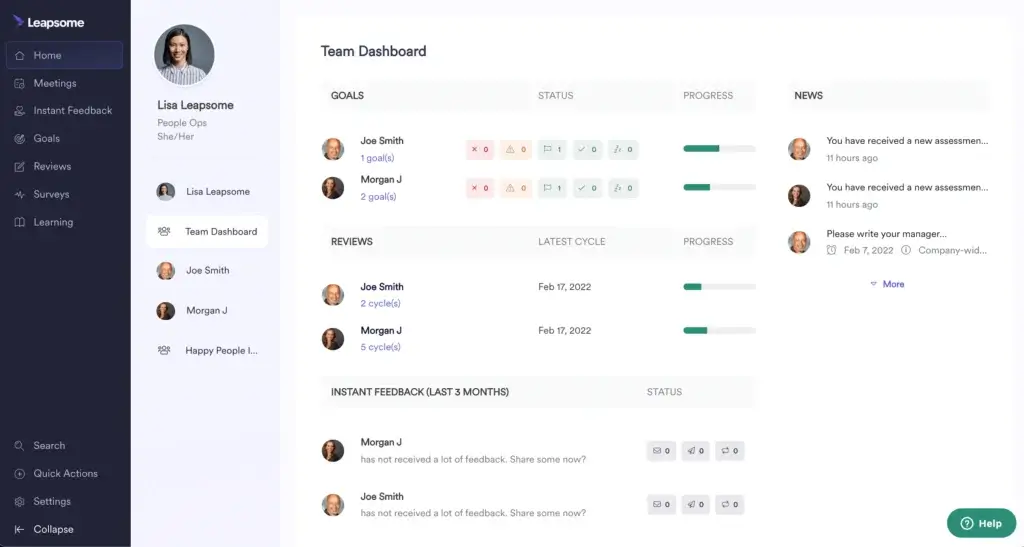
Leapsome is one of the best choices if you want HR software that goes beyond administration and focuses more heavily on employee growth. The platform combines HRIS capabilities with performance reviews, goals, surveys, learning, compensation, and broader talent management workflows.
That makes it especially attractive for businesses that care about manager effectiveness, employee development, and structured performance processes. Compared with payroll-led systems, Leapsome feels much more development-oriented. It is not the best fit if payroll is your primary concern, but it is a strong option if people development is a strategic priority.
Pricing & Plans
Leapsome offers modular pricing that adjusts based on the products and processes you choose. The company positions the platform as an AI-powered people platform with flexible pricing rather than a single fixed plan.
Pros & Cons
Pros
- Excellent performance and development features
- Strong surveys, goals, and review tools
- Combines HRIS with talent management well
- Good fit for growth-focused HR teams
Cons
- Not a payroll-first platform
- Pricing is modular rather than fully transparent
- Less specialized for global employment than Deel
Greenhouse
Features & Benefits
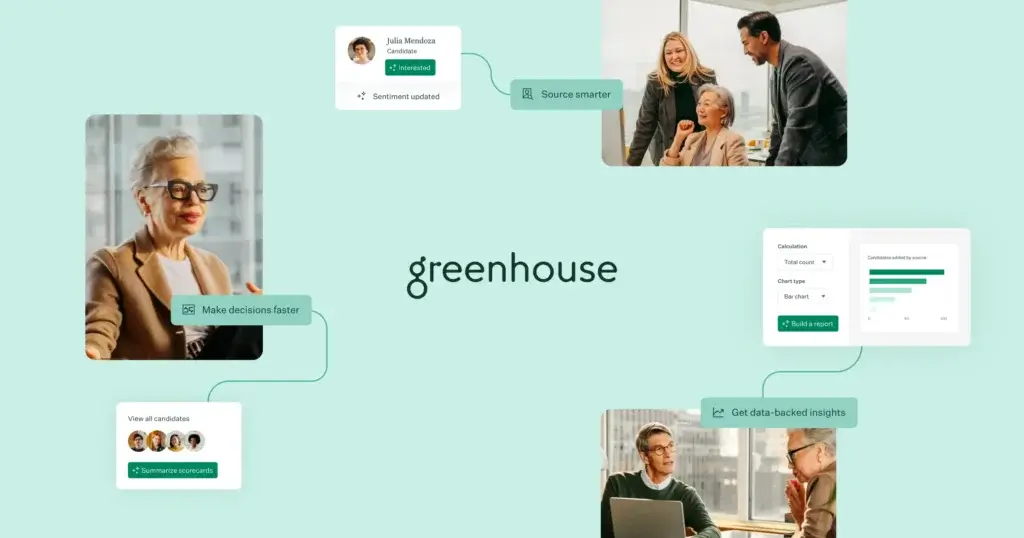
Greenhouse is not a full HR suite in the same way that HiBob, BambooHR, or Rippling are. Its strength is recruiting. It remains one of the strongest applicant tracking and structured hiring platforms on the market, and it is especially useful for businesses where hiring quality and process consistency are mission-critical.
The platform is designed to support structured hiring, recruiting automation, candidate experience, and built-in AI recruiting tools. I would not treat Greenhouse as your only HR platform, but I would absolutely consider it if talent acquisition is the most strategic part of your HR stack.
Pricing & Plans
Greenhouse offers Core, Plus, and Pro plans, but pricing is customized based on hiring needs and plan requirements.
Pros & Cons
Pros
- Excellent applicant tracking and structured hiring workflows
- Strong recruiting specialization
- Useful automation and AI recruiting features
- Good for scaling hiring teams
Cons
- Not a complete HR suite on its own
- Best paired with a broader HRIS
- Pricing requires a sales process
Shapes

Features & Benefits
Shapes is one of the more interesting newer HR platforms in this category because it combines a modern people platform approach with unusually transparent pricing. The product includes employee directory, org chart, onboarding automation, performance management, surveys, time off, attendance, time tracking, and analytics in a single offer.
That pricing simplicity is a real advantage in a market where most vendors rely on quotes, modules, and layered upsells. For cost-conscious growing businesses, Shapes is an appealing alternative to more established vendors if you want broad HR functionality without a complicated buying process.
Pricing & Plans
Shapes lists public pricing at $8 per employee per month, billed annually, with all features included and setup and onboarding included as well.
Pros & Cons
Pros
- Transparent flat pricing
- Broad feature coverage for the cost
- Modern product positioning and UX
- Good value for growing businesses
Cons
- Smaller market presence than major HR vendors
- Less proven at enterprise scale
- Not as deep as Workday or Rippling for complex operations
Paylocity
Features & Benefits
Paylocity is a strong option for businesses that want payroll, HR, and workforce operations in one environment. The company positions the platform across HR, finance, and IT, but payroll remains one of its clearest strengths. That makes it especially appealing for U.S.-focused organizations that want a broad HR system with strong payroll roots.
Compared with smaller HR tools, Paylocity offers more operational depth. Compared with enterprise suites, it is often easier to approach. For many mid-market businesses, that balance is attractive.
Pricing & Plans
Paylocity uses flexible pricing based on business needs and platform configuration, rather than fixed public plan tiers.
Pros & Cons
Pros
- Strong payroll foundation
- Broad HR platform for mid-market companies
- Useful for workforce management and operations
- Good option for U.S.-based organizations
Cons
- Pricing is custom
- Less globally focused than Deel
- Less modern feeling than some newer HR vendors
Workday
Features & Benefits
Workday remains one of the most important names in enterprise HCM. It is designed for organizations that need global scale, deep analytics, workforce planning, and a highly configurable platform for complex HR operations. It is not the easiest or lightest product in this list, but that is not its purpose. Workday is built for enterprise depth.
Its current positioning also puts more focus on AI, skills intelligence, and broader workforce strategy. That strengthens its value for large organizations that want more than transactional HR and need a platform that supports planning, talent, and organizational complexity at scale.
Pricing & Plans
Workday uses custom enterprise pricing and does not publish standard public plan tiers for HCM.
Pros & Cons
Pros
- Excellent for large enterprises
- Strong analytics and workforce planning
- Deep HCM breadth and scalability
- Advanced AI and skills-focused capabilities
Cons
- Complex to buy and implement
- Usually too heavy for small businesses
- Pricing requires a full sales process
Comparing the Tools
Not every HR platform in this guide is trying to solve the same problem. Some are broad HR systems built to centralize employee data, payroll, workflows, and reporting. Others are more specialized and stand out in areas like global hiring, recruiting, performance management, or enterprise workforce planning.
That is why a single oversized comparison table is not the best format here. Instead, this section breaks the comparison into two clearer views: a quick-pick summary for fast decision-making, followed by a more focused capability table for buyers who want a side-by-side look at the most important differences.
Quick Picks by Use Case
If you want the fastest way to narrow your shortlist, start here. These picks highlight where each platform stands out most clearly.
| Tool | Best For | Top Strength | Main Trade-Off | Pricing Model |
| HiBob | Modern growing companies | Best overall HR balance | Quote-based pricing | Custom quote |
| Deel | Global teams | International payroll and compliance | Can be costly for domestic-only teams | Modular, partly transparent |
| BambooHR | Small businesses | Ease of use | Less advanced for complex needs | Custom quote |
| Rippling | HR plus IT automation | Unified HR, payroll, and IT workflows | Pricing can expand with modules | Modular quote |
| Leapsome | Performance and development | Strong reviews, goals, and surveys | Not payroll-first | Modular quote |
| Greenhouse | Hiring-heavy teams | Structured recruiting excellence | Not a full HR suite | Custom quote |
| Shapes | Budget-conscious growing teams | Transparent flat pricing | Smaller market presence | Public flat rate |
| Paylocity | U.S. payroll-led HR teams | Strong payroll foundation | Less globally focused | Custom quote |
| Workday | Large enterprises | Enterprise HCM depth and analytics | Heavy for smaller businesses | Custom enterprise quote |
How These Tools Differ
While all of these platforms support HR workflows in some form, they are not all built for the same buyer. Some are broad HR systems designed to centralize employee data, payroll, and operations. Others are more specialized and stand out in areas like international hiring, recruiting, performance management, or enterprise workforce planning.
The clearest way to compare them is by looking at where each one fits best, what it does especially well, and where it is more limited. This format is easier to scan than a second large table and gives you a faster way to narrow your shortlist.
HiBob – Best overall balance for growing companies
HiBob is the most well-rounded option in this list for modern mid-sized businesses. It combines strong core HR, onboarding, workflows, compensation support, and employee experience features in a platform that feels more modern than many traditional HR systems. It is a great fit when you want a central HR platform rather than a highly specialized add-on.
Deel – Best for global hiring and international payroll
Deel is the strongest option here for companies managing employees and contractors across multiple countries. It stands out for global hiring, international payroll, compliance, and employer of record services. If international employment complexity is one of your biggest concerns, Deel deserves to be near the top of your shortlist.
BambooHR – Best for small businesses that want simplicity
BambooHR remains one of the most approachable HR systems for smaller businesses. Its main advantage is ease of use. It gives you a reliable HR foundation without the heavier learning curve and operational complexity of larger HCM suites. For SMBs, that simplicity is often a major strength.
Rippling – Best for HR plus IT automation
Rippling is one of the most differentiated platforms in the market because it goes beyond HR. It connects HR, payroll, benefits, IT, permissions, and app access in one system. If your company wants to automate employee lifecycle processes across departments, Rippling is one of the strongest choices available.
Leapsome – Best for performance and employee development
Leapsome is especially strong when performance management, feedback, goals, surveys, and learning are strategic priorities. It is less payroll-centric than several other vendors in this guide, but it is one of the best options if you want HR software to support manager effectiveness and employee growth more directly.
Greenhouse – Best for recruiting-heavy teams
Greenhouse is the strongest recruiting specialist in this comparison. It is not meant to replace a full HR suite, but it excels at applicant tracking, structured hiring, and recruiting workflows. If hiring quality is the main driver behind your software decision, Greenhouse is one of the best platforms to evaluate.
Shapes – Best for transparent pricing
Shapes stands out because it offers a more modern HR platform with clear public pricing, which is still uncommon in this category. It is appealing for growing businesses that want broad HR functionality without a long quote-driven buying process. Its trade-off is that it has a smaller market presence than more established HR vendors.
Paylocity – Best for payroll-led U.S. HR teams
Paylocity is a strong fit for U.S.-focused businesses that want HR software built on a solid payroll foundation. It offers broader HCM capabilities than a basic payroll tool, but its clearest advantage is still in payroll-centered workforce operations. It is more relevant for domestic HR needs than for internationally complex organizations.
Workday – Best for enterprise scale and workforce complexity
Workday remains one of the top enterprise HCM platforms for large organizations that need scale, analytics, and workforce planning. It is not the lightest or simplest platform in this list, but for enterprise buyers that is often the point. Workday is best when you need depth, configurability, and strong support for organizational complexity.
How to Use This Comparison
If you want a broad HR platform, start with HiBob, BambooHR, Rippling, and Workday. These are the strongest options when your goal is to centralize HR operations in one primary system. HiBob is the best all-around fit for many growing companies, BambooHR is ideal for smaller teams, Rippling is the most operationally flexible, and Workday is best suited to enterprise-scale environments.
If your needs are more specialized, the shortlist gets even easier to narrow. Choose Deel for global hiring and international payroll, Leapsome for performance and employee development, Greenhouse for recruiting-heavy workflows, Shapes for a more transparent pricing model, and Paylocity for payroll-led HR operations in the U.S. market.
If you want, I can also rewrite the quick-picks table into plain text so the whole comparison section has the same style.
Conclusion
The best HR software depends less on feature volume and more on fit. If you want a modern all-around HR platform, HiBob is one of the strongest options in this list. If your business hires internationally, Deel is the most obvious shortlist candidate. If you run a smaller company and want something practical and easy to roll out, BambooHR remains a very strong choice.
Rippling is the best fit if you want HR to connect with IT and broader operational workflows. Leapsome is ideal when performance and employee development are high priorities. Greenhouse is the right pick if recruiting is your main focus. Shapes stands out for transparent pricing, Paylocity is compelling for payroll-led HR needs, and Workday remains one of the strongest options for enterprise-scale HCM.
The smartest way to choose is to define your primary need first. Are you trying to improve payroll, simplify global hiring, centralize HR operations, strengthen recruiting, or support enterprise workforce planning? Once you answer that, your shortlist usually becomes much clearer.
Frequently Asked Questions (FAQs)
What is the best HR software overall?
For many growing companies, HiBob is one of the best overall HR software options because it combines strong core HR functionality with a modern employee experience and good scalability.
What is the best HR software for small businesses?
BambooHR is one of the best options for small businesses thanks to its clean interface, approachable setup, and solid core HR tools.
Which HR software is best for global teams?
Deel is one of the strongest choices for global teams because it combines international hiring, payroll, compliance, contractor management, and employer of record services.
Which HR platform is best for payroll?
For payroll-first needs, Paylocity and Rippling are strong domestic options, while Deel is especially compelling for international payroll and global employment.
Is Greenhouse a full HR software platform?
No. Greenhouse is primarily a recruiting platform. It is best paired with a broader HRIS if you want full HR software coverage.
Which HR software is best for performance management?
Leapsome is one of the strongest options for performance reviews, goals, surveys, learning, and employee development workflows.
Is Workday a good fit for small businesses?
Usually not. Workday is designed for larger and more complex organizations, so smaller businesses often find it heavier than they need.
What makes Rippling different from other HR software?
Rippling stands out because it connects HR with payroll, IT, app access, permissions, and broader workflow automation in one platform.
Is transparent pricing common in HR software?
No. Most HR software vendors use quote-based pricing, which is why Shapes and Deel stand out for offering more pricing clarity than many competitors.
How should I choose the right HR software?
Start with your main priority. If it is global hiring, look at Deel. If it is small business HR, start with BambooHR. If it is all-around HR, shortlist HiBob. If it is HR plus IT automation, evaluate Rippling. If it is enterprise scale, Workday is one of the strongest options to consider.