
Introduction
Choosing the right ERP system is not only about replacing spreadsheets or modernizing finance. It is about selecting a business platform that can support your industry, operating model, supply chain, reporting needs, and long-term growth.
In this Infor review, you will get a practical look at what Infor offers, where it performs well, where it becomes complex, and which types of companies are most likely to benefit from it in 2026.
Infor is not a basic ERP tool. It is a broad enterprise software provider focused on industry-specific cloud ERP suites for sectors such as manufacturing, distribution, food and beverage, healthcare, fashion, hospitality, public sector, and services.
This industry-first approach is the biggest reason to consider Infor. Instead of selling one generic ERP system and then customizing it heavily, Infor positions its CloudSuites around industry workflows, micro-vertical needs, embedded AI, integration, analytics, and process automation.
What Is Infor?
Infor is a cloud enterprise software company that provides ERP, supply chain, financial management, warehouse management, manufacturing, asset management, human capital management, analytics, and AI-driven business applications.
Its main ERP offering is Infor CloudSuite, a group of industry-specific cloud ERP suites designed to help companies run finance, operations, procurement, production, inventory, supply chain, service, compliance, and reporting from a connected platform.
Background and Positioning
Infor is best known for its focus on industry depth. While many ERP vendors start with a broad platform and adapt it to different industries, Infor’s positioning is built around preconfigured industry CloudSuites.
That makes Infor especially relevant for companies where operational details matter. Manufacturers, distributors, food producers, healthcare organizations, fashion brands, and equipment companies often need workflows that go beyond standard accounting and inventory management.
Target Users and Use Cases
Infor is most relevant for mid-sized, upper mid-market, and enterprise companies that need strong operational ERP capabilities. It is particularly useful when your business has industry-specific requirements that would require heavy customization in a more generic ERP system.
Infor may be a strong fit for several buyer types:
- Manufacturers – Supports discrete, process, mixed-mode, and project-based manufacturing.
- Distributors – Strong fit for wholesale distribution, inventory, purchasing, warehouse, and order workflows.
- Food and beverage companies – Useful for batch, recipe, compliance, traceability, and quality requirements.
- Healthcare organizations – Relevant for finance, supply chain, workforce, and operational management.
- Fashion and retail businesses – Supports product lifecycle, demand, inventory, and commerce-related processes.
Infor is not the best choice if you want a simple, low-cost ERP that can be self-implemented quickly. It is strongest when your company needs industry depth, operational control, and a serious ERP implementation partner.
Core ERP Features
How Does Infor Work?
Infor works by combining ERP applications, industry-specific workflows, analytics, integration tools, automation, and AI capabilities inside its cloud platform. The exact experience depends on which Infor CloudSuite you choose.
For example, a manufacturer may use Infor CloudSuite Industrial or Infor LN-based capabilities, while a distributor may use CloudSuite Distribution. A healthcare organization, fashion business, or food and beverage company may use a different CloudSuite configured around its own industry needs.
Financial Management
Infor supports core financial management capabilities such as general ledger, accounts payable, accounts receivable, budgeting, cash management, multi-entity accounting, reporting, and financial controls.
For larger organizations, the value is not only the accounting functionality. It is the connection between finance and operations. Infor can help finance teams understand how procurement, inventory, production, warehouse performance, service operations, and supply chain activity affect margins and cash flow.
Supply Chain Management
Supply chain management is one of Infor’s strongest areas. The platform supports procurement, inventory control, demand planning, warehouse operations, order fulfillment, supplier management, logistics, and operational visibility.
This makes Infor especially relevant for product-based businesses that need to manage complex supply chains. If your company depends on accurate stock levels, supplier performance, lead times, warehouse execution, and customer fulfillment, Infor is worth serious consideration.
Inventory and Warehouse Management
Infor offers strong inventory and warehouse management capabilities, especially for manufacturers and distributors. Depending on the CloudSuite, you can manage stock, locations, purchasing, replenishment, order entry, picking, packing, shipping, and warehouse workflows.
Infor also offers dedicated warehouse management system capabilities for companies that need deeper execution control. This is useful when warehouse operations are too complex for basic ERP inventory features.
Manufacturing and Production Planning
Manufacturing is one of Infor’s core strengths. Infor supports discrete manufacturing, process manufacturing, mixed-mode manufacturing, engineer-to-order, configure-to-order, make-to-order, make-to-stock, and project-based production environments.
That depth matters because manufacturing ERP is rarely simple. You may need production scheduling, bills of material, routings, shop floor visibility, quality management, traceability, maintenance, costing, compliance, and service workflows connected to finance.
Distribution Management
Infor CloudSuite Distribution is built for wholesale and industrial distributors that need strong control over purchasing, order management, inventory, warehouse processes, supplier relationships, customer management, service, and financial operations.
This is one of the areas where Infor can be more attractive than generic ERP platforms. Distribution businesses often need specialized workflows around pricing, rebates, availability, substitutions, counter sales, replenishment, and branch operations.
Industry-Specific Workflows
Infor’s industry-specific approach is the main reason many companies evaluate it. Instead of forcing every industry into the same ERP structure, Infor offers CloudSuites for different sectors with preconfigured capabilities and process models.
This can reduce the need for custom development. It can also help implementation teams start from industry best practices instead of building every workflow from scratch.
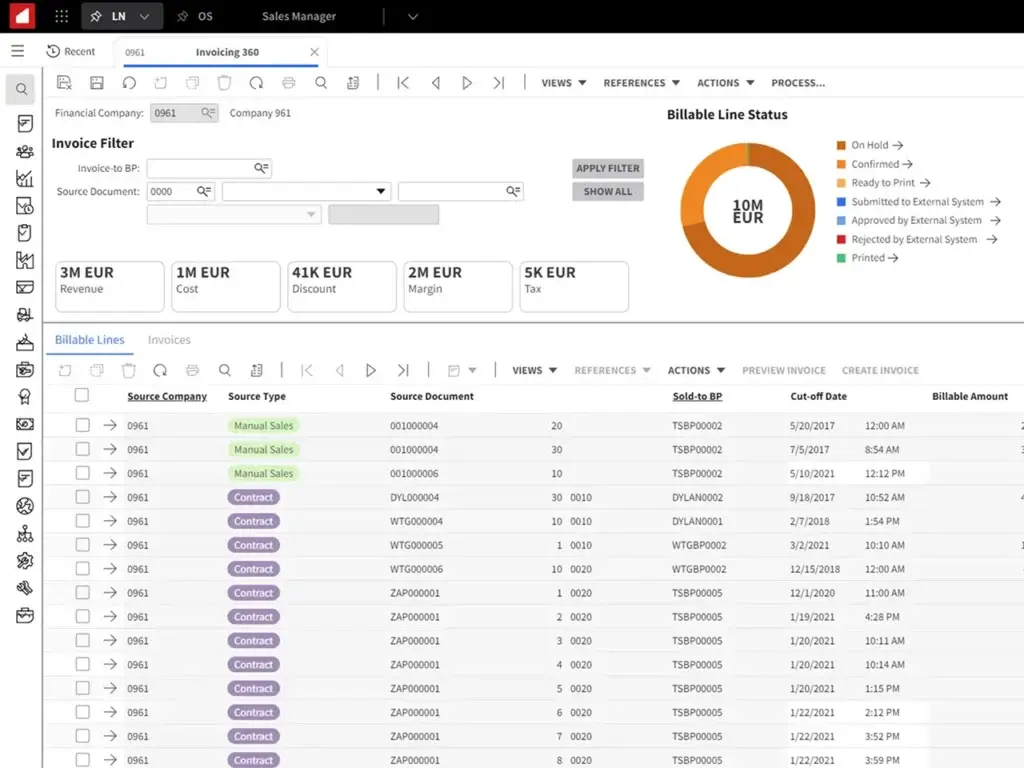
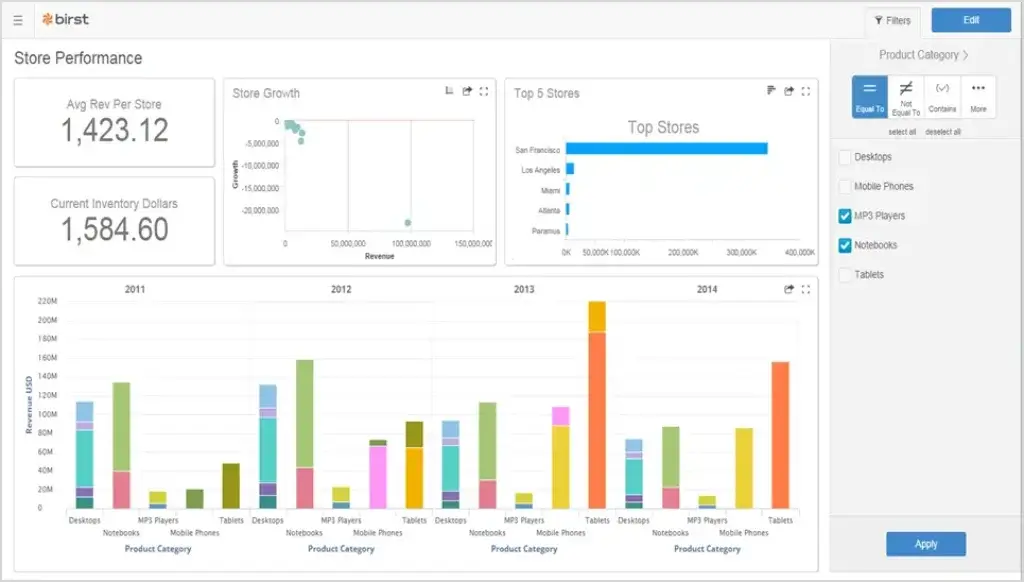
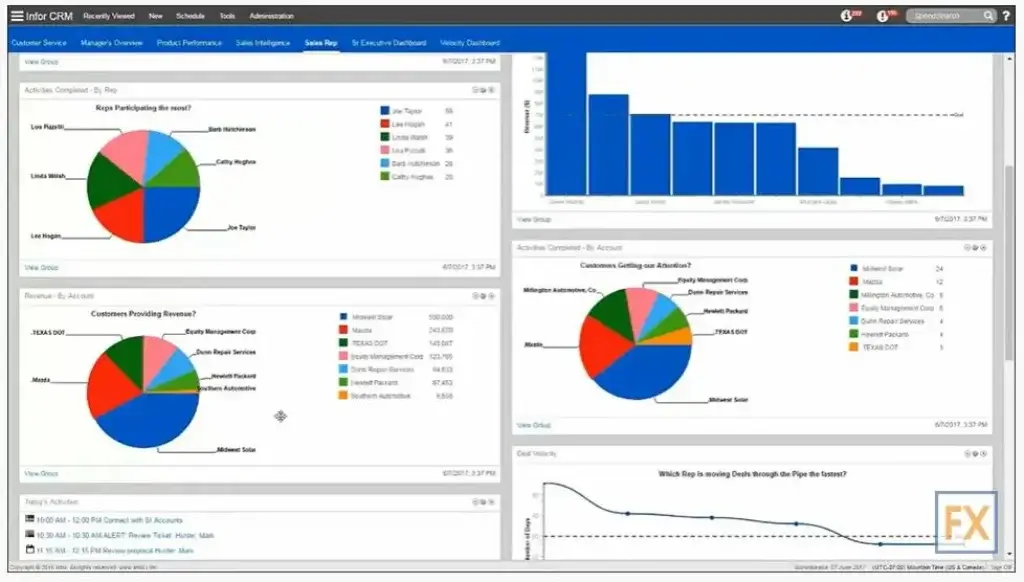
Reporting, Dashboards, and Analytics
Infor supports reporting and analytics through its broader platform, including data, insights, dashboards, and business intelligence capabilities. Infor Data Lake helps centralize data from Infor applications and other systems so companies can analyze performance across business functions.
For ERP buyers, this is important because operational data is only useful if teams can act on it. Finance leaders, operations managers, warehouse supervisors, and executives need visibility into exceptions, trends, costs, productivity, and service levels.
Automation and AI Features
Infor has invested heavily in industry-specific AI and automation. Its AI capabilities are designed to support practical business use cases such as prediction, anomaly detection, workflow assistance, productivity improvements, and decision support.
Infor’s AI approach is most valuable when it is applied to real operational processes. For example, manufacturers may use AI to analyze production or service data, while distributors may use automation to improve warehouse productivity or product attribution.
Integration and Infor OS
Infor OS is the technology foundation behind many Infor cloud capabilities. It includes tools for integration, data, analytics, automation, security, user experience, and extensibility.
Infor ION helps connect Infor and third-party applications, while Infor Data Lake supports centralized data storage and analysis. This matters for companies that need ERP to connect with ecommerce, CRM, supply chain systems, warehouse tools, financial platforms, or industry-specific applications.
Platform Structure
Infor CloudSuite Modules and Applications
Infor CloudSuite is not one single ERP product. It is a family of industry cloud ERP suites designed for specific industries and operating models.
Before buying Infor, you need to understand which CloudSuite fits your business. The right choice depends on your industry, company size, manufacturing model, distribution complexity, compliance needs, and implementation goals.
Infor CloudSuite Industrial
Infor CloudSuite Industrial is designed for small and mid-sized industrial manufacturers. It supports manufacturing, inventory, purchasing, customer orders, production, service, and operational management.
This is a strong option for manufacturers that need ERP depth but do not want unnecessary enterprise complexity. It is especially relevant for job-focused, configure-to-order, service-oriented, and mixed-mode manufacturing environments.
Infor CloudSuite Industrial Enterprise
Infor CloudSuite Industrial Enterprise is designed for larger and more complex manufacturers. It is often associated with Infor LN-based capabilities and supports global manufacturing, complex operations, multi-site environments, supply chain workflows, and advanced production requirements.
This is a better fit when your manufacturing operation requires deeper planning, stronger global control, complex product structures, or multi-entity coordination.
Infor CloudSuite Distribution
Infor CloudSuite Distribution is built for wholesale distributors. It supports order management, inventory, purchasing, warehouse operations, financials, customer relationships, supplier management, and branch-level distribution workflows.
It is especially useful for distributors that need more than basic inventory software. If pricing complexity, warehouse productivity, supplier performance, and fulfillment speed are major priorities, this CloudSuite is highly relevant.
Infor CloudSuite Food and Beverage
Infor CloudSuite Food and Beverage is designed for companies that manage recipes, batches, quality, shelf life, regulatory requirements, product development, production, traceability, and recalls.
This industry fit is important because food and beverage ERP requires more than standard manufacturing functionality. Compliance, lot tracking, quality control, and demand variability can create operational pressure that generic ERP tools may not handle well without customization.
Infor CloudSuite Healthcare
Infor CloudSuite Healthcare supports healthcare organizations with finance, supply chain, workforce, procurement, and operational management capabilities.
Healthcare buyers often need strong compliance, cost control, supplier visibility, and workforce-related workflows. Infor’s healthcare positioning makes it relevant for hospitals, health systems, and healthcare service organizations.
Infor CloudSuite Fashion
Infor CloudSuite Fashion is designed for apparel, footwear, accessories, and fashion businesses. It can support product lifecycle, sourcing, demand, inventory, production, distribution, and customer-related workflows.
This can be useful for brands that manage seasonality, product variations, styles, sizes, colors, supplier networks, and complex order cycles.
Infor ERP Module Comparison
The table below summarizes the major Infor CloudSuite options and where they fit best.
| Infor CloudSuite | Best For | Main Capabilities |
| CloudSuite Industrial | Small and mid-sized manufacturers | Manufacturing, inventory, purchasing, orders, service, operations |
| CloudSuite Industrial Enterprise | Complex and global manufacturers | Advanced manufacturing, multi-site operations, supply chain, production planning |
| CloudSuite Distribution | Wholesale and industrial distributors | Order management, purchasing, warehouse, inventory, financials, supplier management |
| CloudSuite Food and Beverage | Food, beverage, and process manufacturers | Batch, recipe, quality, compliance, traceability, recalls |
| CloudSuite Healthcare | Healthcare organizations | Finance, supply chain, workforce, procurement, healthcare operations |
| CloudSuite Fashion | Fashion and apparel companies | Product lifecycle, sourcing, inventory, demand, distribution |
Pros and Cons
Benefits and Limitations of Infor
Positive
✅ Industry-specific ERP
✅ Strong manufacturing depth
✅ Distribution capabilities
✅ Cloud and AI focus
Negative
❌ Quote-based pricing
❌ Implementation complexity
❌ Learning curve
❌ Partner-dependent setup
Strengths & Benefits
Infor has several important advantages, especially for companies that need ERP functionality built around industry requirements rather than generic back-office processes.
- Industry depth – Strong fit for manufacturing, distribution, healthcare, fashion, and food sectors.
- Manufacturing strength – Supports complex production, planning, quality, and operational workflows.
- Distribution focus – Useful for wholesale, warehouse, purchasing, and branch operations.
- Cloud platform – Built around modern cloud deployment, integration, analytics, and automation.
- AI capabilities – Applies AI to industry workflows, productivity, and decision support.
Limitations & Drawbacks
Infor is powerful, but it is not the easiest ERP system to evaluate or deploy. Buyers should understand the implementation effort before committing.
- Pricing transparency – Public pricing is limited, so most buyers need a custom quote.
- Implementation effort – ERP rollout usually requires partner support and careful planning.
- Learning curve – Advanced industry workflows require training and process discipline.
- Complex product structure – Choosing the right CloudSuite can require expert guidance.
- Customization risk – Poor scoping can increase cost, timeline, and long-term maintenance.
My opinion is that Infor is one of the strongest ERP options for companies with serious manufacturing, distribution, and industry-specific operational needs. However, it is not the right ERP for companies that simply want a lightweight finance and inventory system.
Operational Fit
Infor User Experience, Support, and Security
The user experience with Infor depends heavily on which CloudSuite you use, how well it is configured, and how complex your operations are. A well-implemented Infor environment can give teams strong operational visibility, but the system requires proper training and ownership.
Ease of Use
Infor is not designed as a simple plug-and-play ERP. It is built for companies that need operational depth. That means the interface, workflows, reporting, and configuration need to reflect how your teams actually work.
Users in finance, manufacturing, warehouse, purchasing, and operations may all interact with the system differently. Adoption improves when workflows are role-based and when users are trained around their daily processes.
Implementation Experience
Infor implementation can be moderate to complex depending on your industry, CloudSuite, data quality, integrations, workflows, and customization requirements.
A typical implementation may include process discovery, solution design, data migration, system configuration, role permissions, integrations, reporting, testing, training, and phased rollout. For larger companies, this is a strategic ERP project rather than a simple SaaS setup.
Customer Support and Partner Network
Infor works with implementation partners, consultants, and system integrators that support CloudSuite deployments. The quality of your partner can have a major impact on the project outcome.
When evaluating Infor, you should assess the partner as carefully as the software. Ask whether they have experience in your industry, your CloudSuite, your company size, and your specific operational model.
Security and Compliance
Infor’s cloud environment is designed for enterprise use, with role-based access, governance, security controls, integration management, and cloud infrastructure considerations.
However, ERP security still depends on configuration. You need to define user permissions, approval workflows, data access rules, integration controls, audit requirements, and compliance processes during implementation.
AI Governance Considerations
Infor’s AI capabilities can help companies improve productivity, automate work, detect exceptions, and support better decisions. Still, AI should be governed carefully when it touches financial, operational, customer, supplier, or employee data.
Before enabling AI-driven workflows, define what data AI can access, which users can use AI features, how outputs are reviewed, and how sensitive business information is protected.
Pricing
Infor Pricing & Plans
Infor pricing is typically quote-based. The final cost depends on the CloudSuite selected, the number of users, the modules, the industry requirements, the deployment scope, integrations, data migration, customization, training, support, and implementation partner.
This means you should evaluate Infor based on the total cost of ownership, not only software subscription cost. ERP license fees are only one part of the investment.
Quote-Based Pricing
Infor does not publish a simple universal pricing table for all CloudSuite ERP products. Most buyers need to speak with Infor or an authorized partner to receive pricing based on their requirements.
This is common for enterprise ERP systems because the implementation scope can vary significantly. A distributor with a few warehouses will not have the same requirements as a global manufacturer with multiple plants, entities, currencies, and compliance needs.
Implementation Costs
Implementation can become a major part of the total budget. You may need consulting, configuration, workflow design, integrations, data migration, testing, user training, project management, and post-go-live support.
The more complex your processes are, the more important scoping becomes. Over-customization can increase implementation cost and make future upgrades harder.
Ongoing Costs
Ongoing costs may include subscriptions, support, additional users, premium modules, integrations, analytics, partner services, training, and optimization work.
You should also budget for internal ownership. ERP success requires business users who understand the system, maintain data quality, manage process changes, and continuously improve workflows.
Pricing Table
The table below summarizes how Infor pricing is typically evaluated.
| Cost Area | Infor Pricing Approach | What to Consider |
| Software subscription | Custom quote | Depends on CloudSuite, users, modules, and contract terms |
| Implementation | Partner or services quote | Includes configuration, data migration, workflows, integrations, and testing |
| Training | Varies by project | Role-based training is important for adoption |
| Integrations | Depends on scope | Costs vary by third-party systems, APIs, and process complexity |
| Customization | Depends on requirements | Should be controlled carefully to avoid long-term complexity |
| Ongoing support | Varies by agreement | May include partner support, managed services, and optimization |
For most companies, the safest pricing approach is to define your required workflows first. Then request a quote based on the specific CloudSuite, user roles, integrations, reporting needs, and implementation phases you actually need.
Infor can deliver strong value, but only when the scope is realistic. Buying too much functionality at the beginning can make the project slower, more expensive, and harder for users to adopt.
Use Cases
Who Should Use Infor?
Infor is best for companies that need an ERP system with industry-specific capabilities and are prepared to invest in a structured implementation. It is especially relevant for businesses where operations are complex and ERP must support more than finance.
Manufacturing Companies
Infor is a strong fit for manufacturers that need production planning, shop floor visibility, inventory control, quality management, traceability, procurement, service, and costing.
It is particularly relevant if your manufacturing model includes engineer-to-order, configure-to-order, mixed-mode, process manufacturing, or multi-site production.
Distribution Companies
Infor is also a strong option for distributors that need warehouse management, inventory visibility, purchasing, order management, customer service, supplier control, and financial management.
If your distribution business manages complex pricing, high order volume, multiple warehouses, branch operations, or supplier variability, Infor may offer more relevant functionality than a general ERP tool.
Food and Beverage Businesses
Food and beverage companies can benefit from Infor’s industry-specific workflows around recipes, batches, quality, traceability, shelf life, compliance, recalls, and production planning.
This is a strong use case because food and beverage ERP often requires controls that are not available in lightweight ERP systems without significant customization.
Healthcare Organizations
Infor can support healthcare organizations that need finance, supply chain, procurement, workforce, and operational visibility. Healthcare buyers often need strong governance, cost control, and compliance-aware processes.
Infor is most relevant for healthcare organizations that want an enterprise platform rather than isolated tools for finance, HR, and procurement.
Fashion and Apparel Companies
Infor can support fashion and apparel businesses that need product lifecycle management, sourcing, inventory, demand planning, supplier coordination, and distribution workflows.
This is useful when your business manages styles, seasons, sizes, colors, product variants, and fast-changing demand patterns.
When Infor Might Not Be Right
Infor may not be the best fit if your company is small, has simple accounting needs, or wants a low-cost ERP that can be implemented with minimal consulting.
It may also be less appealing if your team wants transparent public pricing, a very simple user experience, or a broad ecosystem with easier access to freelancers and consultants compared with larger ERP platforms such as Microsoft Dynamics 365, NetSuite, or SAP.
User Feedback
Infor Customer Reviews
User feedback for Infor is generally strongest around industry functionality, manufacturing depth, distribution capabilities, operational control, and the ability to support complex business processes.
What Users Like Most
Positive feedback often focuses on Infor’s fit for industry-specific operations. Users in manufacturing and distribution tend to value its ability to manage production, inventory, purchasing, orders, warehouse workflows, and business processes in one platform.
Users also appreciate that Infor can support complex operational requirements that may be difficult to manage in lighter ERP systems.
Common Complaints
Common complaints usually focus on learning curve, implementation complexity, interface expectations, support variability, and the need for specialized expertise.
These issues are not unusual in enterprise ERP. However, they are important because they show that Infor is not a simple software purchase. It requires careful planning, training, and a strong implementation team.
My Take on the Review Pattern
The review pattern suggests that Infor performs best when buyers choose it for the right reason. It is strongest when industry fit matters more than simplicity.
If you need a lightweight ERP, Infor may feel too heavy. If you need manufacturing, distribution, supply chain, or industry-specific operational depth, Infor can be a highly capable ERP platform.
Competitors
Competitor Alternatives to Infor
Infor competes with ERP systems such as SAP S/4HANA Cloud, Oracle Fusion Cloud ERP, Microsoft Dynamics 365, NetSuite, Epicor, Acumatica, Sage X3, SYSPRO, and Odoo.
The best alternative depends on your industry, company size, budget, implementation resources, reporting needs, and preferred software ecosystem.
| Feature Type | Infor | SAP S/4HANA Cloud | Microsoft Dynamics 365 | NetSuite |
| Core angle | Industry-specific cloud ERP suites | Enterprise ERP for complex global operations | Microsoft-based ERP and CRM ecosystem | Unified cloud ERP suite |
| Best for | Manufacturing, distribution, healthcare, food, fashion | Large global enterprises | Microsoft-first SMBs, mid-market, and enterprises | Growing companies needing cloud financials and operations |
| Pricing style | Quote-based | Quote-based | Published app pricing plus implementation | Quote-based |
| Implementation complexity | Moderate to high | High | Moderate to high | Moderate to high |
| Industry depth | Very strong | Very strong | Strong, depending on apps and partners | Strong for many mid-market use cases |
| Overall fit | Best for industry-specific operations | Best for large enterprise standardization | Best for Microsoft ecosystem alignment | Best for cloud ERP standardization |
Compared with SAP S/4HANA Cloud, Infor may feel more industry-focused and practical for certain manufacturing, distribution, and healthcare use cases. SAP is often stronger for very large enterprises that need global standardization and broad enterprise process coverage.
Compared with Microsoft Dynamics 365, Infor is usually more appealing when industry-specific operational depth is the main priority. Dynamics 365 is stronger when Microsoft ecosystem alignment, Power BI, Microsoft 365, and Power Platform are major buying factors.
Compared with NetSuite, Infor is often stronger for complex manufacturing and distribution environments. NetSuite may be more attractive for companies that want a unified cloud ERP suite with broader mid-market recognition.
Compared with Epicor, Infor competes closely in manufacturing and distribution. Epicor can be attractive for manufacturers that want a focused industry ERP, while Infor may offer broader CloudSuite coverage across more industries.
Best Practices
Getting Started with Infor
Getting started with Infor requires a structured ERP selection and implementation process. The platform can be powerful, but the value depends on choosing the right CloudSuite, defining the right scope, and working with the right implementation team.
Start with Industry Requirements
Before evaluating features, map your industry requirements. A manufacturer, distributor, healthcare organization, and fashion brand will not need the same ERP workflows.
Define what you need for finance, inventory, procurement, production, warehouse operations, quality, compliance, reporting, customer management, and integrations.
Choose the Right Infor CloudSuite
The most important early decision is selecting the correct CloudSuite. For example, a mid-sized manufacturer may evaluate CloudSuite Industrial, while a wholesale distributor may evaluate CloudSuite Distribution.
Choosing the wrong product can create unnecessary complexity. Choosing the right one can give you a better starting point with more relevant workflows.
Evaluate Implementation Partners Carefully
Infor implementation quality depends heavily on the partner or services team. Look for a partner with proven experience in your industry, CloudSuite, company size, and operational model.
Ask about project methodology, timeline, data migration, integrations, customization strategy, training, reporting, support, and references from similar customers.
Plan Data Migration Early
ERP data migration is often more difficult than expected. You should clean customer records, supplier records, item masters, bills of material, inventory balances, financial data, open orders, and historical records before migration.
Bad data can weaken trust in the new ERP system. If users do not trust the data, they may return to spreadsheets and manual workarounds.
Control Customization
Infor can support complex workflows, but customization should be controlled carefully. Every customization should have a clear business reason and long-term maintenance plan.
Where possible, use standard industry workflows first. Customize only when the requirement is truly important to your competitive advantage or compliance needs.
Roll Out in Phases
A phased rollout is often safer than launching every module and workflow at once. Many companies start with core finance and operations, then add warehouse, manufacturing, analytics, AI, or advanced workflows later.
This approach reduces risk, improves adoption, and gives your team time to adjust before expanding the system.
Conclusion
Final Thoughts
Infor is a strong ERP choice for companies that need industry-specific functionality, especially in manufacturing, distribution, food and beverage, healthcare, fashion, and other operationally complex sectors.
Its biggest strengths are industry CloudSuites, manufacturing depth, distribution capabilities, supply chain functionality, integration through Infor OS, analytics, and AI-driven innovation. It is particularly valuable when your company needs ERP workflows that reflect how your industry actually operates.
Infor is not the simplest ERP system. Pricing is quote-based, implementation can be complex, and success often depends on the quality of your partner, data, process design, and internal ownership.
Overall, Infor is easy to recommend for mid-sized and enterprise companies that need deep industry ERP capabilities and are ready to invest in proper implementation. If your business wants a lightweight accounting system, it may be too much. If you need a serious ERP platform for complex operations, Infor deserves a place on your shortlist in 2026.
Frequently Asked Questions
Have more questions?
What is Infor?
Infor is a cloud enterprise software company that provides industry-specific ERP, supply chain, financial management, warehouse, manufacturing, analytics, AI, and business applications. Its main ERP offering is Infor CloudSuite, a group of cloud ERP suites built for specific industries.
Is Infor an ERP system?
Yes. Infor offers ERP systems through its CloudSuite product family. Infor CloudSuite supports finance, supply chain, manufacturing, distribution, inventory, warehouse operations, procurement, reporting, and industry-specific workflows.
Who is Infor best for?
Infor is best for mid-sized, upper mid-market, and enterprise companies that need industry-specific ERP functionality. It is especially strong for manufacturing, distribution, food and beverage, healthcare, fashion, industrial equipment, and other complex operational environments.
How much does Infor cost?
Infor pricing is usually quote-based. The final cost depends on the CloudSuite selected, number of users, modules, implementation scope, integrations, customization, support, and partner services. Buyers should evaluate total cost of ownership rather than only software subscription pricing.
What is Infor CloudSuite?
Infor CloudSuite is a family of industry-specific cloud ERP suites. Examples include CloudSuite Industrial, CloudSuite Industrial Enterprise, CloudSuite Distribution, CloudSuite Food and Beverage, CloudSuite Healthcare, and CloudSuite Fashion.
Does Infor support manufacturing?
Yes. Manufacturing is one of Infor’s strongest areas. Infor supports discrete, process, mixed-mode, engineer-to-order, configure-to-order, make-to-order, make-to-stock, and project-based manufacturing workflows depending on the selected CloudSuite.
Does Infor support distribution companies?
Yes. Infor CloudSuite Distribution is built for wholesale and industrial distributors. It supports purchasing, order management, inventory, warehouse operations, financials, customer management, supplier management, and distribution-specific workflows.
Is Infor easy to use?
Infor can be easy to use when it is configured well and users are trained by role. However, it has a learning curve because it is built for complex industry operations. Implementation quality, workflow design, and training have a major impact on usability.
What are the best Infor alternatives?
The best Infor alternatives include SAP S/4HANA Cloud, Oracle Fusion Cloud ERP, Microsoft Dynamics 365, NetSuite, Epicor, Acumatica, Sage X3, SYSPRO, and Odoo. The right choice depends on your industry, company size, budget, and implementation needs.
Is Infor worth it?
Infor is worth considering if your company needs deep industry-specific ERP capabilities, especially for manufacturing, distribution, food and beverage, healthcare, or fashion. It may be too complex for small teams that only need basic accounting, inventory, or lightweight business management software.