Introduction
Choosing the best RMM software is no longer just about remote access or basic device monitoring. Your IT team needs a platform that helps you monitor endpoints, automate patching, reduce ticket volume, secure devices, and support users across offices, remote locations, and hybrid environments.
Remote Monitoring and Management (RMM) software gives you centralized control over laptops, desktops, servers, network devices, and other IT assets. The right platform helps your team move from reactive troubleshooting to proactive IT operations.
In this guide, we compare the top RMM tools for 2026, including NinjaOne, Datto RMM, Atera, N-able N-sight, ConnectWise RMM, Freshservice, monday service, and ManageEngine RMM Central. Some are RMM-first tools, while others are broader ITSM or IT operations platforms with strong monitoring, asset management, automation, and service management capabilities.
That distinction matters. If you need endpoint-level monitoring, patching, scripting, and remote support, you should focus on RMM-first tools. If you need service desk workflows, ITIL processes, change management, and enterprise operations, an ITSM-first platform may be the better fit.
What Is RMM Software?
Remote Monitoring and Management software helps IT teams remotely monitor, manage, secure, and maintain IT endpoints and infrastructure. It is commonly used by internal IT teams, managed service providers, and distributed organizations that need real-time visibility across many devices.
With RMM software, you can detect device health issues, monitor system performance, deploy patches, run scripts, access endpoints remotely, generate reports, and automate routine maintenance tasks from one central console.
Key Benefits of RMM Software for IT Teams
- Proactive monitoring: Detect endpoint, server, and network issues before they affect users.
- Automated patching: Reduce security risk by keeping operating systems and applications updated.
- Remote support: Troubleshoot devices without requiring physical access.
- IT automation: Standardize repetitive tasks such as maintenance, remediation, and software deployment.
- Asset visibility: Track devices, configurations, software, and ownership in one place.
- Security support: Improve endpoint hygiene through patching, monitoring, alerts, and reporting.
- Operational efficiency: Help your IT team support more users and devices without adding unnecessary manual work.
RMM vs ITSM vs PSA: What Is the Difference?
RMM, ITSM, and PSA tools often overlap, but they are not the same.
RMM software focuses on monitoring and managing endpoints, networks, servers, and devices. It is typically used for patching, alerts, remote access, scripting, and endpoint maintenance.
ITSM software focuses on IT service delivery. It usually includes incident management, service requests, change management, problem management, knowledge bases, and service portals. You can learn more in our guide on what ITSM is.
PSA software is more common among MSPs. It helps manage tickets, contracts, billing, projects, time tracking, and service operations.
For many IT teams, the strongest setup combines RMM for endpoint operations and ITSM for service management. If your main priority is broader IT service delivery, you can also compare platforms in our guide to the best ITSM software.
Best RMM Software Compared
The table below gives you a quick overview of the top RMM tools and where each platform fits best. Use it to narrow your shortlist before reading the detailed reviews.
| Software | Best For | Platform Type | Main Strength |
| NinjaOne | Best overall RMM software | RMM-first | Endpoint management, patching, automation, and remote access |
| Datto RMM | MSPs and scalable endpoint management | RMM-first | Secure cloud-based monitoring and management |
| Atera | Small IT teams and MSPs | RMM and PSA | All-in-one IT management with technician-based pricing |
| N-able N-sight | MSPs needing RMM, ticketing, and security | RMM-first | Endpoint management with built-in remote support |
| ConnectWise RMM | ConnectWise ecosystem users | RMM-first | Automated patching and MSP workflow alignment |
| Freshservice | ITSM-first teams with asset visibility | ITSM-first | ITIL workflows, ITAM, CMDB, and service management |
| monday service | Visual IT service workflows | ITSM-first | No-code customization, service requests, and automation |
Top RMM Software
In-Depth Reviews for IT Teams
Below, you will find a deeper look at each RMM platform. The reviews focus on practical IT management value, including endpoint visibility, automation, patch management, remote support, integrations, and ideal use cases.
NinjaOne
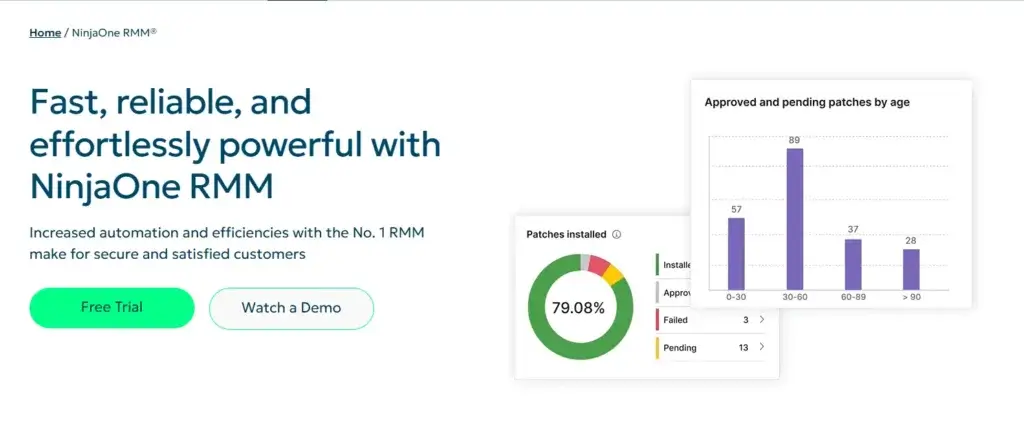
NinjaOne is the strongest overall choice if you want a modern RMM platform that balances power, usability, and fast implementation. It is built for IT teams and MSPs that need endpoint monitoring, patch management, remote access, automation, backup, documentation, and ticketing in one cloud-native environment.
What makes NinjaOne stand out is how effectively it reduces operational friction. Many RMM tools are powerful but difficult to navigate. NinjaOne keeps the experience clean and fast, which matters when your technicians need to move quickly from alert to device context to remediation.
Top Benefits and Features
- Unified endpoint management: Manage Windows, Mac, Linux, servers, virtual machines, and network devices from one console.
- Automated patch management: Automate patch identification, approval, deployment, and reporting across distributed endpoints.
- Remote access: Support users and troubleshoot devices securely without needing to be on-site.
- Automation and scripting: Use built-in scripts or create your own PowerShell, Batch, and Shell scripts.
- Endpoint security support: Strengthen endpoint hygiene through visibility, patching, alerts, and security integrations.
- Ticketing and documentation: Give technicians device context, activity history, and documentation in the same workflow.
- Fast onboarding: A clean interface helps new technicians become productive quickly.
Why Choose NinjaOne?
Choose NinjaOne if you want the best RMM software for centralized endpoint management, automation, and remote support without unnecessary complexity. It is especially strong for IT teams that want to standardize device management while keeping the platform easy enough for daily technician use.
It is also a strong fit if your team is trying to reduce tool sprawl. Instead of separating monitoring, patching, remote support, documentation, backup, and ticketing across multiple systems, NinjaOne brings these workflows closer together.
Who Is NinjaOne Best For?
NinjaOne is best for internal IT teams, MSPs, and growing businesses that need a scalable RMM platform with strong endpoint visibility, automation, patching, and remote troubleshooting.
Datto RMM

Datto RMM is a secure, cloud-based RMM platform designed to help IT teams and MSPs remotely monitor, manage, and secure endpoints. It is a strong option if you manage many clients, locations, or device groups and need a mature RMM system that can scale with your operational model.
Top Benefits and Features
- Cloud-based RMM: Manage endpoints remotely without maintaining on-premise RMM infrastructure.
- Endpoint monitoring: Track device health, performance, alerts, and availability.
- Patch management: Automate patching and reduce manual update work.
- Remote support: Troubleshoot endpoints without requiring physical access.
- Multi-tenant management: Useful for MSPs managing multiple customer environments.
- Reporting: Show clients and internal leaders how endpoint health and IT operations are performing.
Why Choose Datto RMM?
Choose Datto RMM if you are an MSP or IT organization that needs a proven RMM platform with strong multi-tenant endpoint management. It is especially relevant if you already operate inside the Kaseya or Datto ecosystem.
Who Is Datto RMM Best For?
Datto RMM is best for MSPs, IT service providers, and larger IT teams that need scalable remote monitoring, endpoint control, automated patching, and security-focused device management.
Atera

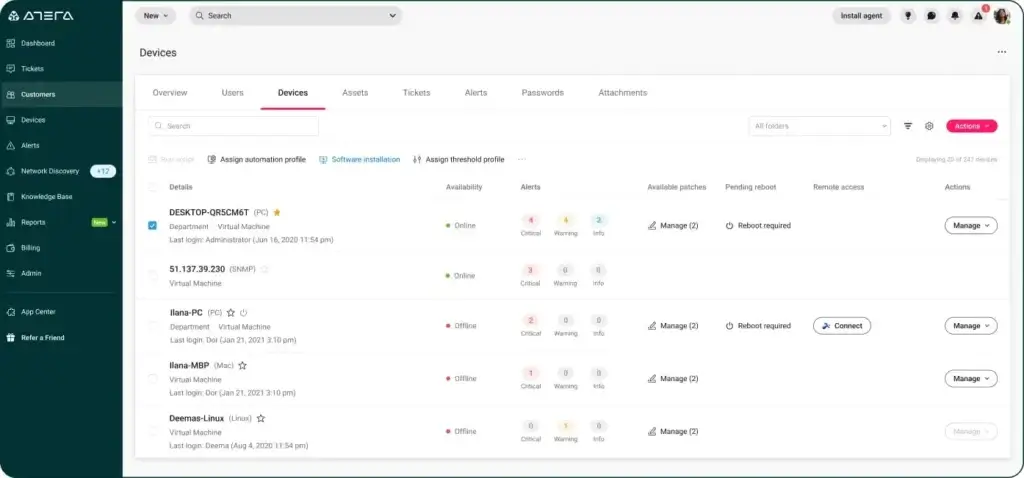
Atera is a strong choice if you want RMM, PSA, ticketing, patching, remote support, and automation in one platform. It is especially appealing for smaller IT teams and MSPs because it is designed around simplicity, fast implementation, and technician-based pricing.
While enterprise RMM tools can feel heavy, Atera keeps the experience more accessible. You can monitor endpoints, receive alerts, automate patching, manage tickets, and support users remotely without building a complex IT operations stack.
Top Benefits and Features
- RMM and PSA in one platform: Combine monitoring, ticketing, billing, automation, and support workflows.
- Patch management: Automate patch schedules and maintain devices across supported operating systems.
- Remote access: Troubleshoot user devices quickly from a centralized interface.
- AI capabilities: Use AI-supported workflows to reduce manual IT work and speed up service delivery.
- Real-time alerts: Monitor endpoint issues and respond before they escalate.
- Technician-based pricing: Useful for teams that manage many endpoints with a smaller number of technicians.
Why Choose Atera?
Choose Atera if you need a practical RMM and PSA combination without the complexity of larger MSP platforms. It is one of the better fits for smaller teams that want to control costs while still getting monitoring, patching, support, automation, and ticketing in one place.
Who Is Atera Best For?
Atera is best for small IT teams, MSPs, and lean service providers that need affordable RMM functionality with built-in operational tools.
N-able N-sight

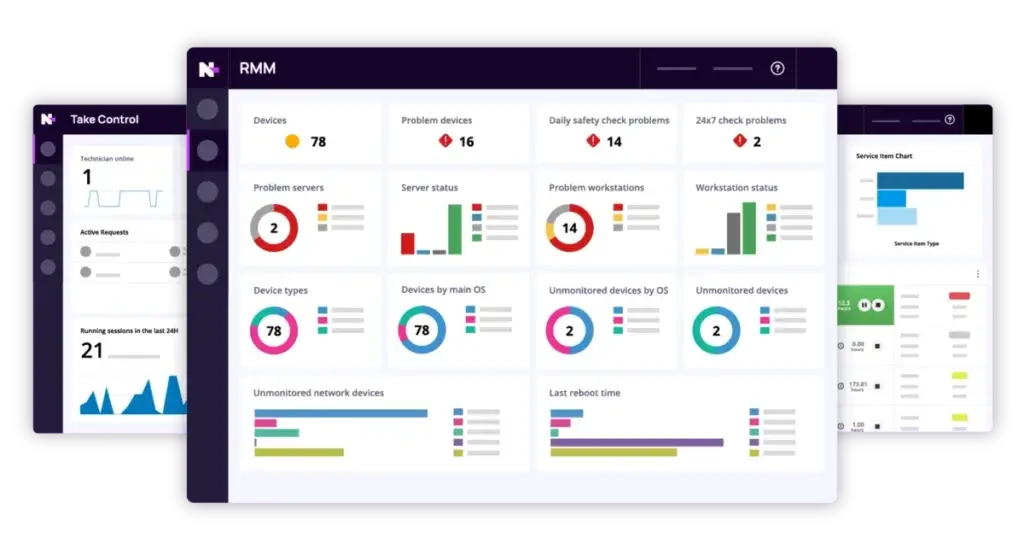
N-able N-sight is a strong RMM option for MSPs and IT teams that want endpoint management, remote support, ticketing, patch management, security capabilities, and billing support in one platform.
Its biggest advantage is that it combines core RMM functionality with operational tools that MSPs often need. This makes it useful for teams that want to manage devices, users, and endpoint resilience without stitching together too many separate systems.
Top Benefits and Features
- Unified endpoint management: Manage and secure endpoints from a centralized platform.
- Remote support: Resolve endpoint issues through built-in remote access capabilities.
- Patch management: Maintain workstations and servers with automated or controlled patching.
- Ticketing and billing: Support service operations beyond endpoint monitoring.
- Security tools: Strengthen endpoint resilience with monitoring, vulnerability, and security-focused features.
- Apple management: Useful for environments that include macOS devices.
Why Choose N-able N-sight?
Choose N-able N-sight if you want a practical RMM solution with stronger MSP operations coverage than basic endpoint monitoring tools. It is particularly useful if your team needs to combine technical endpoint management with ticketing, billing, and support workflows.
Who Is N-able N-sight Best For?
N-able N-sight is best for MSPs and IT teams that want endpoint management, patching, security features, remote support, and service operations in one platform.
ConnectWise RMM

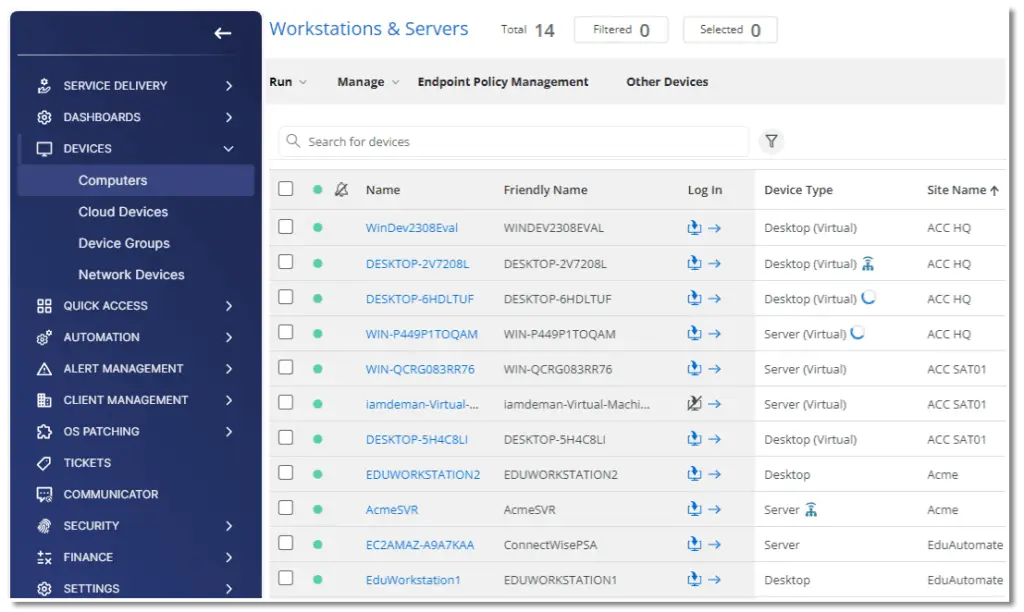
ConnectWise RMM is a strong option for MSPs and IT teams already using ConnectWise products. It focuses on automated patching, endpoint visibility, monitoring, remote management, and service provider workflows.
The key advantage is ecosystem alignment. If your team already uses ConnectWise for PSA, service desk, or business operations, ConnectWise RMM can fit more naturally into your existing processes than a standalone RMM platform.
Top Benefits and Features
- Automated patching: Reduce manual patch work and support more consistent endpoint security.
- Endpoint monitoring: Maintain real-time visibility across managed environments.
- Remote management: Support devices and resolve issues from a central interface.
- Compliance reporting: Help document patch status and security-related activity.
- MSP alignment: Works well for service providers that already rely on the ConnectWise ecosystem.
Why Choose ConnectWise RMM?
Choose ConnectWise RMM if your IT operations already depend on ConnectWise tools and you want RMM capabilities that align with that ecosystem. It may be less appealing for teams that want a lighter, simpler standalone RMM, but it is strong for MSPs with established ConnectWise processes.
Who Is ConnectWise RMM Best For?
ConnectWise RMM is best for MSPs and IT teams that already use ConnectWise products and want automated patching, monitoring, and remote endpoint management inside a familiar ecosystem.
Freshservice

Freshservice should not be treated as a classic RMM-first tool. It is better described as an ITSM-first platform with strong IT asset management, CMDB, workflow automation, IT operations visibility, and service management capabilities.
This makes Freshservice a better fit when your priority is not only endpoint monitoring, but also service desk maturity. If you need incident management, change management, problem management, service requests, employee self-service, and asset context, Freshservice is one of the strongest options in this list.
Top Benefits and Features
- ITIL-aligned ITSM: Manage incidents, problems, changes, releases, and service requests.
- IT asset management: Track hardware, software, cloud tools, contracts, and lifecycle details.
- CMDB: Map assets, dependencies, and change risks in a centralized system of record.
- Workflow automation: Automate approvals, routing, escalations, and asset processes.
- AI-powered service management: Use Freddy AI to assist agents and improve self-service.
- Reporting and analytics: Track service performance, SLA health, and operational trends.
- Marketplace integrations: Connect Freshservice with collaboration, monitoring, and productivity tools.
Why Choose Freshservice?
Choose Freshservice if your IT environment needs structured service management more than pure endpoint operations. It is especially useful when RMM requirements overlap with asset lifecycle visibility, CMDB accuracy, service desk automation, and ITIL-based workflows.
Who Is Freshservice Best For?
Freshservice is best for growing and enterprise IT teams that need ITSM, ITAM, workflow automation, CMDB, and employee service management in one platform.
monday service

monday service is another ITSM-first option rather than a pure RMM platform. Its strength is not deep endpoint control. Its strength is helping IT and service teams build visual, flexible, automated workflows for requests, tickets, assets, approvals, and service operations.
If your team finds traditional ITSM tools too rigid, monday service can be a strong alternative. It gives you customizable boards, automations, dashboards, forms, AI-supported workflows, and integrations in a familiar interface.
Top Benefits and Features
- Visual service workflows: Manage IT requests, tickets, approvals, and service processes with customizable boards.
- No-code automation: Automate assignments, status changes, notifications, and escalations.
- AI service operations: Use AI agents and workflow context to speed up request handling.
- Service portal: Centralize employee requests and support intake.
- Asset workflows: Track assets, ownership, status, and related service activity.
- Integrations: Connect with tools such as Slack, Microsoft Teams, Jira, and other business systems.
Why Choose monday service?
Choose monday service if your team needs an adaptable IT service platform that is easy for non-technical users to understand. It is especially useful for teams that want fast adoption, visual dashboards, and workflow customization without heavy ITSM configuration.
Who Is monday service Best For?
monday service is best for IT teams that want visual service management, flexible workflows, asset tracking, and request automation, but do not need a deep RMM-first endpoint management platform.
| Feature Type | NinjaOne | Datto RMM | Atera | N-able N-sight | Freshservice |
| Primary Fit | Best overall RMM | MSP endpoint management | RMM and PSA for smaller teams | Unified endpoint management | ITSM and ITAM |
| Platform Type | RMM-first | RMM-first | RMM and PSA | RMM-first | ITSM-first |
| Endpoint Monitoring | Excellent | Excellent | Good | Good | Moderate |
| Patch Management | Excellent | Excellent | Good | Good | Available through ITAM and integrations |
| Remote Access | Excellent | Good | Good | Good | Limited |
| Automation | Advanced | Advanced | Good | Good | Advanced ITSM workflows |
| ITIL Alignment | Moderate | Moderate | Limited | Limited | Excellent |
| Best Buyer | Internal IT and MSPs | MSPs | Small IT teams and MSPs | MSPs and IT providers | Growing and enterprise IT teams |
How to Choose the Best RMM Software
The best RMM software depends on your IT environment, team structure, and operational priorities. A tool that works well for a 10-person MSP may not be the right fit for a global enterprise IT department.
Start With Your Core Use Case
If your main challenge is endpoint health, patching, remote access, and device automation, choose an RMM-first platform such as NinjaOne, Datto RMM, Atera, N-able N-sight, or ConnectWise RMM.
If your main challenge is ticketing, ITIL workflows, service requests, asset lifecycle management, and change management, choose an ITSM-first platform such as Freshservice, monday service, or ServiceNow.
Evaluate Endpoint Coverage
Your RMM platform should support the devices you actually manage. Before choosing a tool, confirm coverage for Windows, macOS, Linux, servers, virtual machines, network devices, and mobile devices where relevant.
Prioritize Patch Management
Patch management is one of the most important RMM capabilities because it directly affects security, compliance, and operational stability. Look for automated patch policies, approval controls, reporting, third-party application patching, and rollback visibility.
Review Automation Depth
Strong RMM automation should help your team standardize repetitive work. This includes scripts, remediation workflows, software deployment, device maintenance, alert-based actions, and scheduled tasks.
Check Remote Support Capabilities
Remote access is essential for hybrid and distributed businesses. Look for secure sessions, technician permissions, user consent options, session logging, multi-factor authentication, and support for unattended access where appropriate.
Consider Integrations
Your RMM should connect with the tools your team already uses. Common integrations include PSA systems, service desks, endpoint protection tools, documentation platforms, identity providers, Slack, Microsoft Teams, and reporting tools.
Compare Pricing Models
RMM pricing can be based on endpoints, technicians, modules, or custom enterprise agreements. Endpoint-based pricing may work well for smaller device fleets, while technician-based pricing can be appealing if a small team manages many endpoints.
Best RMM Software by Use Case
| Use Case | Recommended Tool | Why It Fits |
| Best overall RMM software | NinjaOne | Strong mix of endpoint management, patching, automation, usability, and remote access |
| Best RMM for MSPs | Datto RMM | Cloud-based, scalable, and built for managing client environments |
| Best RMM and PSA combination | Atera | Combines monitoring, ticketing, patching, automation, and support |
| Best for unified endpoint management | N-able N-sight | Combines RMM, remote support, patching, security, ticketing, and billing |
| Best for ConnectWise users | ConnectWise RMM | Fits naturally into the ConnectWise ecosystem |
| Best ITSM-first alternative | Freshservice | Strong ITIL workflows, ITAM, CMDB, automation, and employee service management |
| Best for visual IT workflows | monday service | Flexible, visual, easy to adopt, and strong for no-code service workflows |
Conclusion
The best RMM software for most IT teams is NinjaOne. It offers the strongest overall balance of endpoint management, automated patching, remote support, automation, usability, and scalability.
If you are an MSP managing multiple clients, Datto RMM, Atera, N-able N-sight, and ConnectWise RMM are also strong options. Datto RMM is a mature cloud-based choice, Atera is attractive for smaller teams that want RMM and PSA together, N-able N-sight offers unified endpoint and service operations, and ConnectWise RMM is a logical fit if you already use the ConnectWise ecosystem.
If your priority is broader IT service management rather than pure endpoint monitoring, Freshservice and monday service deserve a closer look. Freshservice is better for ITIL-aligned service management and asset visibility, monday service is better for flexible visual workflows, and NinjaOne is better for large-scale IT operations.
Before choosing, define what matters most for your team: endpoint coverage, patch management, remote access, automation, ITSM maturity, pricing model, and integration needs. The right RMM platform should not only help you fix devices faster, but it should also help your IT team operate with more control, consistency, and strategic visibility.
FAQ
What is RMM software?
RMM software stands for Remote Monitoring and Management software. It helps IT teams remotely monitor, manage, patch, secure, and support endpoints, servers, and IT infrastructure from a centralized platform.
What is the best RMM software for IT teams?
NinjaOne is the best overall RMM software for many IT teams because it combines endpoint management, patch management, remote access, automation, and usability in one cloud-native platform.
What is the best RMM software for MSPs?
Datto RMM, NinjaOne, Atera, N-able N-sight, and ConnectWise RMM are strong options for MSPs. The best choice depends on your client count, endpoint volume, PSA needs, automation requirements, and existing tool stack.
What does RMM software do?
RMM software monitors endpoint health, sends alerts, deploys patches, runs scripts, supports remote access, tracks assets, and helps IT teams resolve issues before they affect users or business operations.
What is the difference between RMM and ITSM?
RMM focuses on monitoring and managing endpoints, devices, and infrastructure. ITSM focuses on IT service delivery, including incidents, requests, changes, problems, knowledge management, and service portals.
What is the difference between RMM and PSA?
RMM helps manage technical endpoint operations, while PSA helps manage service business operations such as ticketing, time tracking, billing, contracts, projects, and client management. MSPs often use both together.
Does RMM software include patch management?
Most leading RMM platforms include patch management or integrate with patching tools. Strong patch management should support automation, approval workflows, scheduling, reporting, and visibility across managed endpoints.
Can RMM software improve cybersecurity?
Yes. RMM software can improve cybersecurity by helping IT teams patch vulnerabilities, monitor endpoint health, detect suspicious activity, maintain audit logs, and enforce consistent device management policies.
How much does RMM software cost?
RMM software pricing varies by vendor. Some platforms charge per endpoint, some charge per technician, and others use custom pricing based on modules, users, or managed devices. Always compare total cost, not only starting price.
Is cloud-based RMM better than on-premise RMM?
Cloud-based RMM is usually easier to deploy, access, and scale, especially for distributed IT teams. On-premise RMM may still suit organizations with strict internal hosting or regulatory requirements.