Introduction
Choosing the best AEO tools is becoming just as important as choosing the right SEO platform. Search behavior is changing fast, and your audience is no longer relying only on traditional search results. They are asking ChatGPT, Gemini, Perplexity, Google AI Overviews, Copilot, Claude, and other answer engines for direct recommendations.
That creates a new challenge for marketers. Ranking on Google still matters, but it is no longer the only visibility layer you need to monitor. You also need to understand whether AI engines mention your brand, cite your website, recommend your competitors, summarize your positioning correctly, and use trusted sources that support your category authority.
This is where AEO software becomes valuable. The best answer engine optimization tools help you track AI visibility, analyze prompts, monitor citations, compare competitors, improve content coverage, and turn AI search data into practical marketing actions.
In this guide, you will compare eight leading AEO tools: HubSpot AEO / AEO Grader, Semrush AI Visibility Toolkit, Ahrefs Brand Radar, Profound, Otterly.AI, Peec AI, SE Ranking AEO / AEO Vision, and Frase. Some are built mainly for AI visibility monitoring, while others combine AEO with traditional SEO, content optimization, and reporting workflows.
How to Evaluate the Best AEO Tools
Before choosing an AEO platform, it helps to understand what actually matters. AEO is still a young software category, and many tools use similar language. The real difference is how well each platform helps you move from AI visibility data to better marketing decisions.
AI engine coverage
The best AEO tools should track the answer engines that matter to your audience. At minimum, look for support across ChatGPT, Gemini, Perplexity, and Google AI Overviews. More advanced tools may also cover Copilot, Claude, Grok, AI Mode, DeepSeek, and Meta AI.
Prompt tracking and prompt discovery
Prompt tracking shows how your brand appears for specific buyer questions. Stronger platforms also help you discover new prompts based on topics, competitors, and high-intent search behavior. This is especially useful for SaaS, affiliate, and comparison websites because users often ask AI tools for recommendations before visiting a website.
Brand mentions, citations, and share of voice
AEO is not only about whether your website is cited. You also need to know whether your brand is mentioned, how often competitors appear, which sources AI engines trust, and whether the answer frames your brand positively, negatively, or neutrally.
Competitor benchmarking
Good AEO tools show where competitors are winning. Great AEO tools explain why. You should be able to compare brand visibility, cited URLs, prompt coverage, sentiment, and topic gaps so you can identify what to improve.
Content optimization workflow
Some tools only monitor visibility. Others help you act on the data by improving content briefs, adding missing topics, creating answer-first sections, strengthening FAQs, and improving topical authority. For content-heavy websites, this can be the difference between interesting data and useful execution.
Pricing and scalability
AEO pricing varies widely. Some tools are affordable for smaller teams, while others are designed for enterprise brands. Your ideal choice depends on how many prompts, domains, competitors, regions, and AI engines you need to track.
Best AEO Tools
The tools below are ranked based on practical value for AI visibility, prompt tracking, competitor analysis, content optimization, usability, and fit for marketing teams. The list includes both dedicated AEO platforms and broader SEO tools that now include AI search visibility features.
HubSpot AEO / AEO Grader

Features & Benefits
HubSpot AEO earns the top position because it makes AEO accessible to a much broader group of marketers. While some AI visibility platforms are built mainly for advanced SEO teams or enterprise brands, HubSpot packages AEO in a way that is easy to understand, test, and connect to broader inbound marketing workflows.
The important thing to understand is that HubSpot AEO and HubSpot AEO Grader are related, but not exactly the same. AEO Grader is a free diagnostic tool. It gives you a snapshot of how your brand appears in AI-generated answers. HubSpot AEO is the ongoing monitoring product that helps you track prompts, competitors, citations, visibility changes, and recommendations over time.
This makes HubSpot especially useful if you are new to answer engine optimization. You can start with the AEO Grader to understand your current AI presence, then move into HubSpot AEO if you want continuous monitoring.
HubSpot’s biggest strength is clarity. It does not try to overwhelm you with every possible data point. Instead, it focuses on questions most marketers care about: does AI recognize your brand, how often do you appear, how do competitors compare, which prompts matter, and what should you improve next?
For companies already using HubSpot, the value becomes stronger. AEO can sit closer to your CRM, content, campaign, and inbound marketing workflows, which makes it easier to turn visibility insights into action.
Pricing & Plans
HubSpot AEO Grader is free and works as a one-time diagnostic. HubSpot AEO is a paid tool, with current public positioning around a monthly plan and a free trial. This makes it one of the more accessible ways to start monitoring AI visibility without immediately committing to an enterprise platform.
Pros & Cons
Pros
- Free AEO Grader for quick diagnostics
- Clear difference between snapshot and ongoing monitoring
- Good fit for HubSpot users and inbound teams
- Simple way to start tracking AI search visibility
Cons
- Less advanced than enterprise-only AEO platforms
- Best value is stronger for HubSpot users
- May not replace deeper SEO research tools
Semrush

Features & Benefits
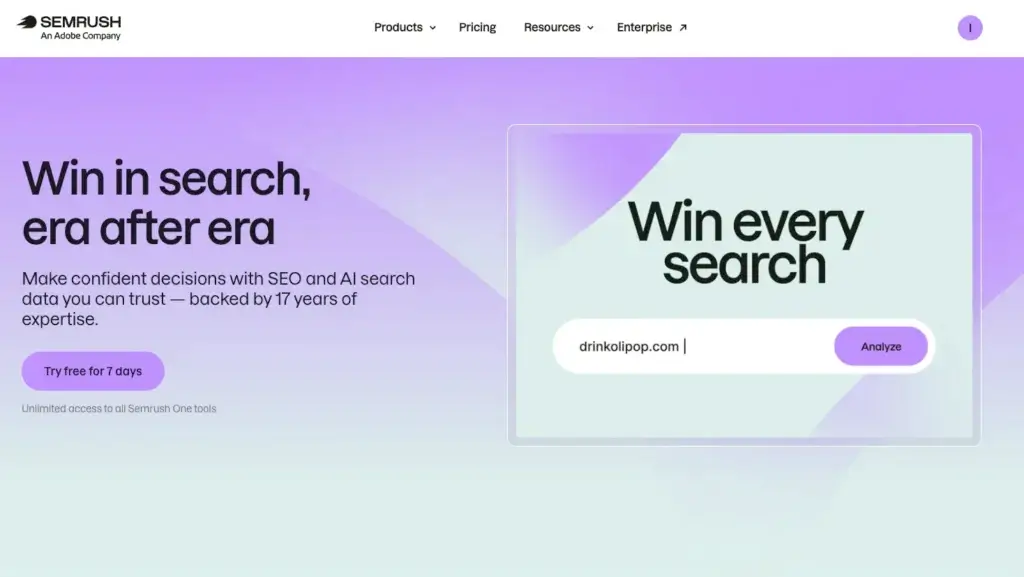
Semrush One is one of the strongest choices if you already see AEO as part of a complete search strategy, not a separate marketing experiment. It brings together traditional SEO tools and AI visibility features, helping you understand how your brand performs across both classic search engines and AI-generated answer experiences.
This matters because answer engine optimization does not work in isolation. AI search visibility is still influenced by crawlable content, technical SEO, trusted third-party mentions, topical authority, backlinks, brand consistency, and the way your company is described across the web. Semrush One is well positioned for this because many teams already use Semrush for keyword research, competitor analysis, site audits, backlink tracking, content planning, and reporting.
The AI visibility layer inside Semrush One helps marketers move beyond rankings and traffic. You can analyze where your brand appears in AI-generated answers, how often competitors appear instead, which prompts matter, which sources are being cited, and where your content or technical setup may be limiting visibility.
For SEO teams, this is especially useful because it connects AEO insights with the metrics they already report on. Instead of treating AI search visibility as a standalone dashboard, Semrush One lets you evaluate it alongside rankings, organic traffic, backlinks, site health, content performance, and competitive visibility.
For agencies, Semrush One also makes the AEO conversation easier to explain to clients. You can show how traditional SEO and AI discovery now overlap, where a client is losing visibility to competitors, and what actions can improve discoverability across both Google and AI answer engines.
Semrush One is not the lightest option in this list. If you only need basic prompt tracking, a focused tool like Otterly.AI or Peec AI may feel simpler. But if you want AEO, SEO, competitive research, technical audits, and content workflows connected in one platform, Semrush One is one of the most practical choices.
Pricing & Plans
Semrush One is positioned as Semrush’s unified SEO and AI visibility solution, with plans starting at $199 per month. Pricing can vary depending on the plan, usage needs, add-ons, and whether your team also needs broader Semrush toolkits for traffic, market analysis, content, or enterprise-level visibility management.
Pros & Cons
Pros
- Strong fit for existing SEO teams
- Combines SEO and AI visibility
- Tracks prompts, mentions, competitors, and citations
- Useful for agencies and client reporting
Cons
- More expensive than lightweight AEO trackers
- Can be more platform than small teams need
- Learning curve may be higher for beginners
Ahrefs Brand Radar
Features & Benefits
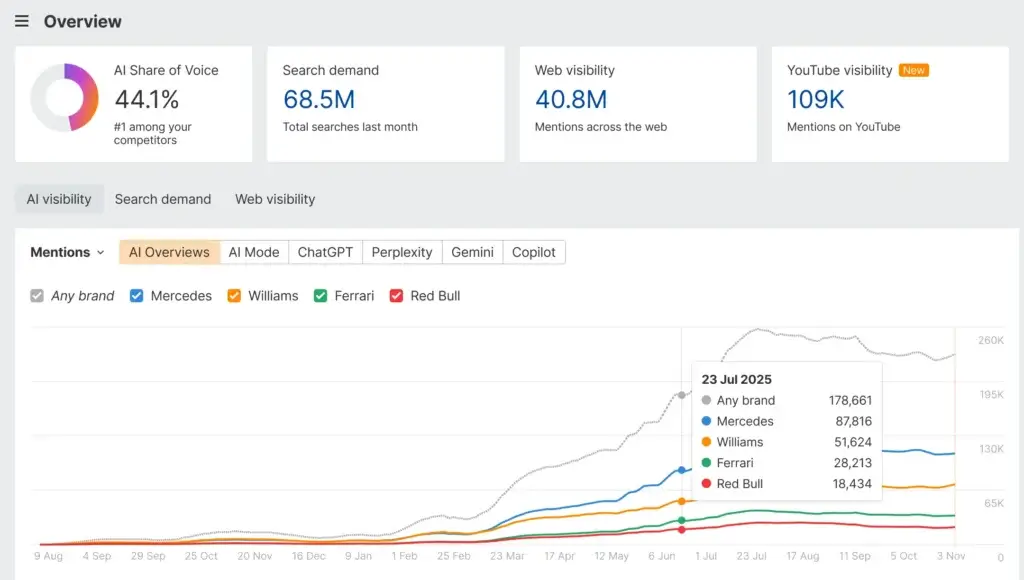
Ahrefs Brand Radar is one of the most interesting AEO tools because it approaches AI visibility from a research-first perspective. Instead of only letting you manually track a small set of prompts, Ahrefs emphasizes large-scale discovery across search-backed prompts and AI answer surfaces.
This is especially valuable for comparison websites, affiliate publishers, SaaS review sites, and content teams that care about buyer-intent prompts. Users often ask AI engines questions like “best project management software for agencies,” “top CRM for small businesses,” or “best email marketing platform for ecommerce.” Those are exactly the kinds of prompts where brand visibility can influence software discovery.
Brand Radar helps you understand which brands, products, regions, topics, and competitors appear across AI-generated answers. Because Ahrefs already has a strong SEO dataset, Brand Radar can be especially useful when you want to connect AI visibility with backlinks, organic rankings, content gaps, and competitor authority.
Ahrefs is not only an AEO platform. It is still one of the most powerful SEO suites available. That makes Brand Radar a better fit for teams that want AI visibility research alongside traditional SEO analysis, rather than a narrow monitoring-only tool.
For a content-driven business, this is one of the best tools in the category. It can help you discover where brands are already winning in AI search and where your content can be improved to earn more citations and mentions.
Pricing & Plans
Ahrefs pricing depends on the plan and add-ons you choose. Brand Radar is part of Ahrefs’ newer AI visibility workflow, so you should check current plan availability before choosing it specifically for AEO.
Pros & Cons
Pros
- Excellent for competitive AI visibility research
- Strong search-backed prompt intelligence
- Useful for SaaS, affiliate, and review websites
- Connects AEO with SEO and backlink data
Cons
- May be more research-focused than workflow-focused
- Pricing depends on Ahrefs plan access
- Not the simplest tool for beginners
Profound

Features & Benefits
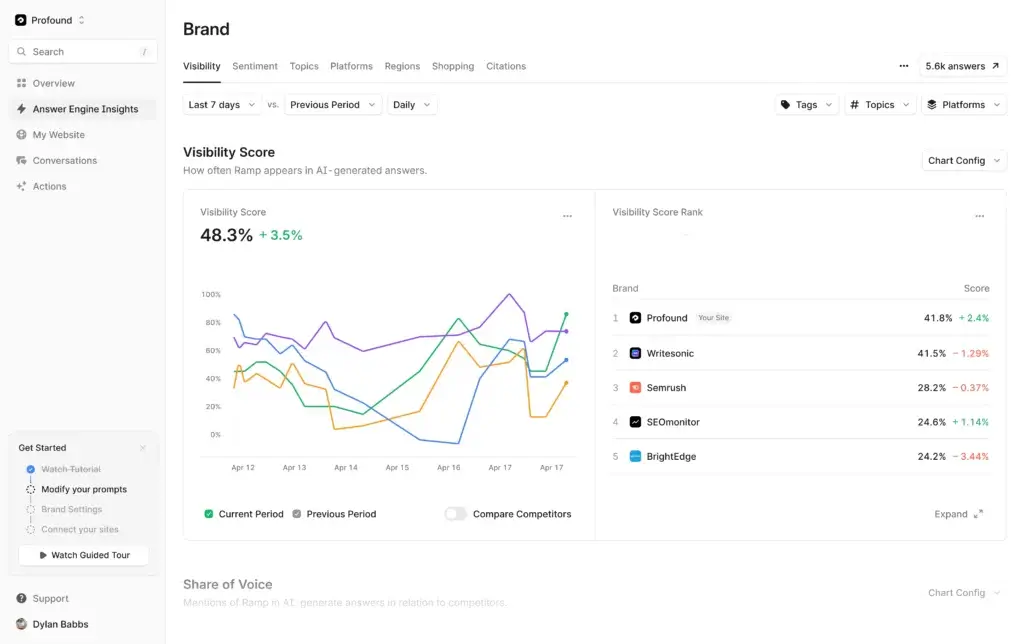
Profound is one of the most advanced dedicated AEO platforms on the market. It is built for companies that want to understand and improve how their brand appears across AI-generated answers, not just monitor a few prompts manually.
The platform focuses on visibility across major answer engines and AI search surfaces, including tools such as ChatGPT, Perplexity, Claude, Gemini, Copilot, Grok, Meta AI, DeepSeek, and Google AI Overviews. That broad coverage is one of the reasons Profound is especially attractive to enterprise brands.
Profound is strongest when AEO has become a strategic channel. If your leadership team wants to know whether your brand is recommended, how your competitors are framed, which sources influence AI answers, and where your company is losing share of voice, Profound is built for that level of analysis.
It can also be useful for brand monitoring, reputation tracking, and strategic content planning. AI engines do not always describe brands the way companies describe themselves. A tool like Profound helps you identify those gaps before they affect buyer perception at scale.
The downside is that Profound may be more than smaller teams need. It is not the cheapest or simplest option, and its best fit is usually larger brands, enterprise SaaS companies, and agencies serving high-value clients.
Pricing & Plans
Profound generally operates as an enterprise-oriented platform, so pricing is typically handled through demos or custom conversations. It is best evaluated when AI visibility is already a meaningful strategic priority.
Pros & Cons
Pros
- Built specifically for enterprise AI visibility
- Broad answer engine coverage
- Strong for share of voice and brand perception
- Useful for executive-level AEO reporting
Cons
- Likely too advanced for small teams
- Pricing is less transparent than lower-cost tools
- Less focused on traditional SEO workflows
Otterly.AI

Features & Benefits
Otterly.AI is one of the easiest AEO tools to understand. It is built around a clear workflow: define prompts, track AI-generated answers, monitor brand mentions, analyze citations, and compare your visibility against competitors.
This makes it a strong fit for smaller marketing teams, consultants, agencies, and businesses testing AEO for the first time. You do not need a full enterprise platform to start learning whether AI search engines mention your brand or cite your website. Otterly gives you a practical way to build that baseline.
The platform tracks visibility across important AI search surfaces such as ChatGPT, Perplexity, Google AI Overviews, AI Mode, and other supported engines depending on plan and configuration. It can show which prompts trigger your brand, which competitors appear, and which sources AI engines use in their responses.
Otterly is also useful for recurring monitoring. AI answers can change often, especially as models update, web sources change, and competitors publish new content. A lightweight tracker helps you watch those changes without manually checking prompts every week.
Compared with Profound or Semrush, Otterly is more focused and easier to adopt. It is not a full SEO suite, and it may not provide the same enterprise reporting depth, but it offers a strong balance of usability and affordability.
Pricing & Plans
Otterly.AI offers tiered pricing based on prompt volume and feature access. Entry-level pricing is accessible compared with enterprise AEO tools, while higher plans support larger prompt libraries and more advanced monitoring.
Pros & Cons
Pros
- Simple AI search monitoring workflow
- Good for prompt tracking and citations
- More affordable than enterprise platforms
- Useful for agencies and smaller teams
Cons
- Prompt limits can matter on lower plans
- Not a complete SEO platform
- Less advanced for enterprise analytics
Peec AI
Features & Benefits
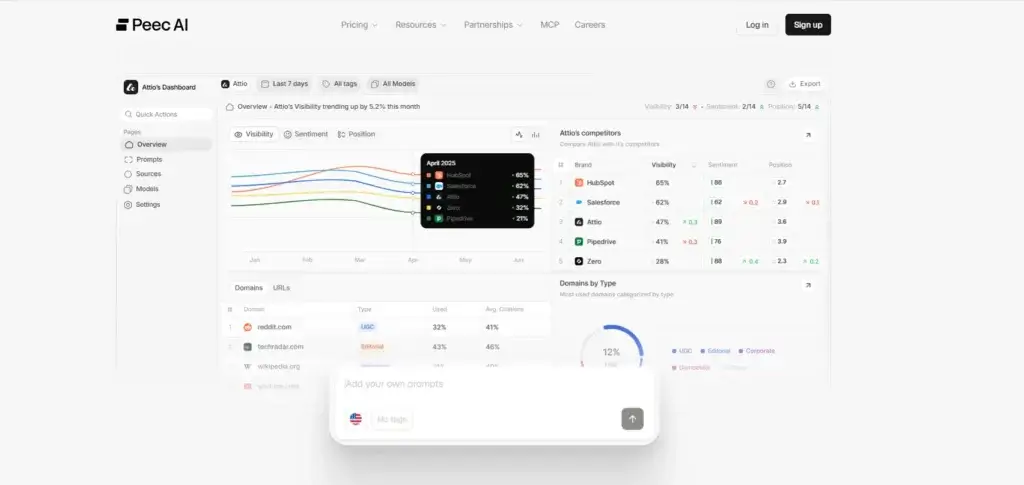
Peec AI is a focused AI search analytics platform designed for marketing teams. Its main value is helping you see how your brand performs across AI answer engines such as ChatGPT, Perplexity, Gemini, and other emerging AI discovery channels.
The platform is especially useful if you want clean dashboards and straightforward visibility insights. It helps you understand where your brand appears, how competitors compare, which prompts influence visibility, and which sources are shaping AI-generated answers.
Peec AI stands out because it is built for marketers who want clarity. Some AEO tools feel technical, while others feel like traditional SEO platforms with AI features added on top. Peec AI sits in the middle. It gives you enough detail to make decisions without forcing you into a heavy SEO workflow.
This makes it a good fit for SaaS companies, B2B marketing teams, agencies, and content teams that need to monitor AI visibility but do not necessarily want a full SEO suite.
The main limitation is that Peec AI may need to be paired with other tools. If you need deep keyword research, backlink analysis, technical SEO audits, or content optimization, you may still use Ahrefs, Semrush, Screaming Frog, Frase, or another platform alongside it.
Pricing & Plans
Peec AI pricing is plan-based and may vary by usage, tracking needs, and team size. It is best evaluated based on the number of prompts, brands, competitors, regions, and AI engines you want to monitor.
Pros & Cons
Pros
- Clean AI search analytics experience
- Good for brand and competitor monitoring
- Useful for marketing teams and agencies
- Less complex than full SEO platforms
Cons
- May require separate SEO tools
- Less established than legacy SEO platforms
- Pricing depends on tracking needs
SE Ranking AEO / AEO Vision
Features & Benefits
SE Ranking is a strong option for teams that want AEO features inside a broader SEO platform. Its AI visibility tools help you track brand mentions, links, competitor visibility, prompts, and performance across AI answer engines.
The platform is especially relevant for agencies because SE Ranking already has a strong reputation for rank tracking, website audits, competitor analysis, and reporting. Adding AI visibility data to that workflow makes it easier to explain how search visibility is expanding beyond traditional rankings.
SE Ranking’s AI visibility tools can help you monitor where your brand appears in AI answers, where competitors show up, how your visibility changes over time, and which prompts create opportunities. It also includes dedicated AI Overviews tracking, which is useful if Google’s AI-generated results affect your organic traffic strategy.
Compared with Semrush and Ahrefs, SE Ranking often appeals to teams looking for a more accessible SEO platform. It may not be as deep in every dataset, but it can deliver a strong mix of usability, reporting, and value.
For agencies managing several clients, this combination matters. You can track traditional SEO performance, AI Overviews, and answer engine visibility in one reporting environment instead of stitching together several tools.
Pricing & Plans
SE Ranking pricing depends on plan, usage, and add-ons. AI visibility features may be included or available through specific packages, so it is worth checking the current plan structure before buying mainly for AEO.
Pros & Cons
Pros
- Good fit for agencies and SEO teams
- Tracks AI mentions, links, and competitors
- Includes AI Overviews and AI search workflows
- Useful reporting environment for client work
Cons
- AI features may depend on plan access
- Not as enterprise-focused as Profound
- May be less deep than Ahrefs for large-scale research
Frase
Features & Benefits
Frase is different from most tools in this list. It is not only an AI visibility tracker. Its strongest value is content optimization, research, briefs, and improving content so it is more likely to perform in both traditional search and AI-generated answers.
That makes Frase especially useful for content teams. If your AEO strategy depends on publishing better articles, improving existing content, answering buyer questions more clearly, and adding the right topical coverage, Frase can be more actionable than a monitoring-only platform.
Frase helps you research topics, analyze competing pages, build content briefs, optimize drafts, and identify missing ideas. Its current positioning also includes visibility tracking across Google and AI search engines such as ChatGPT and Perplexity, which brings it closer to the AEO and GEO software category.
For marketers, the key benefit is execution. Many AEO tools tell you where you are not visible. Frase helps you improve the content that may influence visibility. This is especially important for blogs, review sites, SaaS comparison pages, and educational content hubs.
Frase is not the best standalone choice if your main priority is enterprise AI share-of-voice reporting. But if your main need is turning AEO strategy into better pages, stronger FAQs, clearer answers, and more complete content, it is one of the most practical tools in the list.
Pricing & Plans
Frase pricing starts at an accessible monthly level compared with many enterprise AEO platforms. Plans may vary based on usage, content volume, and access to broader platform features.
Pros & Cons
Pros
- Excellent for content briefs and optimization
- Useful for answer-first content creation
- Good fit for blogs and comparison websites
- More execution-focused than monitoring-only tools
Cons
- Not primarily an enterprise AEO tracker
- May need another tool for deeper AI visibility monitoring
- Best value depends on content production volume
Comparing the Best AEO Tools
When you compare AEO platforms, the biggest difference is whether you need monitoring, research, or execution. HubSpot is the easiest starting point, Semrush and Ahrefs are strongest for SEO-led teams, Profound is the enterprise option, Otterly.AI and Peec AI are focused visibility trackers, SE Ranking works well for agencies, and Frase is strongest for content optimization.
| Tool | Best For | Main AEO Strength | AI Visibility Tracking | Content Optimization | Best Fit |
| HubSpot AEO / AEO Grader | AEO beginners and HubSpot users | Free diagnostic plus ongoing monitoring | Yes | Limited | Inbound marketing teams |
| Semrush | SEO teams and agencies | AI visibility inside a broader SEO platform | Yes | Moderate | SEO-led marketing teams |
| Ahrefs Brand Radar | Competitive research | Large-scale AI visibility and prompt research | Yes | Moderate | SEO professionals and publishers |
| Profound | Enterprise brands | Deep AI visibility and share-of-voice reporting | Yes | Limited | Enterprise marketing teams |
| Otterly.AI | Affordable monitoring | Prompt tracking, mentions, and citations | Yes | Limited | Small teams and agencies |
| Peec AI | Marketing analytics | Clean AI visibility dashboards | Yes | Limited | SaaS and B2B marketing teams |
| SE Ranking AEO / AEO Vision | Agency reporting | AI visibility plus traditional SEO workflows | Yes | Moderate | Agencies and SEO teams |
| Frase | Content optimization | Research, briefs, and answer-focused content | Some | Strong | Content teams and publishers |
How to Choose the Right AEO Tool
The right AEO software depends on what problem you are trying to solve. If you only want to know whether AI engines mention your brand, you need a visibility tracker. If you want to understand competitors and prompts at scale, you need a research platform. If you want to improve the content that AI engines may cite, you need an optimization workflow.
Choose HubSpot AEO if you want the easiest starting point
HubSpot AEO is the best first choice if you want to test AEO without overcomplicating the process. Start with the free AEO Grader, then move into ongoing monitoring if the results show meaningful opportunities.
Choose Semrush if AEO is part of your SEO strategy
Semrush is a strong choice when your team already works with keyword research, audits, backlinks, competitor analysis, and content planning. It is especially useful when you want AI visibility data to sit next to traditional SEO reporting.
Choose Ahrefs if you care about competitive research
Ahrefs Brand Radar is especially useful for discovering which brands appear across large sets of AI prompts. If you run comparison content, affiliate pages, or category pages, this kind of competitive visibility data can be extremely valuable.
Choose Profound if you need enterprise-level AI visibility
Profound is the strongest fit when AEO is a strategic priority for a larger company. It is better for executive reporting, share of voice, brand perception, and multi-engine monitoring than for lightweight content optimization.
Choose Otterly.AI or Peec AI if you want focused tracking
Otterly.AI and Peec AI are good options when you want dedicated AI visibility tracking without buying a full SEO suite. Otterly.AI feels especially practical for prompt libraries and citations, while Peec AI is strong for clean marketing analytics and competitor visibility.
Choose SE Ranking if you need agency-friendly reporting
SE Ranking is a practical option for agencies and SEO teams that want AI visibility tracking alongside rank tracking, audits, and client reporting. It may be especially helpful if your clients need education around how AI search affects organic visibility.
Choose Frase if your main goal is better content
Frase is the best fit when you already know you need to improve your pages. It helps you research, structure, and optimize content so your answers are clearer, more complete, and better aligned with both search engines and answer engines.
Recommended AEO Tool Stack by Use Case
Most teams should not think about AEO as one tool replacing everything else. In many cases, the best setup combines visibility monitoring, competitive research, and content execution.
| Use Case | Recommended Tool | Why It Fits |
| Beginner AEO audit | HubSpot AEO Grader | Free and simple way to understand current AI visibility |
| Ongoing AEO monitoring | HubSpot AEO, Otterly.AI, or Peec AI | Tracks prompts, mentions, citations, and competitors over time |
| SEO and AEO combined | Semrush or SE Ranking | Combines AI visibility with traditional SEO workflows |
| Competitive AI visibility research | Ahrefs Brand Radar | Strong for discovering where brands appear across AI prompts |
| Enterprise brand visibility | Profound | Built for deep monitoring, share of voice, and executive reporting |
| AEO content optimization | Frase | Helps improve briefs, content structure, topical coverage, and answers |
Conclusion
The best AEO tool depends on your maturity, budget, and workflow. If you are just starting, HubSpot AEO / AEO Grader is the most practical entry point because it gives you a clear way to measure AI visibility before investing heavily in the category.
If your team already manages SEO at a serious level, Semrush AI Visibility Toolkit and Ahrefs Brand Radar are stronger choices. Semrush is better when you want AEO inside an all-in-one SEO workflow, while Ahrefs is especially valuable for competitive research and large-scale AI visibility discovery.
Profound is the strongest option for enterprise brands that need deep visibility, share-of-voice reporting, and multi-engine coverage. Otterly.AI and Peec AI are better fits for teams that want focused AI search monitoring without enterprise complexity. SE Ranking is a practical agency-friendly option, especially when AI visibility needs to sit next to traditional SEO reporting.
Frase is the best choice when your biggest challenge is execution. If you need to create better content, structure stronger answers, improve topical coverage, and make your pages more useful for both people and AI engines, it can be one of the most valuable tools in your AEO stack.
For most teams, the smartest approach is to start with a visibility baseline, identify which prompts and competitors matter, then improve the content and sources that answer engines are most likely to trust. That is where AEO becomes more than a trend. It becomes a practical extension of modern search strategy.
Frequently Asked Questions
What are AEO tools?
AEO tools help you measure, monitor, and improve how your brand appears in answer engines such as ChatGPT, Gemini, Perplexity, Google AI Overviews, and other AI-powered search experiences.
What is the best AEO tool overall?
HubSpot AEO / AEO Grader is the best starting point for most marketers because it combines a free diagnostic with ongoing AI visibility monitoring. Larger SEO teams may prefer Semrush or Ahrefs, while enterprise brands may prefer Profound.
Is HubSpot AEO different from AEO Grader?
Yes. HubSpot AEO Grader is a free one-time diagnostic tool, while HubSpot AEO is the ongoing monitoring product for tracking prompts, competitors, citations, and AI visibility changes over time.
Which AEO tool is best for SEO teams?
Semrush AI Visibility Toolkit is one of the best options for SEO teams because it connects AI visibility with traditional SEO workflows such as keyword research, competitor analysis, site audits, and reporting.
Which AEO tool is best for competitor research?
Ahrefs Brand Radar is especially strong for competitor research because it helps you analyze how brands appear across large sets of AI prompts and connect those insights with broader SEO data.
Which AEO tool is best for enterprise brands?
Profound is one of the strongest choices for enterprise brands because it focuses on deep AI visibility tracking, share of voice, brand perception, and multi-engine monitoring.
Which AEO tool is best for small teams?
Otterly.AI is a strong option for smaller teams because it offers focused AI search monitoring, prompt tracking, brand mentions, and citation analysis without the complexity of a full enterprise platform.
Is Frase an AEO tool?
Frase is best described as a content optimization and SEO/GEO platform. It can support AEO by helping you research topics, create stronger briefs, optimize content, and structure pages for clearer answers.
Do AEO tools replace SEO tools?
No. AEO tools do not replace SEO tools. They add another layer of visibility tracking for AI-generated answers, while traditional SEO still matters for crawlability, authority, content quality, backlinks, and organic rankings.
What should you track in an AEO platform?
You should track brand mentions, website citations, prompt visibility, competitor appearances, sentiment, share of voice, cited sources, and visibility changes over time across the answer engines your buyers use most.