Introduction
Search is no longer limited to traditional rankings, blue links, and keyword positions. Buyers are increasingly asking AI tools for recommendations, comparisons, product shortlists, and practical advice before they ever reach a website.
That shift creates a new visibility problem for marketers. Your brand may rank well in Google, but if AI answer engines do not mention, cite, or recommend you, you may still lose influence during the early discovery stage.
HubSpot AEO is designed to help solve that problem. It gives marketing teams a way to understand how their brand appears in AI-generated answers, where competitors are being recommended instead, and what content gaps may be limiting AI visibility.
In this HubSpot AEO review, you’ll get a practical look at its main features, user experience, pricing, strengths, limitations, reviews, and alternatives. The goal is to help you decide whether HubSpot AEO is the right answer engine optimization tool for your business in 2026.
What Is HubSpot AEO?
HubSpot AEO is an answer engine optimization tool built to help brands monitor and improve how they appear in AI-generated responses. Instead of tracking only traditional search rankings, it focuses on AI visibility across answer engines such as ChatGPT, Gemini, and Perplexity.
The tool helps you see whether your brand appears in relevant AI answers, how competitors are positioned, which prompts matter to your audience, and where new or improved content may increase your chances of being cited.
In simple terms, HubSpot AEO helps answer a critical marketing question: when your buyers ask AI for recommendations in your category, does your brand show up?
Background and Evolution
HubSpot introduced AEO as part of its broader move toward AI-powered growth tools. This matters because the buyer journey is changing. Many users no longer begin research by typing a short keyword into a search engine. They ask complete questions, compare options conversationally, and expect AI to summarize the market for them.
Traditional SEO still matters, but it does not fully explain how AI models describe your brand, which sources they rely on, or whether your company appears in category-level answers. HubSpot AEO is built for this new layer of discovery.
The product is still early, but it reflects an important direction for B2B marketing. Brands now need to optimize not only for search engines, but also for answer engines, AI summaries, conversational discovery, and citation-driven visibility.
Target Users and Use Cases
HubSpot AEO is best suited for marketing teams looking to understand and improve their visibility within AI-generated answers. It is especially relevant for companies already using HubSpot Marketing Hub because the tool can work with business context such as industry, competitors, customer segments, and existing content.
- B2B marketing teams – Track visibility for buyer-intent prompts and comparison searches.
- Content teams – Identify gaps where AI engines do not cite or mention the brand.
- SEO teams – Add AI visibility tracking alongside traditional keyword reporting.
- Demand generation teams – Understand how AI discovery affects brand consideration.
- HubSpot users – Connect AEO insights with CRM and marketing workflows.
If your team is already investing in SEO, content marketing, and brand positioning, HubSpot AEO can help you add an AI visibility layer to your strategy. If you only need classic rank tracking, backlink research, or technical SEO audits, it should be used alongside other SEO tools rather than instead of them.
How Does It Work?
HubSpot AEO Key Features
HubSpot AEO is built around one main goal: helping you understand and improve how your brand appears in AI answers. The tool combines visibility scoring, prompt tracking, competitor monitoring, citation analysis, and recommendations.
Unlike a classic SEO platform, HubSpot AEO is not mainly focused on keyword positions or backlink counts. It is focused on whether answer engines recognize your brand, describe it accurately, and include it in the answers your buyers are likely to read.
AI Visibility Score
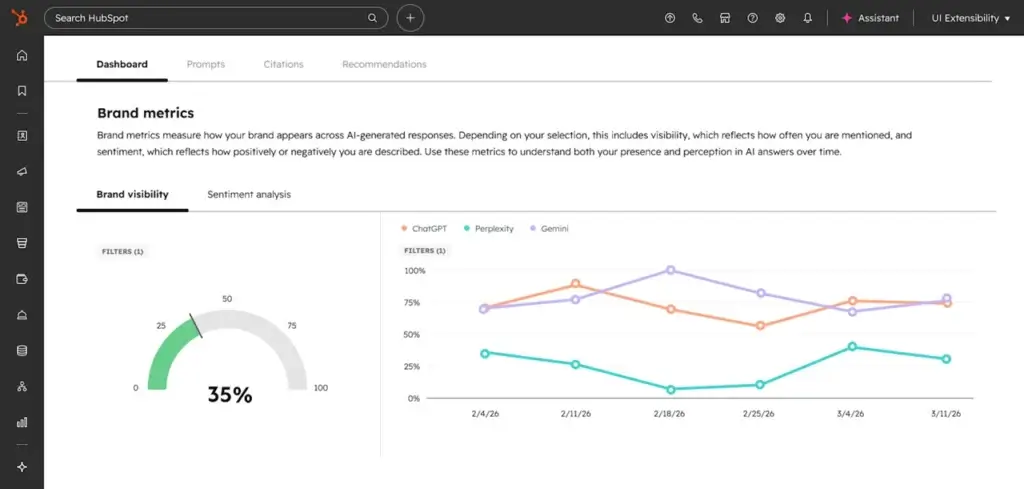
The AI visibility score gives you a high-level view of how visible your brand is inside AI-generated answers. This helps marketers move beyond manual testing, where you ask a few prompts in ChatGPT or Gemini and try to interpret the results yourself.
A score is useful because it gives teams a baseline. You can understand whether your brand is being mentioned often, whether competitors dominate the answer space, and whether your visibility improves after content updates.
However, this score should not be treated like a traditional ranking position. AI answers can change based on prompt wording, model updates, location, user context, and available sources. The score is best used as a directional signal rather than a perfect measurement.

Prompt Tracking
Prompt tracking is one of the most important HubSpot AEO features. Instead of tracking only keywords like “best CRM software” or “email marketing platform,” the tool helps you track the full questions your buyers may ask AI systems.
For example, a buyer might ask, “What are the best CRM platforms for a growing B2B sales team?” or “Which marketing automation tools are best for small businesses?” These prompts are more conversational than traditional keywords, but they can influence buying decisions just as strongly.
HubSpot AEO helps you monitor whether your brand appears in those AI answers. This gives content and SEO teams a clearer view of how AI tools present their category.
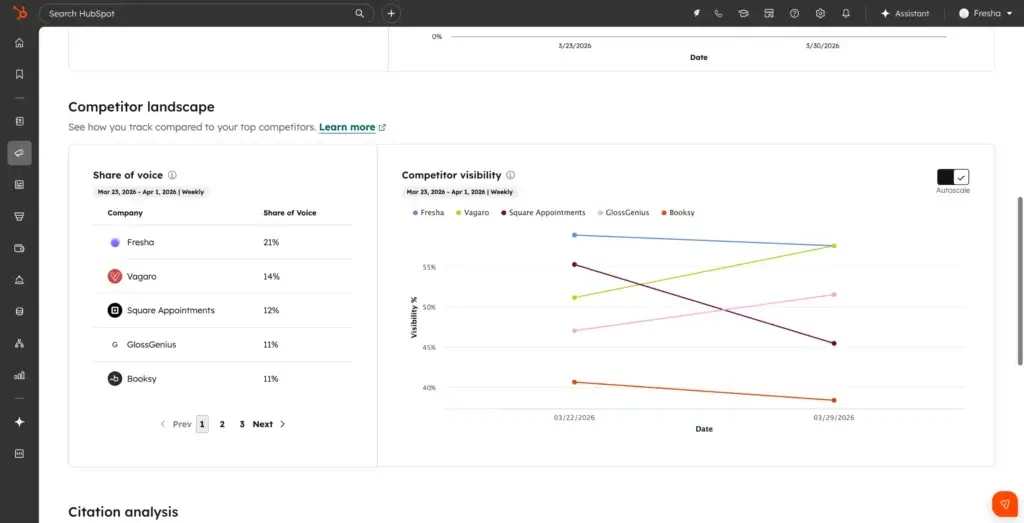
Competitor Visibility Tracking
AI visibility is competitive. It is not enough to know whether your brand appears. You also need to know which competitors appear, how often they are mentioned, and whether they are positioned more favorably.
HubSpot AEO helps teams compare brand visibility against competitors in AI-generated responses. This can support better content planning because it shows which competitors are being associated with the buyer’s questions that matter most.
If competitors are appearing in prompts where your brand is absent, that is a strong signal to review your content, third-party mentions, comparison pages, review presence, and topical authority.
Prioritized Recommendations
One of the most useful parts of HubSpot AEO is that it does not only show visibility gaps. It also provides recommendations for improving those gaps.
These recommendations may point to prompt opportunities, missing content formats, competitor gaps, or areas where your brand needs stronger coverage. For a content team, this can function like a strategic brief for AEO-focused content planning.
This is where HubSpot AEO becomes more practical than manual AI testing. Instead of simply knowing that your brand is missing from an answer, you get clearer direction on what to create or improve next.
CRM and Marketing Hub Context
HubSpot’s main advantage is business context. If you already use HubSpot Marketing Hub, AEO can work from context such as your industry, competitors, existing content, and customer segments.
This makes the tool more relevant for HubSpot users than a generic AI visibility checker. The more accurate your CRM and marketing data are, the more useful the recommendations can become.
For B2B marketers, this is important because buyer prompts are not generic. They depend on your audience, industry, use cases, pain points, and competitive environment.
Content Actions
HubSpot has also referenced Content Actions as part of the AEO workflow. These are intended to help teams move from visibility insight to content execution more quickly.
Because this functionality is tied to HubSpot’s evolving product roadmap, it should be viewed as an emerging capability rather than the main reason to buy the tool today. The stronger current value is visibility tracking, prompt monitoring, citation analysis, and prioritized recommendations.
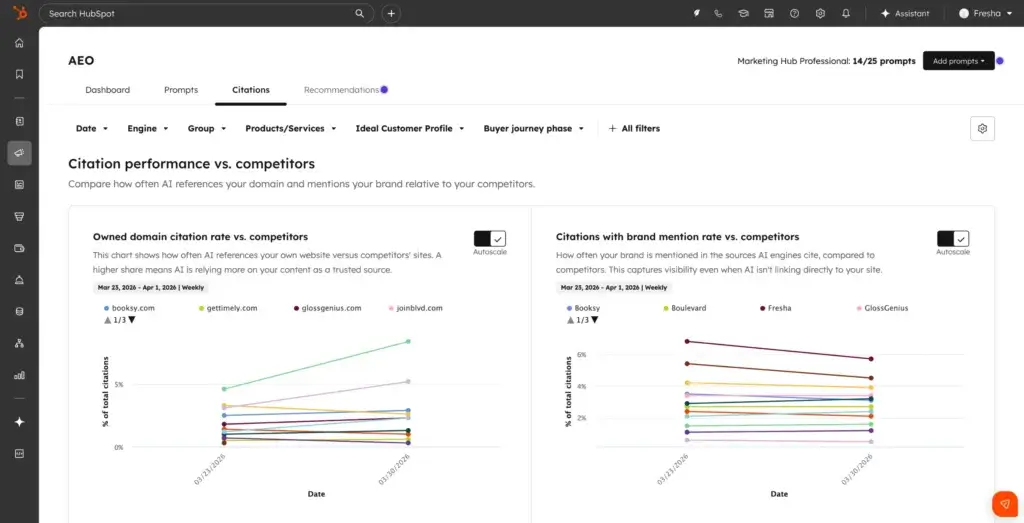
Citation Analysis
AI answer engines often rely on external sources to support their responses. These may include articles, review pages, comparison guides, documentation, forums, product pages, and trusted industry resources.
HubSpot AEO helps identify which sources are influencing AI answers and where your brand is or is not being cited. This is valuable because citation visibility can shape how AI systems understand your brand.
For content teams, citation analysis can reveal whether your existing pages are clear enough, authoritative enough, and structured well enough to be included in AI-generated answers.
Free Tool vs Paid AEO Workflow
HubSpot AEO Grader vs HubSpot AEO
One point that may confuse buyers is the difference between HubSpot AEO Grader and HubSpot AEO. They are related, but they are not the same thing.
The HubSpot AEO Grader is a free diagnostic tool that gives you a snapshot of your current AI visibility. HubSpot AEO is the broader product for ongoing tracking, optimization, and monitoring.
| Category | HubSpot AEO Grader | HubSpot AEO |
| Main Purpose | One-time AI visibility diagnostic | Ongoing AI visibility tracking and optimization |
| Best For | Initial brand assessment | Continuous AEO strategy |
| Cost | Free | Paid tool with free trial options |
| Output | Score, interpretation, and visibility snapshot | Prompt tracking, visibility score, citation analysis, and recommendations |
| Platforms | AI visibility across major answer engines | Tracking across ChatGPT, Gemini, and Perplexity |
| Best User | Marketers testing AI visibility for the first time | Teams building a repeatable AEO workflow |
When to Use the AEO Grader
Use the AEO Grader if you are new to answer engine optimization and want a quick view of how your brand appears in AI answers. It is also useful if you want to show stakeholders why AI visibility needs attention.
The Grader is a good first step because it helps translate an abstract concept into a measurable score. You can use it to identify whether your brand is visible, how AI systems describe you, and whether competitors are taking more space in your category.
When to Use HubSpot AEO
Use HubSpot AEO when you want to move beyond a one-time score and start building an ongoing AI visibility strategy. This is where prompt tracking, competitor comparison, citation monitoring, and content recommendations become more valuable.
For serious content teams, the paid tool is more useful because AI visibility changes over time. You need to monitor whether updates are working, which prompts are improving, and which competitors are gaining or losing visibility.
Pros and Cons
Benefits and Limitations of HubSpot AEO
Positive
✅ AI visibility monitoring
✅ Prompt-level insights
✅ Competitor context
✅ Content planning support
Negative
❌ Early product maturity
❌ Directional data
❌ Prompt dependency
❌ Limited advanced depth
Strengths and Benefits
HubSpot AEO’s biggest strength is accessibility. Many marketers understand that AI search matters, but they do not know where to begin. HubSpot gives teams a practical way to start measuring visibility without building a manual tracking system.
- AI visibility monitoring – Track whether your brand appears in relevant AI answers.
- Prompt-level insights – Understand the questions your buyers may ask AI tools.
- Competitor context – See where competitors appear more often than your brand.
- Content planning support – Turn visibility gaps into content ideas and updates.
The tool is especially useful for teams that already work inside HubSpot. If your CRM, campaigns, and content operations are already connected to HubSpot, AEO can become part of your broader marketing workflow rather than another disconnected analytics tool.
Another benefit is that HubSpot AEO helps teams shift from keyword-first thinking to prompt-first thinking. That is important because AI discovery is conversational. Buyers are not only searching short phrases. They are asking detailed questions and expecting summarized recommendations.
Limitations and Drawbacks
HubSpot AEO is promising, but it is not perfect. The category itself is still developing, and there is no single standard way to measure AI visibility with complete accuracy.
- Early product maturity – AEO tools are still evolving as AI search behavior changes.
- Directional data – AI responses can vary across time, prompt wording, and platform behavior.
- Prompt dependency – Poor prompt selection can lead to weak or misleading insights.
- Limited advanced depth – Enterprise teams may need deeper segmentation and reporting.
The biggest limitation is that AEO is not as stable as classic SEO reporting. A keyword rank can also fluctuate, but AI answers are even more dynamic. Your brand may appear in one response, disappear in another, and be described differently across platforms.
That does not make HubSpot AEO useless. It means the data should be interpreted carefully. You should look for patterns over time rather than treating one AI answer as a final truth.
Ease of Use and Workflow
HubSpot AEO User Experience
HubSpot AEO is designed for marketers, not technical AI researchers. That is one of its biggest advantages. The tool helps translate AI visibility into practical marketing language, including scores, prompts, competitors, citations, and recommendations.
Setup and Onboarding
The setup process is centered around your brand, audience, competitors, and relevant prompts. To get useful results, you need to define the buyer questions that matter most to your business.
This step is important. AEO is only as useful as the prompts you track. If your prompts are too broad, too generic, or disconnected from buying intent, the results may not reflect real customer discovery behavior.
For example, a project management software company should not only track “project management.” It should track prompts like “best project management software for agencies,” “best workflow tools for remote teams,” and “which project management platform is easiest for client collaboration?”
Interface and Daily Workflow
The daily workflow is relatively simple. You review visibility scores, monitor prompts, compare competitor mentions, inspect citations, and identify recommendations.
This makes HubSpot AEO easier for marketing teams to adopt than a complex enterprise analytics platform. Instead of overwhelming users with raw data, it focuses on the decisions marketers need to make: where are we visible, where are we missing, and what should we improve next?
Learning Curve
The learning curve is moderate. The interface should feel approachable for HubSpot users, but the strategy behind AEO still requires thought. You need to understand your audience, define meaningful prompts, evaluate AI responses, and turn recommendations into content updates.
Teams with strong SEO and content experience will adapt faster. Teams that are new to content strategy may need more time to understand how prompts, citations, and answer quality connect to brand visibility.
Best Practice for Better Results
The best way to use HubSpot AEO is to start with high-intent prompts. Focus on the questions buyers ask when they are comparing tools, looking for recommendations, evaluating use cases, or trying to solve a specific problem.
Then, review which sources AI engines cite. If your own content is not cited, ask why. The issue may be weak structure, thin content, lack of third-party validation, missing comparison coverage, or unclear positioning.
Pricing
Plans, Trial, and Cost Considerations
HubSpot AEO pricing should be evaluated based on both direct cost and strategic value. HubSpot promotes a free AEO Grader for initial analysis, while HubSpot AEO is designed for ongoing visibility tracking and optimization.
The tool is especially attractive because it gives marketers a lower-friction way to start measuring AI search visibility. For many teams, that makes it more accessible than enterprise AEO platforms that may require larger budgets, sales calls, or more complex onboarding.
Free AEO Grader
The free AEO Grader is useful if you want to test your current AI visibility before committing to a paid workflow. It gives you a quick assessment of how your brand appears across key AI visibility dimensions.
This is a good first step for marketers who need to educate internal stakeholders. A scorecard can make AI visibility easier to discuss with leadership, content teams, and demand generation teams.
Paid HubSpot AEO
The paid HubSpot AEO product is designed for ongoing use. It adds more practical value through prompt tracking, competitor monitoring, citation analysis, and prioritized recommendations.
For small teams, the biggest question is whether AI visibility is already important enough to justify a dedicated tool. For B2B software, marketing services, agencies, and high-consideration categories, the answer is increasingly yes.
Pricing Table
| Pricing Area | How It Works | What to Check Before Buying |
| AEO Grader | Free AI visibility snapshot | Use it to establish a baseline before investing |
| HubSpot AEO | Paid tool for ongoing tracking and optimization | Confirm current pricing, trial limits, and included prompts |
| Prompt Capacity | Tracks selected buyer prompts across AI engines | Check how many prompts you can monitor |
| Platform Coverage | Focused on major AI answer engines | Confirm which engines are supported in your account |
| HubSpot Context | Can connect with Marketing Hub context | Review whether you need HubSpot Marketing Hub for full value |
| Alternatives | Specialist tools may offer deeper enterprise analytics | Compare reporting, segmentation, and agency use cases |
For most teams, HubSpot AEO is best evaluated as a practical entry point into AI visibility tracking. If you are already using HubSpot, the value is stronger because the tool can fit naturally into your existing marketing workflow.
Best Use Cases
Who Should Use HubSpot AEO?
HubSpot AEO is not for every company. It works best when AI visibility is strategically important and when your team is ready to act on the insights.
Best for HubSpot Marketing Hub Users
HubSpot AEO is most compelling for teams already using HubSpot Marketing Hub. If your campaigns, content, customer segments, and CRM data already live in HubSpot, the tool can become part of your existing operating system.
This makes it easier to move from insight to execution. You can identify a prompt gap, plan content, publish updates, and measure whether AI visibility changes over time.
Best for B2B Content and SEO Teams
B2B content teams should pay close attention to AEO because buyers often use AI tools for comparison and recommendation prompts. These prompts can influence vendor shortlists before a buyer fills out a form or visits a pricing page.
If you publish comparison articles, review pages, best software lists, use-case guides, or educational content, HubSpot AEO can help you understand whether that content is visible inside AI-generated answers.
Best for Demand Generation Teams
Demand generation teams can use HubSpot AEO to understand how AI visibility affects brand consideration. If competitors are consistently recommended for high-intent prompts, your paid and organic campaigns may be fighting an uphill battle.
By identifying those gaps, demand generation teams can work with SEO and content teams to strengthen awareness before buyers enter a direct-response channel.
Best for Agencies and Consultants Testing AEO
Agencies may find HubSpot AEO useful as an entry-level tool for explaining AI visibility to clients. It can help frame the conversation around prompts, competitive presence, citations, and content gaps.
However, agencies managing many clients may eventually need more advanced reporting, account separation, white-label features, and larger prompt libraries than HubSpot AEO currently provides.
When HubSpot AEO Might Not Be the Right Fit
HubSpot AEO may not be the best choice if you do not use HubSpot, if you only need traditional SEO tracking, or if you require enterprise-grade AI visibility analytics across many regions, languages, brands, and custom models.
It may also be too early if your website lacks a basic content foundation. If you do not already have strong category pages, comparison content, product pages, and educational resources, you may need to improve your content strategy before advanced AEO tracking becomes useful.
Competitors and Comparisons
HubSpot AEO Alternatives
HubSpot AEO is not the only tool in the AI visibility and answer engine optimization category. The best alternative depends on your budget, reporting needs, team size, and whether you want a HubSpot-connected workflow or a specialized AEO platform.
| Tool | Best For | Main Advantage | When to Choose It Over HubSpot AEO |
| HubSpot AEO | HubSpot users and B2B marketing teams | Accessible AI visibility tracking connected to HubSpot context | Choose it if you want AEO inside your HubSpot marketing workflow |
| Profound | Enterprise AI visibility teams | Advanced monitoring and deeper AI search intelligence | Choose it if you need enterprise-grade AEO reporting |
| Peec AI | Focused AI visibility tracking | Clear AEO analytics and competitive monitoring | Choose it if you want a specialized AEO platform |
| Otterly.AI | SMBs and lightweight monitoring | Simple tracking for AI search and brand mentions | Choose it if you need a more lightweight AEO tool |
| Scrunch AI | Technical marketing and AI crawlability | Focus on how AI systems access and interpret brand content | Choose it if technical AI visibility is a priority |
| Semrush AI Visibility Toolkit | SEO teams already using Semrush | AI visibility inside a broader SEO workflow | Choose it if your team already depends on Semrush |
| Ahrefs Brand Radar | Brand and competitive intelligence teams | Brand mention and share-of-voice research | Choose it if brand monitoring and competitive data matter most |
HubSpot AEO vs Profound
Profound is generally a stronger fit for larger teams that want deeper AI visibility intelligence, broader monitoring, and more advanced reporting. HubSpot AEO is more accessible and easier to connect with HubSpot-based marketing workflows.
Choose HubSpot AEO if you want an approachable starting point. Choose Profound if AI visibility is already a major strategic function with enterprise-level reporting needs.
HubSpot AEO vs Peec AI
Peec AI is a focused AEO platform built specifically for monitoring brand visibility in AI search. It may appeal to teams that want a dedicated tool without tying the workflow to HubSpot.
HubSpot AEO is better if your content and CRM workflow already lives in HubSpot. Peec AI may be better if you want a specialized, standalone AEO analytics platform.
HubSpot AEO vs Otterly.AI
Otterly.AI is often positioned as a more lightweight option for AI search monitoring. It can be attractive for smaller teams that want simple visibility tracking without a larger platform commitment.
HubSpot AEO has the advantage if you want recommendations and context connected to your marketing operation. Otterly.AI may be a better fit if you want a leaner monitoring tool.
HubSpot AEO vs Scrunch AI
Scrunch AI is useful for teams that care about how AI systems access, interpret, and represent their brand online. It may be stronger for technical marketers who want to understand AI crawlability and content accessibility.
HubSpot AEO is more marketer-friendly and easier to use for prompt visibility, competitive gaps, and content planning. Scrunch may be better when technical AI optimization is a core concern.
HubSpot AEO vs Semrush and Ahrefs
Semrush and Ahrefs are still stronger for traditional SEO work such as keyword research, backlink analysis, competitor research, and organic ranking data.
HubSpot AEO does not replace those platforms. It fills a different role by helping you track how your brand appears in AI-generated answers. For many teams, the best setup is using HubSpot AEO alongside SEO tools, not instead of them.
HubSpot AEO vs Traditional SEO Tools
What It Replaces and What It Does Not
HubSpot AEO should not be viewed as a replacement for your SEO stack. It solves a different problem.
Traditional SEO tools help you understand how your website performs in search engines. They are still essential for keyword research, technical audits, backlink analysis, content optimization, and organic traffic reporting.
HubSpot AEO helps you understand how your brand appears in AI-generated answers. That includes whether your brand is mentioned, whether competitors appear more often, and which sources answer engines use when forming their responses.
What Traditional SEO Tools Do Better
Traditional SEO platforms are still stronger for technical and ranking-based work. You need them to understand page health, search volume, keyword difficulty, backlinks, indexation, and organic traffic trends.
If your site has technical issues, weak internal linking, poor content structure, or thin pages, an AEO tool alone will not fix those problems. A strong SEO foundation still matters because AI engines often rely on clear, authoritative, well-structured content.
What HubSpot AEO Does Better
HubSpot AEO is better for understanding prompt-level brand visibility. It helps answer questions that SEO tools were not originally built to answer, such as whether AI systems mention your brand in a recommendation prompt or whether competitors dominate a category answer.
This makes HubSpot AEO especially useful for content planning. If your brand is missing from a prompt, you can investigate whether you need a comparison page, a stronger use-case guide, clearer product positioning, more third-party mentions, or better structured content.
Best Approach: Use Both Together
The strongest strategy is to use HubSpot AEO with traditional SEO tools. Use SEO software to build the foundation and HubSpot AEO to understand how that foundation performs in AI-generated discovery.
For example, you can use keyword research tools to identify search demand, then use HubSpot AEO to test whether similar buyer questions are producing AI answers that include your brand.
For more context on broader marketing technology choices, you can also review our guide to AI marketing tools and our comparison of keyword research tools.
Best Practices
Getting Started With HubSpot AEO
To get the most out of HubSpot AEO, you should start with a clear workflow. The tool can show you useful insights, but the value comes from how you act on them.
Start With Buyer-Intent Prompts
Begin with prompts that reflect real buying behavior. Focus on questions your prospects ask when they are comparing solutions, evaluating use cases, or deciding which tools belong on their shortlist.
Good prompts are specific. Instead of tracking only “CRM software,” track prompts like “best CRM for small B2B teams,” “HubSpot alternatives for marketing automation,” or “best CRM for companies that need sales and marketing alignment.”
Compare Your Brand Against Direct Competitors
AEO is more useful when you define the right competitors. Add companies that your buyers actually compare against you, not only the biggest brands in the market.
This helps you understand realistic visibility gaps. If a direct competitor is consistently mentioned and your brand is not, that should influence your content roadmap.
Review Cited Sources
Do not focus only on whether your brand appears. Review which sources AI engines cite or reference. These sources can tell you what AI systems trust when answering category questions.
If third-party comparison pages, review sites, or industry guides are influencing the answers, your strategy may need to include digital PR, affiliate partnerships, review optimization, or better external brand mentions.
Turn Recommendations Into Content Briefs
HubSpot AEO recommendations are most useful when they become content briefs. Each recommendation should lead to a clear action, such as creating a new comparison article, updating a product page, adding FAQ content, improving schema, or strengthening a use-case guide.
For example, if your brand is missing from “best marketing automation tools for startups,” you may need a dedicated page that clearly explains that use case, includes comparisons, and answers related questions directly.
Measure Patterns Over Time
AI visibility should be measured over time. A single response is not enough to prove success or failure. Look for recurring patterns across prompts, competitors, engines, and cited sources.
This approach will help you avoid overreacting to one unusual AI answer. It also gives you a better way to prove whether your content updates are improving visibility.
Conclusion
Final Thoughts
⭐ Overall Rating: 9.4/10
HubSpot AEO is a timely product because the way people discover brands is changing. Buyers are no longer relying only on search results, ads, and comparison pages. They are asking AI systems for direct recommendations, summaries, and shortlists.
That creates a new challenge for marketers. You need to know whether AI answer engines understand your brand, whether they recommend your competitors, and which sources shape those answers.
HubSpot AEO gives teams a practical way to monitor that new layer of visibility. Its strengths are prompt tracking, competitor analysis, citation visibility, recommendations, and HubSpot workflow alignment. It is especially useful for teams already using HubSpot Marketing Hub and investing in content-led growth.
At the same time, HubSpot AEO should be used with realistic expectations. AEO is still a developing category, AI answers can vary, and the data should be treated as directional. You still need strong content, clear positioning, technical SEO, third-party authority, and ongoing review.
Choose HubSpot AEO If
HubSpot AEO is worth testing if your business cares about AI visibility, especially if you already use HubSpot for marketing and CRM. It gives you a practical way to track brand mentions, competitor visibility, prompt performance, citations, and content opportunities across major AI answer engines.
The tool is particularly valuable for B2B SaaS companies, agencies, service businesses, and content-led brands that rely on educational search traffic and category-level discovery. If buyers are likely to ask AI tools for recommendations in your market, AEO should be part of your visibility strategy.
You should consider HubSpot AEO if your team wants an accessible AI visibility tool that connects naturally with HubSpot’s marketing ecosystem.
- You already use HubSpot – The workflow fit is stronger inside the HubSpot ecosystem.
- You publish SEO content – AEO insights can improve topic selection and content updates.
- You compete in a crowded market – Competitor visibility tracking can reveal important gaps.
- You want a practical starting point – The tool is easier to approach than many enterprise platforms.
Consider Alternatives If
You may want to compare alternatives if you need enterprise-level reporting, multi-region tracking, deeper AI model coverage, advanced citation intelligence, or agency-ready client reporting.
You may also prefer a traditional SEO platform if your main challenge is still keyword rankings, technical SEO, backlinks, or organic traffic reporting. HubSpot AEO should complement those tools, not replace them.
Overall, HubSpot AEO is one of the most practical entry points into answer engine optimization. It is not the most advanced tool for every use case, but it gives marketing teams a clear way to begin tracking and improving AI visibility.
Have more questions?
Frequently Asked Questions
What is HubSpot AEO?
HubSpot AEO is an answer engine optimization tool that helps marketers track and improve how their brand appears in AI-generated answers across platforms such as ChatGPT, Gemini, and Perplexity.
How does HubSpot AEO work?
HubSpot AEO tracks buyer-intent prompts, monitors whether your brand appears in AI answers, compares competitor visibility, analyzes citations, and provides recommendations for improving your AI search presence.
Is HubSpot AEO free?
HubSpot offers a free AEO Grader for an initial AI visibility snapshot. HubSpot AEO is the broader paid workflow for ongoing prompt tracking, visibility monitoring, citation analysis, and recommendations.
What is the difference between HubSpot AEO and HubSpot AEO Grader?
HubSpot AEO Grader is a free diagnostic tool that gives you a one-time visibility score. HubSpot AEO is designed for ongoing AI visibility tracking, competitor monitoring, and optimization recommendations.
Which AI platforms does HubSpot AEO track?
HubSpot AEO focuses on major AI answer engines such as ChatGPT, Gemini, and Perplexity. These platforms are important because many buyers now use them for product research and recommendations.
Is HubSpot AEO good for SEO?
Yes, HubSpot AEO can support SEO by helping teams understand how their content and brand appear in AI-generated answers. However, it should complement traditional SEO tools rather than replace them.
Who should use HubSpot AEO?
HubSpot AEO is best for B2B marketers, SEO teams, content teams, demand generation teams, and HubSpot users who want to track and improve brand visibility in AI search results.
What are the best HubSpot AEO alternatives?
The best HubSpot AEO alternatives include Profound, Peec AI, Otterly.AI, Scrunch AI, Semrush AI Visibility Toolkit, and Ahrefs Brand Radar. The right choice depends on your reporting needs, budget, and workflow.
Does HubSpot AEO replace Semrush or Ahrefs?
No. HubSpot AEO does not replace Semrush or Ahrefs. It focuses on AI answer visibility, while traditional SEO tools are stronger for keyword research, backlinks, technical SEO, and organic ranking analysis.
Is HubSpot AEO worth it for small businesses?
HubSpot AEO can be worth it for small businesses that already use HubSpot and rely on content marketing, SEO, or category visibility. It may be less suitable if you do not use HubSpot or only need basic SEO tracking.