
Introduction
Finding the best keyword research tools in 2026 is no longer just about pulling search volume and keyword difficulty. Search has become broader, more competitive, and more influenced by AI-generated answers, SERP features, topical authority, and multi-channel visibility. That means the right platform should help you move beyond a simple keyword list and turn data into a practical SEO strategy.
In this guide, you’ll discover how Semrush, Ahrefs, Similarweb, SpyFu, Surfer, and Moz compare across keyword research depth, competitor analysis, content optimization, pricing, and ideal use cases. Some of these tools are full SEO suites. Others are better for content teams, PPC-focused marketers, or businesses that need traffic intelligence in addition to keyword data.
If your goal is to find high-intent keywords, uncover content gaps, evaluate ranking opportunities, and choose the right software for your workflow, this comparison will help you make a smarter decision.
What to look for in a keyword research tool
Before choosing a platform, focus on the features that actually affect your workflow and results:
- Keyword database depth – A strong tool should surface broad keyword sets, long-tail variations, question keywords, related topics, and clustering options.
- Intent and prioritization – Search volume alone is not enough. You need a tool that helps you evaluate keyword difficulty, clicks, commercial value, and search intent.
- Competitor keyword analysis – The best tools show which terms your competitors rank for, where they are getting traffic, and which gaps you can realistically target.
- Content workflow support – For many teams, keyword research is only useful if it connects directly to content briefs, optimization, and publishing workflows.
- Traffic and market context – Some tools go beyond SEO and help you understand traffic share, channel mix, and audience behavior, which can improve keyword prioritization.
- Ease of use – A tool can be powerful but still slow your team down if the interface is hard to navigate or the metrics are unclear.
- Pricing and scalability – Review plan limits, keyword credits, tracked keywords, user seats, and the cost of add-ons before committing.
With these factors in mind, here are the best keyword research tools to consider in 2026.
Semrush
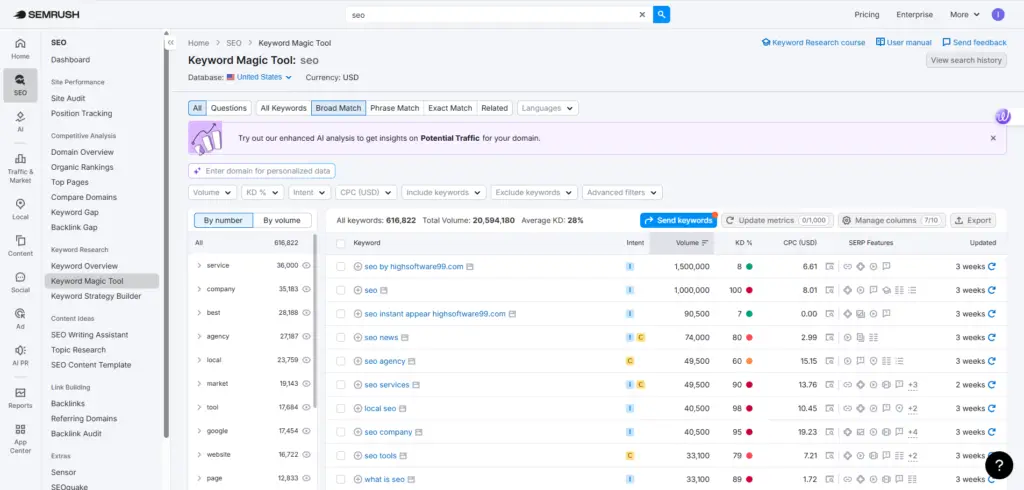
Semrush is the strongest all-around choice if you want a keyword research tool that also supports broader SEO, PPC, and content workflows. Its biggest advantage is that keyword discovery is not isolated from the rest of your strategy. You can move from keyword ideas to keyword gap analysis, site auditing, competitor benchmarking, content planning, and rank tracking without switching platforms.
For many marketers, that makes Semrush the most practical long-term choice. Instead of using one tool for keyword ideas and another for validation, Semrush gives you a connected system for finding opportunities and acting on them.
Core features and capabilities
- Keyword Magic Tool – Excellent for expanding a seed topic into broad keyword sets, subtopics, and long-tail variations.
- Keyword Gap – Helps you compare your site with competitors to find missing rankings and quick-win opportunities.
- Intent, volume, CPC, and trend data – Useful for prioritizing keywords by business value, not just search demand.
- Organic Research and Traffic Analytics – Lets you see top competitor pages, estimated traffic, and ranking patterns.
- Content support – Helpful if you want to move from keyword research into brief creation and optimization.
- AI visibility direction – Semrush is also pushing into AI search visibility, which makes it more future-facing than a traditional keyword-only tool.
Why it stands out for keyword research
Semrush is especially strong when you need breadth. Its database is massive, and the interface makes it easy to go from a head term into related clusters, intent segments, and lower-competition variants. That is valuable when you are planning a full content hub, mapping keywords to the funnel, or building a competitor-driven SEO roadmap.
It is also one of the better choices for agencies and in-house teams because it connects keyword research with audits, reporting, and broader marketing data.
Strengths and limitations
Strengths:
- Best balance of keyword research depth and wider SEO functionality.
- Strong keyword clustering, competitor analysis, and content workflows.
- Very practical for agencies, SaaS teams, and content-led businesses.
- Better long-term value than narrow keyword-only tools.
Limitations:
- Can feel overwhelming for newer users.
- Advanced plans can get expensive as usage grows.
- Some teams may not need the full suite.
Pricing and plans
Semrush pricing starts at the Pro level for smaller teams, with higher tiers for more projects, data, and reporting capacity. It is not the cheapest option, but it is one of the best-value choices if you plan to use keyword research as part of a full SEO system rather than a standalone task.
Best for: Marketing teams, agencies, and businesses that want the best overall keyword research software with room to scale.
Ahrefs

Ahrefs is one of the best keyword research tools if your SEO process is heavily tied to competitor intelligence, backlink analysis, and search demand validation. It is especially popular with SEO professionals because the data is deep, the workflows are clean, and the tool does a strong job of helping you judge whether a keyword is actually worth chasing.
While Semrush is broader, Ahrefs often feels sharper for pure SEO analysis. If your workflow starts with competitor pages, backlink opportunities, content gaps, and traffic potential, Ahrefs is an excellent fit.
Core features and capabilities
- Keywords Explorer – Strong for search volume, keyword difficulty, traffic potential, click data, and related terms.
- Site Explorer – Lets you reverse-engineer competitor pages, traffic patterns, backlinks, and ranking keywords.
- Content Gap – Very useful for finding terms your competitors rank for that your site has not yet targeted.
- SERP and click insights – Helpful when raw volume is misleading and you need better prioritization.
- Content Explorer – Strong for content ideation and identifying link-worthy topics.
- Brand Radar and AI visibility direction – Shows Ahrefs is evolving beyond classic SEO research.
Why it stands out for keyword research
Ahrefs is particularly strong at helping you separate attractive keywords from useful keywords. The platform’s traffic potential and click-based perspective can be more actionable than relying on volume alone. That matters when you are working in crowded SERPs where rankings, features, and click distribution can distort opportunity.
It also remains one of the strongest tools for combining keyword research with backlink-led SEO strategy, which is why many experienced SEOs still lean toward Ahrefs first.
Strengths and limitations
Strengths:
- Outstanding backlink and competitor intelligence.
- Very strong keyword prioritization metrics.
- Clean and intuitive workflows for SEO professionals.
- Excellent fit for content gap and ranking opportunity analysis.
Limitations:
- Less of an all-in-one marketing suite than Semrush.
- Some advanced AI features are positioned separately.
- Pricing can become expensive for heavier usage.
Pricing and plans
Ahrefs offers a low-cost Starter entry point, plus Lite, Standard, Advanced, and Enterprise plans for larger usage needs. That gives it a broader pricing ladder than before, but the real value appears once you are actively using the deeper research and competitor analysis features.
Best for: SEO specialists, consultants, and teams that care most about keyword intelligence, backlinks, and organic search analysis.
SimilarWeb

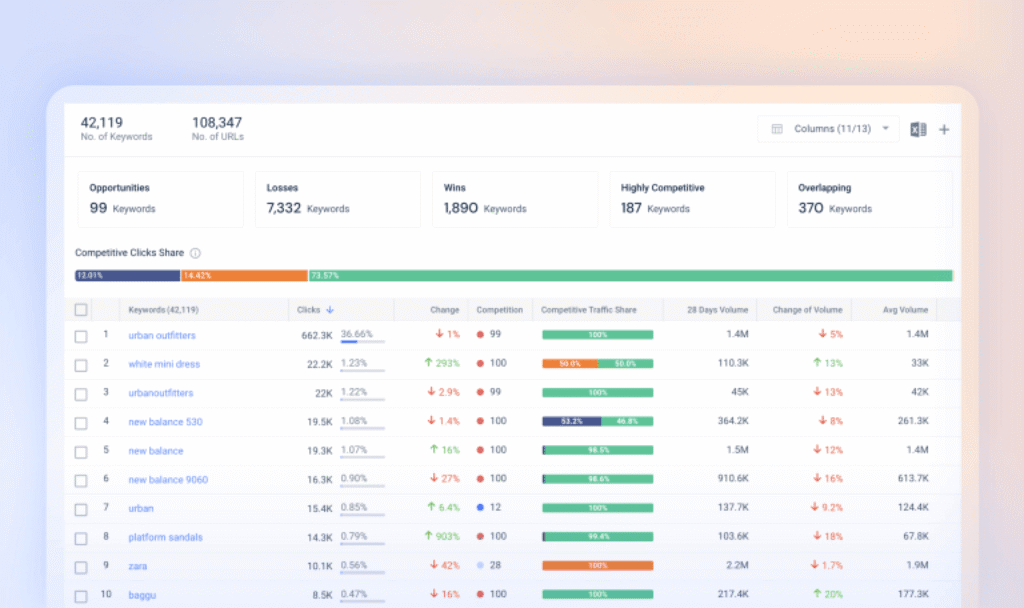
Similarweb is not the most traditional keyword research tool on this list, but it earns its place because it helps you understand keywords in a wider traffic and market context. Instead of focusing mainly on rankings and keyword lists, Similarweb helps you answer bigger questions: which channels drive traffic, how audiences behave, where competitors are growing, and which market shifts could influence your content strategy.
If your SEO work is tied closely to broader demand generation, paid search, competitive intelligence, or market benchmarking, Similarweb can be extremely valuable.
Core features and capabilities
- Keyword research and gap analysis – Useful for spotting opportunities in both organic and paid search.
- Traffic source intelligence – Helps you understand whether keyword opportunities are part of a wider channel strategy.
- Competitor benchmarking – Lets you compare domains by traffic share, engagement, and market movement.
- Audience and market insights – Valuable for prioritizing keyword themes by business impact.
- AI search intelligence direction – Similarweb is clearly expanding into AI discovery and brand visibility workflows.
- App and digital ecosystem data – Useful if search is only one part of your acquisition strategy.
Why it stands out for keyword research
Similarweb is best when you do not want to evaluate keywords in isolation. For example, a keyword may look promising on paper, but Similarweb can help you understand whether the category is actually growing, which competitors dominate adjacent channels, and whether search demand aligns with real traffic trends.
That makes it especially useful for strategists, category managers, growth marketers, and businesses making higher-level decisions about market entry or content investment.
Strengths and limitations
Strengths:
- Excellent traffic and market intelligence.
- Strong context for competitor and channel analysis.
- Helpful for tying keyword research to broader strategy.
- More valuable than classic SEO tools for market-led teams.
Limitations:
- Not as deep as Semrush or Ahrefs for technical SEO and backlinks.
- Can be too much for small content teams.
- Pricing and package structure are less transparent than simpler tools.
Pricing and plans
Similarweb offers free tools and trials for some workflows, but its more advanced intelligence packages are more sales-led and enterprise-oriented than the typical self-serve SEO tool. That makes it better suited for teams that already know they need traffic intelligence, not just keyword data.
Best for: Growth teams, analysts, and marketers who need keyword research plus serious traffic and market benchmarking.
SpyFu
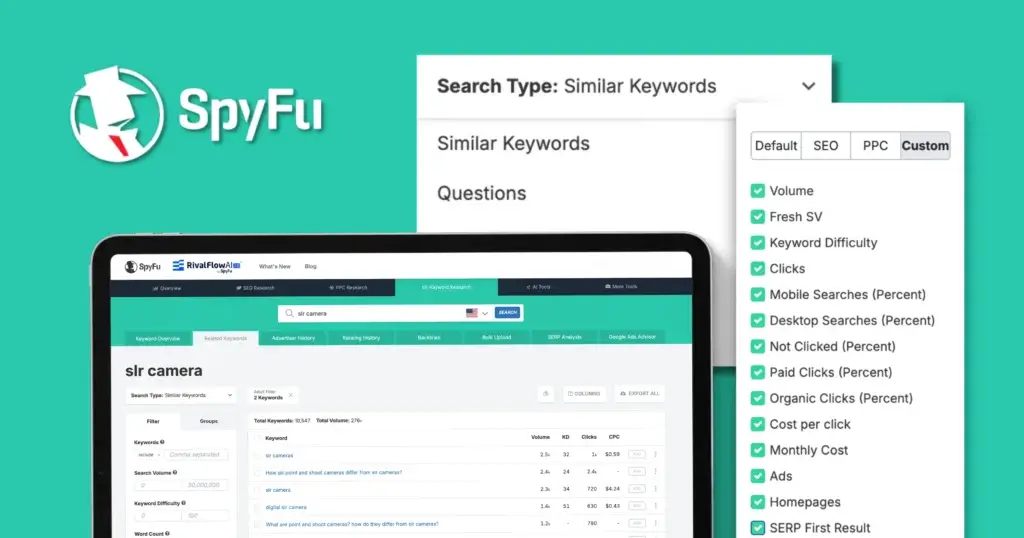
SpyFu is one of the best affordable keyword research tools if your main goal is to learn from competitors quickly. It is particularly strong for uncovering which keywords competitors rank for, which terms they buy in Google Ads, and how their search strategy has changed over time.
It is not as polished or as broad as Semrush or Ahrefs, but for many smaller teams that is exactly the point. SpyFu keeps the research practical and cost-effective.
Core features and capabilities
- Competitor keyword research – Strong for discovering organic and paid keywords from rival domains.
- PPC ad history – One of SpyFu’s most useful differentiators for paid search research.
- Keyword tracking – Helps smaller teams monitor movement without overcomplicating the workflow.
- Historical data – Useful when you want to see how a competitor strategy has evolved over time.
- AI brand monitoring direction – Adds some modern positioning beyond classic competitor spying.
- Simple reporting – Helpful for freelancers and smaller agencies.
Why it stands out for keyword research
SpyFu is ideal when you already know your market and want to identify competitor wins fast. Rather than drowning you in endless keyword expansion, it often works best as a shortcut tool. You enter a competitor, study what is working, and use those insights to build your own content or PPC strategy.
That makes it especially practical for lean teams, niche websites, and cost-conscious marketers.
Strengths and limitations
Strengths:
- Very good value for the price.
- Excellent competitor keyword and ad intelligence.
- Useful historical SEO and PPC data.
- Easier to approach than more complex SEO suites.
Limitations:
- Narrower than Semrush and Ahrefs overall.
- Less impressive for backlink depth and technical SEO.
- Better for competitor-led workflows than content-led planning.
Pricing and plans
SpyFu remains one of the more affordable options in this category, with Basic, Pro + AI, and Team/Agency plans. That makes it one of the easiest tools to justify if your main use case is competitor keyword analysis without enterprise-level costs.
Best for: Freelancers, small businesses, PPC marketers, and budget-conscious teams focused on competitor keywords.
Surfer

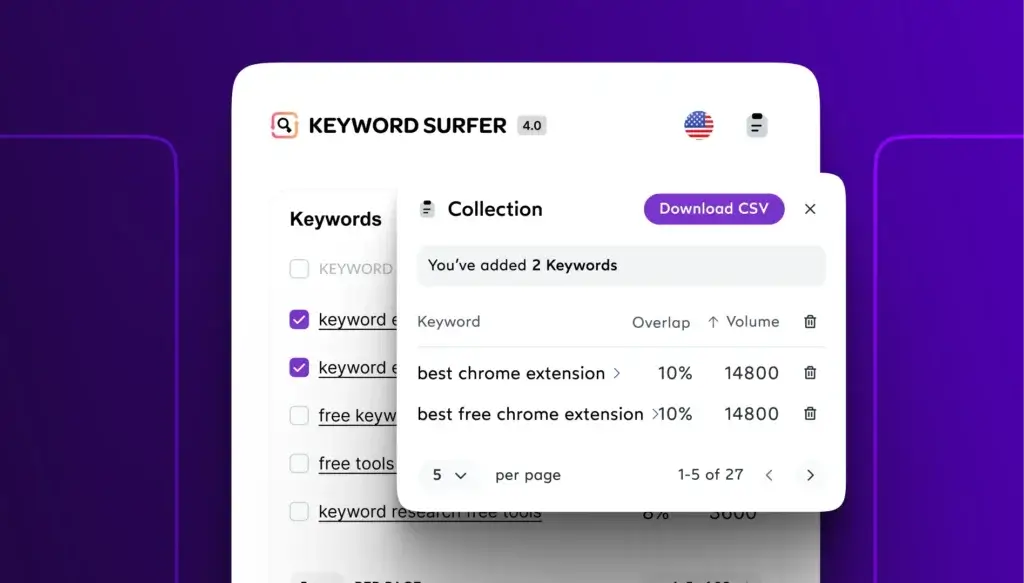
Surfer is not the best choice if you want the broadest keyword database. It is the best choice if your real problem is what happens after you find a keyword. Many teams already have keyword ideas, but they struggle to turn those ideas into pages that are structured well enough to rank. That is where Surfer stands out.
It is best understood as a content optimization platform with keyword research support, not as a full SEO suite. For editorial teams, that distinction matters.
Core features and capabilities
- Content Editor – Gives real-time optimization guidance while you write.
- Keyword Research and topic planning – Useful for building article ideas and topical clusters.
- Topical Map – Helpful for planning content hubs and broader topical authority.
- Content Audit – Strong for improving older pages instead of always publishing new ones.
- Surfer AI – Speeds up content creation and workflow execution.
- AI Search Guidelines – One of the clearer attempts to help publishers adapt content for AI-driven visibility.
Why it stands out for keyword research
Surfer stands out because it connects keywords to execution. If your team’s bottleneck is not discovering keywords, but creating better pages around those keywords, Surfer may generate more value than a broader keyword platform on its own.
It works especially well alongside Semrush or Ahrefs. In that kind of stack, one tool handles deep research while Surfer helps you write content that matches the SERP more effectively.
Strengths and limitations
Strengths:
- Excellent bridge between keyword research and content production.
- Strong for on-page optimization and editorial workflows.
- Useful for topic clusters and content refreshes.
- A smart add-on for content-heavy teams.
Limitations:
- Not a full keyword intelligence or backlink platform.
- Less suitable if you need broad market and competitor analysis.
- Best value usually comes when paired with another SEO tool.
Pricing and plans
Surfer is priced based on content workflows and credits rather than on classic SEO-suite limits. It is easier to justify for teams publishing frequently than for businesses doing only occasional keyword research.
Best for: Content teams, agencies, and editors who want to turn keyword opportunities into better-performing pages.
Moz
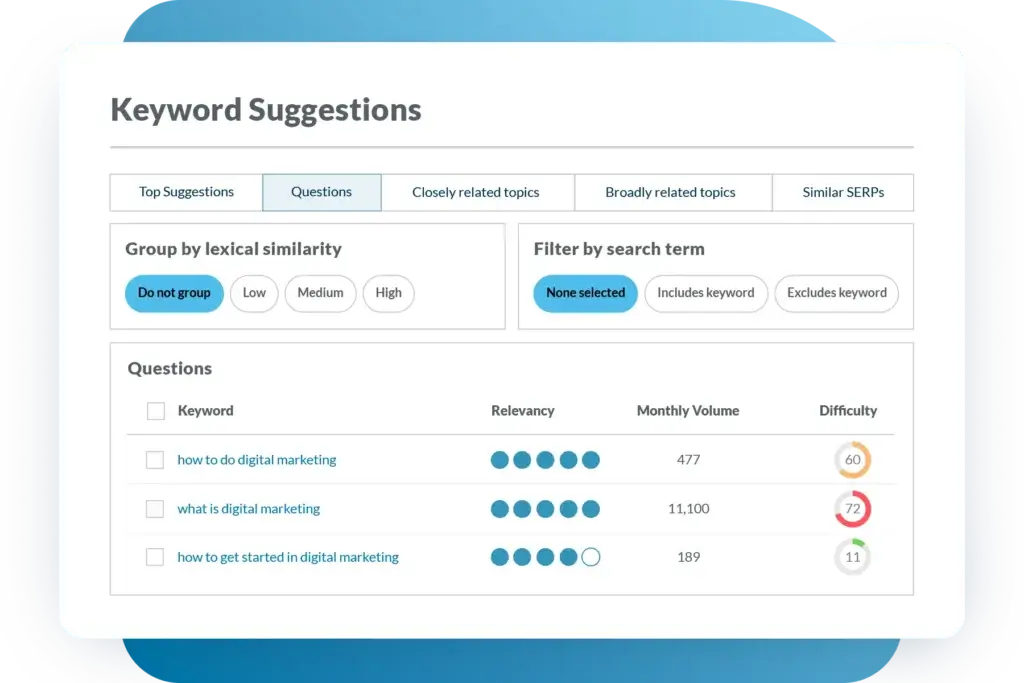
Moz still deserves a place among the best keyword research tools because it remains one of the more approachable platforms for teams that want dependable SEO data without the heavier learning curve of larger suites. It does not lead this category on raw power, but it does offer a solid balance of keyword research, rank tracking, site crawling, and backlink visibility.
If you want a tool that feels manageable and still covers the main SEO essentials, Moz can be a smart option.
Core features and capabilities
- Keyword research and prioritization – Helps you evaluate opportunities by volume, difficulty, and relevance.
- Rank tracking – Useful for monitoring progress over time.
- Site Crawl – Good for ongoing technical maintenance.
- Link Explorer – Supports backlink checks and basic competitor link analysis.
- Trusted metrics – Domain Authority is still widely recognized by marketers.
- Simpler workflows – Better for teams that do not want enterprise-level complexity.
Why it stands out for keyword research
Moz is appealing because it lowers the barrier to entry. For smaller businesses, newer SEO teams, or marketers who want practical keyword workflows without too many moving parts, that simplicity can be a real strength.
It is not the most advanced platform on this list, but it is one of the easiest to adopt for steady, ongoing SEO work.
Strengths and limitations
Strengths:
- Cleaner learning curve than some larger competitors.
- Reliable all-around SEO functionality.
- Good fit for small to mid-sized teams.
- Useful for steady, manageable keyword research workflows.
Limitations:
- Not as deep as Semrush or Ahrefs for advanced users.
- Backlink and competitor data may feel lighter for power users.
- Less differentiated in a crowded SEO software market.
Pricing and plans
Moz Pro usually appeals to teams looking for a mid-range SEO platform. Pricing is generally more accessible than large enterprise suites, though the value depends on how much depth you need beyond the basics.
Best for: Small businesses, newer SEO teams, and marketers who want keyword research plus core SEO tools in a simpler package.
How to choose the best keyword research tool for your business
Start with your real workflow, not the feature list
The best keyword research tool depends less on marketing claims and more on how your team actually works. Ask yourself whether you mainly need to discover keywords, analyze competitors, plan content, or connect SEO data to a broader acquisition strategy.
If you want the most complete platform, Semrush is the strongest overall pick. If you care most about SEO depth and backlink-led analysis, Ahrefs is often the better fit. If your team is focused on traffic benchmarking and digital market intelligence, Similarweb brings a different kind of value. If you need affordable competitor keyword research, SpyFu is hard to ignore. If content production is your bottleneck, Surfer may improve outcomes faster than a larger suite on its own. If ease of use matters most, Moz remains a solid option.
Key decision criteria
- Choose Semrush if you want the best overall keyword research tool with broader SEO and marketing workflows.
- Choose Ahrefs if you prioritize competitor SEO, backlinks, and deeper organic analysis.
- Choose Similarweb if your keyword strategy depends on traffic trends, market intelligence, and channel benchmarking.
- Choose SpyFu if you want affordable competitor keyword and PPC insight.
- Choose Surfer if your biggest challenge is turning keywords into better content.
- Choose Moz if you want dependable SEO basics with a more approachable interface.
Quick comparison table
| Tool | Best For | Main Strength | Main Limitation |
| Semrush | All-around keyword research and SEO | Broadest all-in-one workflow | Can be expensive and complex |
| Ahrefs | SEO professionals and competitor analysis | Backlinks and keyword depth | Less broad beyond SEO |
| Similarweb | Traffic and market intelligence | Strong strategic context | Less technical SEO depth |
| SpyFu | Budget competitor keyword research | Affordable PPC and keyword spying | Narrower overall scope |
| Surfer | Content optimization | Turns keywords into optimized pages | Not a full SEO suite |
| Moz | Beginner-friendly SEO workflows | Accessible and dependable | Less advanced than top rivals |
Conclusion
If you are choosing one platform, Semrush is the best keyword research tool for most businesses because it offers the strongest mix of keyword discovery, competitor analysis, content support, and broader SEO functionality. It is the most complete option for teams that want one system rather than a fragmented stack.
Ahrefs is the better choice when your SEO process is deeply tied to backlinks, competitor research, and organic search depth. Similarweb is the smarter pick when keyword strategy needs to be backed by bigger traffic and market intelligence. SpyFu is the budget-friendly option for competitor and PPC research. Surfer is the right tool for content teams that already have keyword ideas but need stronger execution. Moz is still worth considering if you want a more approachable SEO platform.
The right decision comes down to your workflow. If your team publishes a lot of content, prioritize execution. If you compete in a crowded market, prioritize competitor analysis. If you need one platform to handle everything, go with the broadest suite. Once you define that priority, the best keyword research software becomes much easier to identify.
FAQs
What is the best keyword research tool overall?
For most businesses, Semrush is the best overall keyword research tool because it combines keyword discovery, competitor analysis, content workflows, and broader SEO functionality in one platform.
Which keyword research tool is best for SEO professionals?
Ahrefs is one of the best choices for SEO professionals because of its strong backlink intelligence, content gap analysis, and keyword prioritization features.
Which tool is best for beginners?
Moz is often one of the easier tools to learn, especially if you want keyword research plus basic SEO workflows without too much complexity.
Is Semrush better than Ahrefs for keyword research?
Semrush is better if you want a broader all-in-one workflow. Ahrefs is better if you care more about deep SEO analysis, competitor research, and backlinks. The better choice depends on your workflow.
Is Similarweb a keyword research tool?
Yes, but it is better described as a digital intelligence platform that includes keyword research. Its real strength is giving you traffic, audience, and market context around keyword opportunities.
Is SpyFu good for small businesses?
Yes, SpyFu is a strong option for small businesses because it offers practical competitor keyword and PPC research at a lower price than many larger SEO suites.
Is Surfer enough on its own for keyword research?
Surfer can help with keyword-guided content planning, but it usually works best alongside a broader research tool like Semrush or Ahrefs if you need deeper competitor and market data.
Do keyword research tools help with AI search optimization?
Increasingly, yes. Several major platforms are adding AI visibility, AI search monitoring, and content guidance features that help you adapt to newer search experiences.
Can you use more than one keyword research tool together?
Yes, many teams combine tools. A common setup is Semrush or Ahrefs for research, plus Surfer for content optimization and execution.
How should you choose the right plan?
Estimate how many users, projects, tracked keywords, and reports you actually need. Then compare plan limits carefully, especially if you expect your content operation or SEO program to grow.