Introduction
Choosing the best bill pay software for small businesses can make a direct difference in how quickly you pay vendors, close your books, manage cash flow, and reduce manual accounts payable work.
For many small businesses, bill pay starts inside email inboxes, spreadsheets, bank portals, and paper checks. That can work for a very small operation, but it becomes risky as the number of vendors, invoices, due dates, approvals, and payment methods grows.
The right bill pay platform helps you collect bills, route approvals, schedule payments, sync with accounting software, reduce duplicate entry, and keep an audit trail of who approved what and when. It also gives you better control over cash flow because you can time payments more intentionally instead of reacting to due dates at the last minute.
In this guide, you’ll find the best bill pay software for small businesses in 2026: Melio, BILL, Plooto, QuickBooks Bill Pay, Xero, Zoho Books, and Ramp.
If you want the quick recommendation, Melio is one of the strongest options for small businesses that want a dedicated, easy-to-use bill payment platform. BILL is better when you need deeper AP automation and approval workflows. Plooto is excellent for accounting firms and businesses that want AP and AR workflows connected to QuickBooks or Xero. QuickBooks Bill Pay is the most natural fit if you already run your books in QuickBooks Online. Xero is ideal if you want bill pay inside a modern accounting platform. Zoho Books is a high-value choice for budget-conscious teams that want accounting, bills, approvals, and vendor workflows together. Ramp is best when bill pay should connect with spend management, corporate cards, expense controls, and broader finance automation.
What to look for in bill pay software
The best option depends on how your business receives bills, who needs to approve them, how you pay vendors, and which accounting system you use.
- Payment methods: Look for ACH, check, card, wire, and international payment options.
- Approvals: Make sure bills can route to the right person before payment.
- Accounting sync: Prioritize clean integrations with QuickBooks, Xero, Zoho Books, or your ERP.
- Cash flow control: Choose software that lets you schedule payments and manage timing.
- Vendor management: Store vendor details, payment preferences, tax information, and history.
- Audit trail: Keep records of approvals, edits, payment status, and user activity.
- Ease of use: Small teams need a workflow that owners, bookkeepers, and approvers will actually use.
- Fees: Review subscription pricing, ACH fees, check fees, card fees, wire fees, and international fees.
Best Bill Pay Software for Small Businesses in 2026
Melio

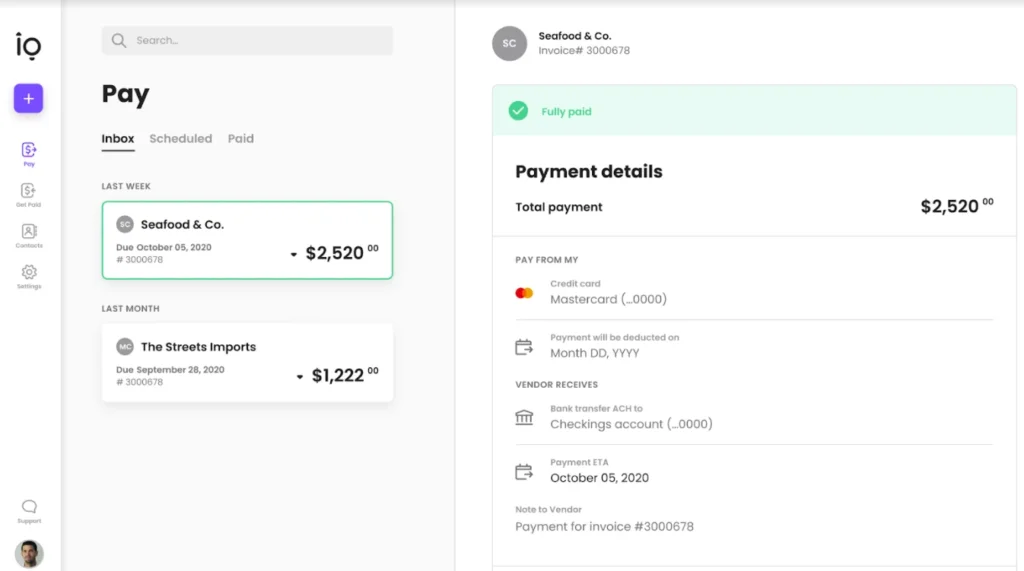
Melio is one of the best bill pay software options for small businesses because it focuses on the exact problem many owners and bookkeepers face: paying vendors without turning accounts payable into a manual, messy process.
You can use Melio to pay bills by bank transfer, card, check, and international payment methods, depending on eligibility and location. This is especially useful when your vendor only accepts checks or bank transfers, but you want more flexibility in how your business funds the payment.
Melio is also strong for businesses that want to keep payments simple without moving into a heavy AP automation system too early. You can upload bills, schedule payments, invite team members, and sync payment activity with accounting software such as QuickBooks and Xero.
The important update is that Xero completed its acquisition of Melio in 2025. For small businesses, this makes Melio even more strategically relevant because it strengthens the connection between accounting software and embedded bill payments.
Key features
- ACH, card, check, and international payment options
- Bill upload, scheduling, and payment status tracking
- Approval workflows for better payment control
- QuickBooks and Xero accounting sync
- Vendor payment history and payment reminders
- Role-based access for owners, bookkeepers, and team members
- Accounts payable and receivable workflows
Pros and cons
Pros
✅ Very easy for small businesses to adopt
✅ Strong payment flexibility for vendor bills
✅ Good fit for QuickBooks and Xero users
✅ Useful for improving cash flow timing
Cons
❌ Card and expedited payment fees can add up
❌ Not as deep as BILL for complex AP operations
❌ International payment availability should be reviewed by country
❌ Growing finance teams may eventually need more advanced controls
Pricing
Melio offers a free-start model with payment-related fees depending on how you pay. Standard bank transfers may be low-cost or free depending on current terms, while card payments, expedited payments, checks, and international payments can carry additional fees. You should review the current pricing page before publishing because payment fees can change.
Who should use Melio?
Melio is best for small businesses, bookkeepers, and service companies that want a simple way to pay vendors, schedule payments, and sync bills with QuickBooks or Xero. It is one of the strongest choices when you need practical bill pay without implementing a complex AP automation platform.
BILL
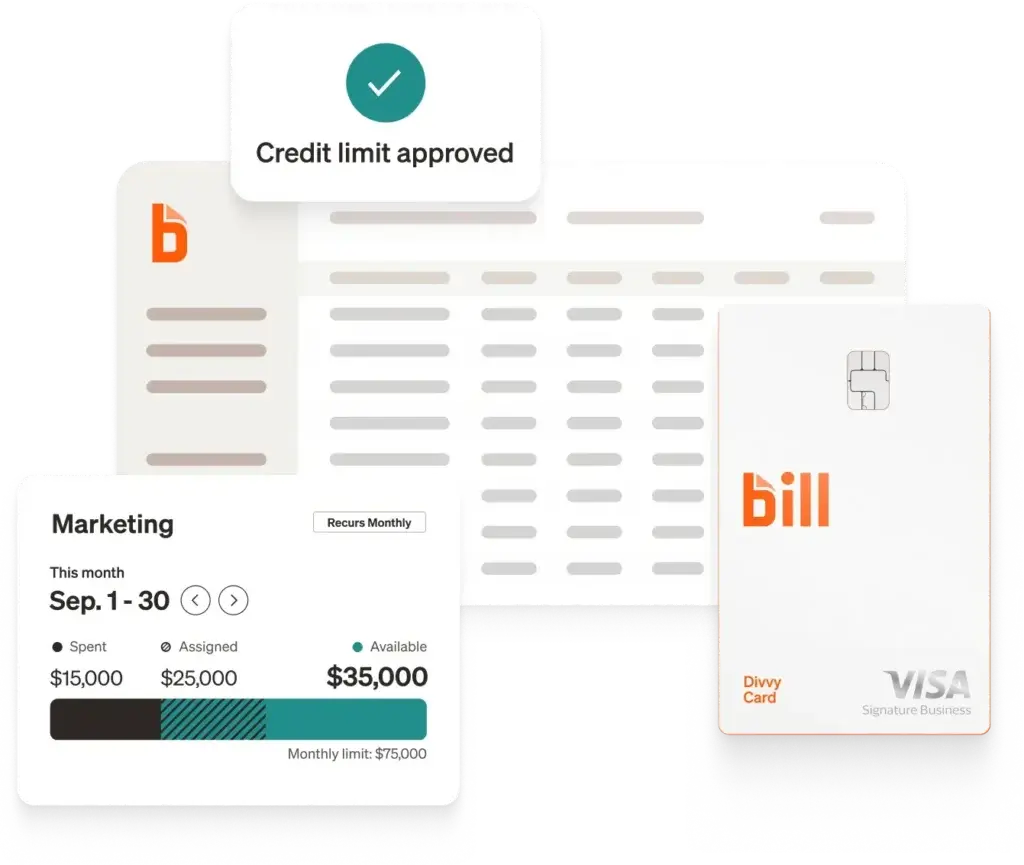
BILL is one of the most established platforms in accounts payable automation. It is a better fit than basic bill pay tools when your business needs structured approval workflows, invoice capture, payment controls, document storage, and accounting synchronization.
For small businesses, BILL works well when you have more than one person involved in paying bills. For example, an office manager may upload invoices, a department lead may approve them, and the owner or finance manager may release payment. BILL helps turn that process into a documented workflow instead of a chain of emails.
BILL also supports multiple payment methods, including ACH, check, virtual card, and international wire options. That makes it useful for businesses with many vendors, recurring bills, and more formal accounts payable requirements.
Key features
- Invoice capture and digital document storage
- Custom approval workflows for vendor bills
- ACH, check, virtual card, and international payment options
- Accounting integrations with QuickBooks, Xero, NetSuite, and Sage Intacct
- Vendor management and payment status tracking
- AP and AR tools for paying and getting paid
- Spend and expense capabilities available through BILL’s broader platform
Pros and cons
Pros
✅ Strong AP automation depth for growing businesses
✅ Excellent approval workflow capabilities
✅ Good accounting integrations and document controls
✅ Useful for companies with recurring vendor payments
Cons
❌ More expensive than simpler bill pay tools
❌ May feel too structured for very small teams
❌ Payment fees can vary by method
❌ Setup requires more process planning than Melio
Pricing
BILL publishes plan-based pricing for AP and AR, with entry plans typically starting at a monthly subscription cost. Accountants can also use a separate console model for managing multiple clients. Payment fees may apply depending on payment method, so businesses should evaluate the full cost based on transaction volume.
Who should use BILL?
BILL is best for small businesses that are becoming more finance-led and need stronger controls over invoice intake, approvals, payments, and audit trails. It is also a strong fit for accounting firms, professional services businesses, nonprofits, and companies with multiple approvers.
Plooto


Plooto is a business payments platform built around accounts payable, accounts receivable, approval workflows, and accounting synchronization. It is particularly strong for small businesses and accounting firms that want to manage payment operations without relying on separate bank portals and manual reconciliation.
One of Plooto’s biggest strengths is its focus on accountant-friendly workflows. If you manage payments for multiple clients or work closely with an external bookkeeper, Plooto gives you a more controlled way to approve, send, collect, and reconcile payments.
Plooto integrates with QuickBooks and Xero, and higher-level packages can support more advanced accounting workflows. It also includes approval controls, audit trails, and payment tracking, which help reduce the risk of missed payments or unauthorized vendor payments.
Key features
- Accounts payable and accounts receivable workflows
- Approval routing for bill payments
- Two-way sync with QuickBooks and Xero
- Vendor and customer payment tracking
- Electronic payments and check payment options
- Audit trails for approvals and payment activity
- Accountant and bookkeeper-friendly client management
Pros and cons
Pros
✅ Strong fit for accounting firms and bookkeepers
✅ Combines AP and AR payment workflows
✅ Good QuickBooks and Xero synchronization
✅ Useful approval controls for small finance teams
Cons
❌ Not as broad as Ramp for spend management
❌ Pricing can vary by package and client setup
❌ Some advanced capabilities may require higher plans
❌ Best value appears when payment volume is consistent
Pricing
Plooto offers tiered pricing, including lower-cost plans for basic workflows and higher packages for businesses with more advanced payment needs. Accountants and bookkeepers may also have client-focused pricing options. Because payment fees and package names can vary by region and plan, review current Plooto pricing before choosing a subscription.
Who should use Plooto?
Plooto is best for small businesses, accounting firms, and bookkeeping teams that want a dedicated payment operations platform for AP and AR. It is especially useful if QuickBooks or Xero is already your accounting foundation and you want payment activity to sync cleanly.
QuickBooks Bill Pay

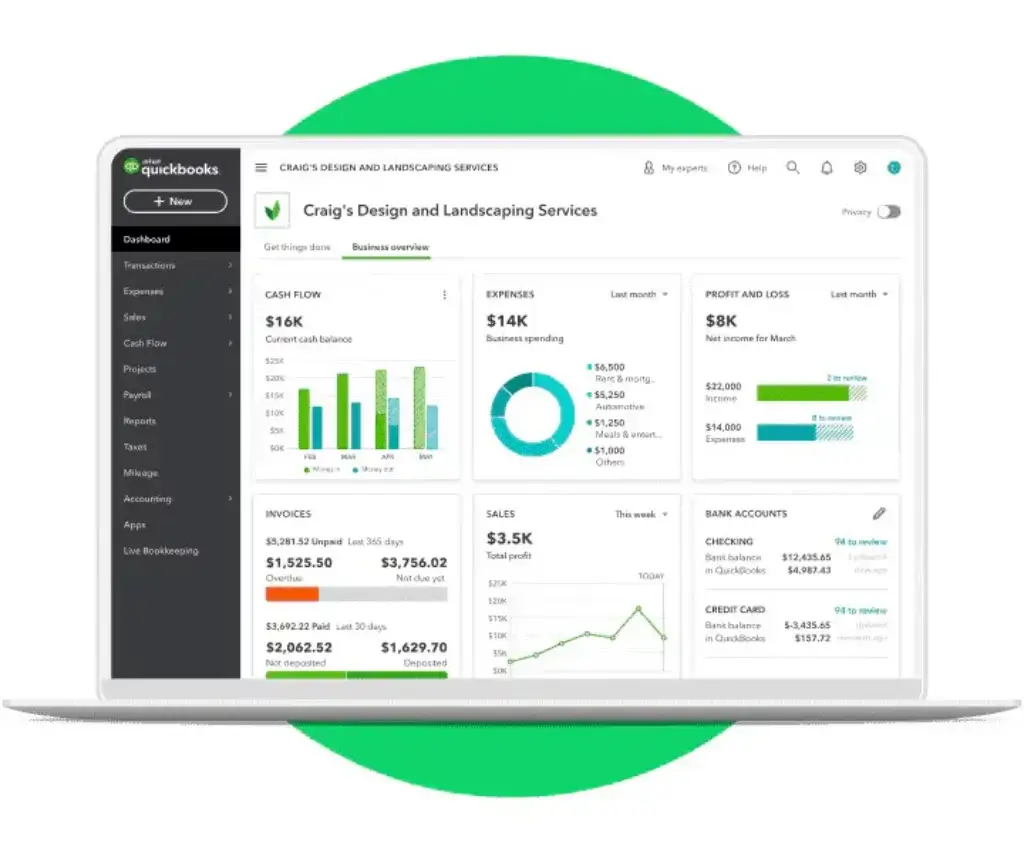
QuickBooks Bill Pay is the most natural option if your business already uses QuickBooks Online. Instead of moving bills between your accounting system and a separate payment tool, you can manage bills and payments inside the QuickBooks environment.
This matters for small businesses because QuickBooks is often the system of record for bills, expenses, vendors, cash flow, and reporting. When bill pay is embedded into that workflow, you reduce duplicate data entry and simplify reconciliation.
QuickBooks Bill Pay can support bill scheduling, ACH payments, check payments, approvals, and vendor payment tracking. For many small businesses, the main advantage is convenience rather than advanced AP customization.
Key features
- Bill payments inside QuickBooks Online
- ACH and check payment options
- Bill scheduling and payment status tracking
- Approval workflow capabilities in higher packages
- Vendor records connected to accounting data
- Reduced duplicate entry for QuickBooks users
- Cash flow visibility inside the accounting system
Pros and cons
Pros
✅ Best fit for existing QuickBooks Online users
✅ Keeps bill pay close to accounting records
✅ Reduces reconciliation friction
✅ Familiar interface for many bookkeepers and accountants
Cons
❌ Less useful if you do not use QuickBooks Online
❌ Transaction fees apply for certain payment methods
❌ Advanced approvals may require higher-tier bill pay plans
❌ Not as specialized as dedicated AP tools for complex workflows
Pricing
QuickBooks Bill Pay pricing depends on the plan and payment method. Check payments and faster ACH payments may carry per-transaction fees, and monthly packages vary based on included features and payment allowances. Review current QuickBooks Bill Pay pricing together with your QuickBooks Online subscription cost.
Who should use QuickBooks Bill Pay?
QuickBooks Bill Pay is best for small businesses that already use QuickBooks Online and want the simplest path to paying bills without adding another standalone AP platform. It is especially practical for companies with moderate bill volume and a bookkeeper who already works in QuickBooks.
Xero


Xero is primarily cloud accounting software, but it has become more important in the bill pay category because of its investment in embedded payments and its acquisition of Melio. For small businesses, Xero can be attractive when you want your accounting system and payment workflows to live closer together.
Xero is known for a clean interface, strong bank reconciliation, unlimited users on many plans, and accountant-friendly collaboration. Its bill management tools help you enter bills, track due dates, schedule payments, and monitor payables.
For U.S. small businesses, Xero’s online bill payments are especially relevant because they bring payment execution closer to the accounting workflow. That makes Xero stronger as a complete small business finance platform, not just a bookkeeping system.
Key features
- Cloud accounting with bill and vendor tracking
- Online bill payment capabilities for supported users
- Bank feeds and reconciliation automation
- Cash flow visibility and financial reporting
- Bill capture and document management with Hubdoc
- Unlimited users on many plans
- Large app marketplace for payroll, payments, and operations
Pros and cons
Pros
✅ Strong accounting foundation for small businesses
✅ Modern interface and good accountant collaboration
✅ Useful bill tracking and reconciliation workflows
✅ Melio acquisition strengthens its payments direction
Cons
❌ Not a dedicated AP automation platform like BILL
❌ Payment features and fees may vary by region
❌ Some advanced accounting features require higher plans
❌ U.S. payroll usually requires a partner integration
Pricing
Xero uses tiered monthly pricing. U.S. plans commonly include Early, Growing, and Established options, with promotional discounts often available for new customers. Payment fees may apply in addition to the monthly subscription when using online bill payments or online invoice payments.
Who should use Xero?
Xero is best for small businesses that want cloud accounting, bill tracking, reconciliation, and payments in one ecosystem. It is especially strong for businesses that value accountant collaboration, clean bank reconciliation, and a modern alternative to QuickBooks.
Zoho Books


Zoho Books is a strong option if you want accounting, vendor bills, purchase workflows, approvals, and reporting in one affordable platform. It is not only bill pay software, but it can handle important accounts payable tasks for small businesses that want more than a standalone payment tool.
Zoho Books is especially attractive when price matters. Compared with many accounting and finance platforms, Zoho usually gives you a broad feature set at a lower monthly cost. It also integrates naturally with other Zoho products such as Zoho CRM, Zoho Inventory, Zoho Expense, and Zoho Analytics.
For bill pay and AP workflows, Zoho Books supports vendor bill tracking, purchase orders, vendor credits, approval workflows, and batch vendor payments on higher plans. That makes it a practical choice for small businesses that want accounting and payables in one system.
Key features
- Vendor bill creation, tracking, and payment recording
- Purchase orders and vendor credits
- Approval workflows for purchases and bills
- Vendor portal and vendor management features on supported plans
- Bank feeds, reconciliation, and financial reporting
- Integration with Zoho CRM, Inventory, Expense, and Analytics
- Affordable tiered pricing for small businesses
Pros and cons
Pros
✅ Excellent value for small businesses
✅ Strong fit for companies using Zoho apps
✅ Good accounting, billing, and vendor workflows
✅ Useful automation and approval capabilities
Cons
❌ Not as payment-focused as Melio or BILL
❌ Some AP features require higher plans
❌ Accountant adoption may be lower than QuickBooks or Xero in some markets
❌ Payment capabilities can vary by country and integration
Pricing
Zoho Books offers a free plan for eligible small businesses and multiple paid plans. Paid plans generally scale by users, automation, inventory, purchase features, approvals, and advanced accounting capabilities. Vendor batch payments, purchase approvals, and PO matching are usually tied to higher plan levels.
Who should use Zoho Books?
Zoho Books is best for small businesses that want affordable accounting software with solid bill management, vendor tracking, approvals, and automation. It is an especially strong choice if your business already uses Zoho CRM or other Zoho applications.
Ramp

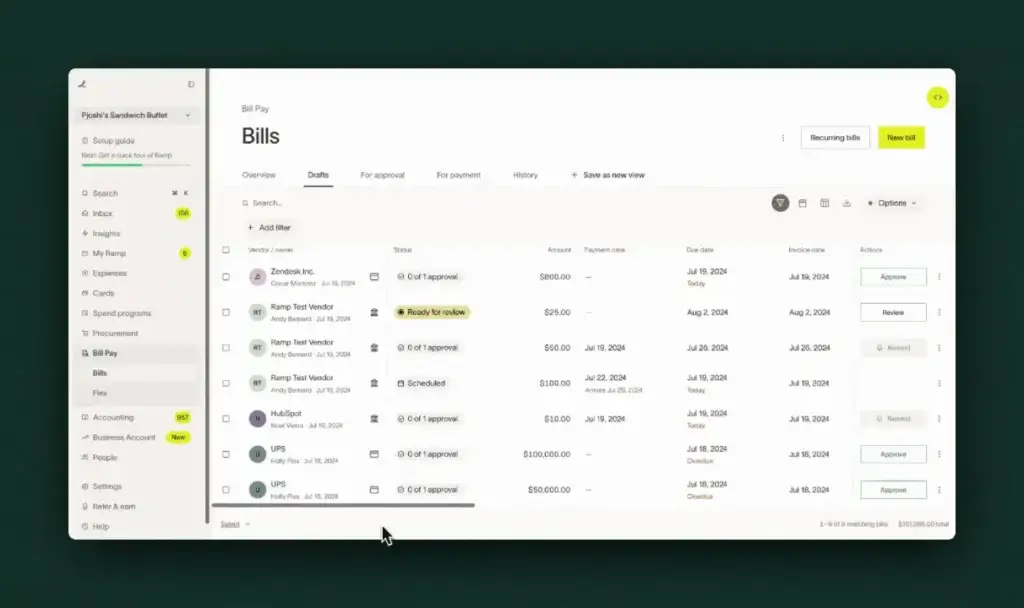
Ramp is a modern finance platform that combines bill pay, corporate cards, expense management, reimbursements, procurement, vendor management, and reporting. It is a strong option when bill pay is only one part of a broader spend control problem.
For small businesses, Ramp is especially useful when you want to manage vendor bills, card spend, employee expenses, and approvals in one platform. Instead of looking at bill pay separately from card payments and reimbursements, Ramp helps finance teams see company spend more holistically.
Ramp Bill Pay supports invoice intake, approvals, payments, accounting sync, vendor management, and payment status tracking. It also connects with accounting systems such as QuickBooks, Xero, NetSuite, Sage Intacct, and other finance tools.
Key features
- Bill pay and accounts payable automation
- Corporate cards with spend limits and controls
- Expense management and receipt matching
- Approval workflows for bills and spend requests
- Vendor management and payment tracking
- Accounting integrations with QuickBooks, Xero, NetSuite, and Sage Intacct
- Real-time spend visibility and reporting
Pros and cons
Pros
✅ Strong all-in-one finance workflow
✅ Connects bill pay with cards and expenses
✅ Free plan is attractive for smaller teams
✅ Good accounting integrations and spend visibility
Cons
❌ Best value appears when you use more of Ramp’s platform
❌ Some advanced features may require paid plans
❌ Bill pay transaction fees can apply by payment method
❌ Not every small business needs cards and spend management
Pricing
Ramp offers a free plan at $0 per user per month, with paid plans available for more advanced features. Bill pay transaction fees can apply depending on payment type, including ACH, check, wire, and international wire payments. This makes Ramp attractive for small businesses, but you should estimate costs based on payment volume.
Who should use Ramp?
Ramp is best for small businesses that want bill pay connected to broader spend management. It is especially useful if you need AP automation, corporate cards, expense controls, approvals, and accounting sync in one finance platform.
Bill Pay Software Comparison Table
| Software | Best For | Biggest Strength | Main Tradeoff |
| Melio | Small businesses that want simple vendor payments | Flexible payments with an easy bill pay workflow | Less advanced than full AP automation platforms |
| BILL | Growing businesses with structured AP approvals | Deep AP automation, approvals, and document controls | Costs more than basic bill pay tools |
| Plooto | Accounting firms and QuickBooks or Xero users | AP and AR workflows with strong accounting sync | Best value depends on payment volume and workflow needs |
| QuickBooks Bill Pay | Businesses already using QuickBooks Online | Bill payments inside the accounting workflow | Less useful outside the QuickBooks ecosystem |
| Xero | Small businesses that want accounting and payments together | Modern accounting with bill tracking and online payments | Not as specialized as a dedicated AP automation tool |
| Zoho Books | Budget-conscious businesses using Zoho apps | Affordable accounting, bills, approvals, and automation | Some AP features require higher plans |
| Ramp | Businesses that want bill pay plus spend management | AP, cards, expenses, controls, and reporting in one platform | Best fit when you use the broader Ramp ecosystem |
How to Choose the Best Bill Pay Software for Your Business
Start with your accounting system. If your business already uses QuickBooks Online, QuickBooks Bill Pay or Melio may be the easiest path. If you use Xero, you should compare Xero’s built-in bill payment capabilities with Melio and Plooto.
Then look at approval complexity. If one person reviews and pays bills, a simple tool may be enough. If bills need to move through multiple approvers, departments, locations, or client entities, BILL, Plooto, or Ramp may be a better fit.
You should also review how your vendors prefer to get paid. Some vendors accept ACH, some still want checks, some accept card-funded payments, and others require international payments. The best bill pay software should support the payment methods you use most often without creating excessive fees.
Finally, consider whether you only need bill pay or a broader finance workflow. If you need corporate cards, expenses, reimbursements, procurement requests, and spend controls, Ramp may deliver more long-term value than a standalone bill pay tool.
Conclusion
The best bill pay software for small businesses depends on how simple or structured your accounts payable process needs to be.
Melio is the best overall starting point for many small businesses because it is easy to use, flexible, and focused on vendor payments. BILL is the better choice when approvals, controls, and AP automation matter more. Plooto is excellent for accounting firms and businesses that want AP and AR workflows connected to QuickBooks or Xero.
QuickBooks Bill Pay is the most convenient option if your business already operates in QuickBooks Online. Xero is a strong choice if you want accounting and bill payments to work together in one cloud platform. Zoho Books gives you a lot of accounting and vendor management value for the price. Ramp is the strongest option when bill pay should connect with cards, expenses, approvals, and spend management.
If you are choosing for a small business, avoid picking software based only on the lowest monthly price. The better decision is to compare total payment fees, accounting sync, approval needs, vendor payment methods, and how much manual work the platform removes from your weekly finance routine.
FAQs
What is bill pay software?
Bill pay software helps businesses manage, approve, schedule, and send payments to vendors. It can replace manual checks, bank portal payments, spreadsheets, and email-based approval workflows.
What is the best bill pay software for small businesses?
Melio is one of the best overall choices for many small businesses because it is easy to use and focused on vendor payments. BILL is better for more advanced AP automation, while QuickBooks Bill Pay is best for QuickBooks users.
Is Melio good for small business bill pay?
Yes. Melio is a strong option for small businesses that want to pay vendors by bank transfer, card, check, or international payment methods while keeping payment workflows simple.
Is BILL better than Melio?
BILL is better if you need deeper AP automation, document capture, approval workflows, and more structured controls. Melio is usually simpler and easier for small businesses that mainly need flexible vendor payments.
Can bill pay software sync with QuickBooks?
Yes. Many bill pay platforms sync with QuickBooks, including Melio, BILL, Plooto, Ramp, and QuickBooks Bill Pay. The depth of the sync varies by platform and plan.
Can bill pay software sync with Xero?
Yes. Platforms such as Melio, BILL, Plooto, and Ramp can support Xero workflows, and Xero also offers its own bill management and online payment capabilities in supported markets.
What is the cheapest bill pay software?
The cheapest option depends on your payment volume and payment method. Melio and Ramp can be affordable starting points, while Zoho Books is strong if you want accounting and bill management at a low monthly cost.
Do small businesses still need checks?
Some small businesses still need checks because certain vendors prefer or require them. Good bill pay software can send checks on your behalf, which reduces manual printing, mailing, and tracking.
What is the difference between bill pay software and AP automation software?
Bill pay software focuses on paying vendor bills. AP automation software usually goes deeper by adding invoice capture, approval routing, document management, payment controls, audit trails, and accounting automation.
Which bill pay software is best for accountants?
Plooto and BILL are strong choices for accountants because they support structured payment workflows, client management, approvals, and accounting synchronization. Melio is also useful for accountants serving smaller clients.