Introduction
Choosing the best ITSM software for small businesses can make a major difference in how quickly your team resolves IT issues, supports employees, manages devices, and keeps daily operations running smoothly.
Small businesses do not always have large IT departments, dedicated process owners, or unlimited budgets. You need an IT service management tool that is practical, affordable, easy to adopt, and flexible enough to support both internal IT teams and Managed Service Providers (MSPs).
The right ITSM software helps you organize service requests, automate repetitive work, track assets, manage incidents, and improve visibility across your IT environment. It can also reduce downtime, improve employee support, and give your team a more structured way to handle IT operations.
In this guide, we compare the best ITSM software for small businesses in 2026, including NinjaOne, monday service, InvGate Service Management, Freshservice, and Atera. You’ll also find a practical comparison table, use-case recommendations, implementation tips, and FAQs to help you choose the right platform.
Quick Comparison: Best ITSM Software for Small Businesses
If you want a fast overview before reading the full reviews, use the table below to compare each ITSM tool by best fit, pricing model, and core features.
| ITSM Tool | Best For | Pricing Model | Key Features |
| NinjaOne | Endpoint automation and remote IT | Quote-based, flexible per-device pricing | Patch management, remote access, ticketing |
| monday service | No-code service workflows | Seat-based, starts from Standard plan | No-code automation, dashboards, ticketing |
| InvGate Service Management | Affordable ITIL-aligned ITSM | Annual plans, Starter from $1,499/year | ITIL workflows, automation, reporting |
| Freshservice | AI-powered ITSM | Agent-based plans, starts from $19/month annually | AI workflows, self-service, asset management |
| Atera | MSPs and multi-device IT teams | Per-technician pricing | RMM, PSA, remote support, patching |
Editor’s note: Pricing can change based on billing cycle, number of users, region, selected modules, and contract terms. Always confirm final pricing with the vendor before purchasing.
What Small Businesses Need in an ITSM Solution
Not every ITSM platform is built for a small business environment. Enterprise tools often focus on complex configuration, deep governance, and advanced ITIL processes. Small businesses usually need something more practical.
The best ITSM software for small businesses should help you improve service quality without creating unnecessary complexity. It should be easy to deploy, simple for technicians to use, and flexible enough to grow with your business.
Cost-Effective Pricing
Pricing is one of the most important factors for small businesses. You need a tool that gives you enough functionality without forcing you into a large enterprise contract too early.
Look for:
✔️ Transparent pricing that is easy to understand
✔️ Flexible billing models such as per-user, per-device, or per-technician pricing
✔️ Free trials or demos so you can test the platform before committing
✔️ Scalable plans that let you add features when your needs grow
For example, Atera can be attractive for MSPs because it uses per-technician pricing, while monday service is a strong fit for teams that want flexible service workflows and visual dashboards.
Ease of Use and Fast Adoption
A small IT team cannot spend months configuring a complex system. Your ITSM platform should be easy to learn, simple to navigate, and quick to deploy.
Look for:
✔️ A clean interface that reduces training time
✔️ Pre-built templates for common IT requests
✔️ No-code automation for ticket routing and approvals
✔️ Simple reporting that helps you track performance
monday service is especially strong for visual workflow management, while Freshservice offers a more traditional ITSM structure with a modern user experience.
Automation That Reduces Manual Work
Automation is one of the biggest reasons to invest in ITSM software. It helps your team reduce repetitive tasks, respond faster, and avoid manual errors.
Look for automation features such as:
✔️ Automated ticket routing based on category, priority, or requester
✔️ Self-service portals that reduce repetitive support requests
✔️ Patch automation for endpoint security and maintenance
✔️ Approval workflows for access requests, hardware, and software
NinjaOne is a strong choice when endpoint automation is a priority. Freshservice is better suited when you want AI-assisted workflows and broader ITSM process automation.
Cloud-Based Deployment
For most small businesses, cloud-based ITSM software is the most practical option. It is easier to deploy, requires less infrastructure, and supports remote IT work.
Cloud-based ITSM benefits include:
✔️ Lower upfront costs because you do not need to host servers
✔️ Remote access for distributed IT teams and MSPs
✔️ Automatic updates handled by the vendor
✔️ Faster setup compared with on-premise systems
On-premise ITSM may still matter for organizations with strict compliance, data control, or security requirements. However, most small businesses will get better speed, flexibility, and cost control from cloud-based ITSM software.
For a deeper comparison, read our full guide to cloud-based ITSM vs on-premise ITSM.
Top ITSM Software for Small Businesses in 2026
Below are the top ITSM tools for small businesses based on usability, automation, pricing structure, deployment model, and fit for small IT teams or MSPs.
Freshservice

Overview:
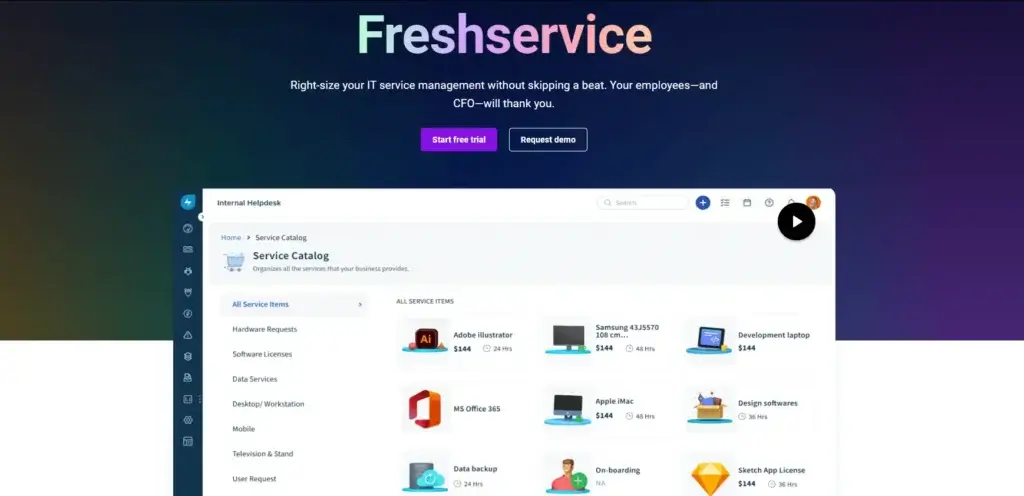
Freshservice is a cloud-based ITSM platform from Freshworks. It is built for teams that want ITIL-aligned service management, automation, asset management, and AI-assisted support in a modern interface.
For small businesses, Freshservice is often a strong choice when you want more structured ITSM than a basic ticketing tool, but you still need a platform that is easier to adopt than traditional enterprise ITSM software.
Key Features:
✔️ Freddy AI – Use AI features to support ticket handling and service workflows.
✔️ Incident and Service Request Management – Organize IT support in a structured way.
✔️ Self-Service Portal and Knowledge Base – Help employees solve common issues faster.
✔️ Asset Management – Track IT assets and connect them to service activity.
Pricing:
💰 Freshservice pricing starts from $19/agent/month when billed annually. Monthly pricing and higher-tier plans may cost more depending on features, agents, and add-ons.
Best Fit:
Freshservice is best for small businesses that want AI-powered service management, ITIL-aligned workflows, asset visibility, and room to scale. It may be more than you need if your team only wants simple ticket tracking.
NinjaOne
Overview:
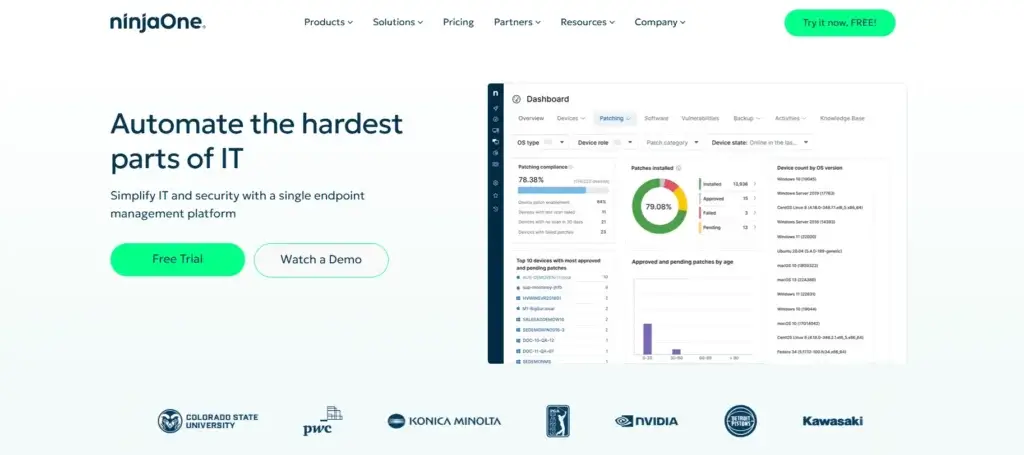
NinjaOne is a cloud-based IT management platform built for small IT teams and MSPs that need strong endpoint visibility, automation, and remote support. It is especially useful when your IT workload depends on monitoring devices, deploying patches, handling tickets, and supporting users remotely.
Unlike traditional ITSM platforms that focus mainly on process management, NinjaOne brings IT service support closer to endpoint management. This makes it a practical choice for businesses that need to manage laptops, desktops, servers, and remote devices from one place.
Key Features:
✔️ Endpoint Monitoring – Track device health, performance, and availability.
✔️ Automated Patch Management – Keep Windows, Mac, and Linux devices updated.
✔️ Remote Access – Support users and troubleshoot devices from anywhere.
✔️ Integrated Ticketing – Connect support requests with endpoint data.
Pricing:
💰 NinjaOne uses quote-based pricing with flexible per-device pricing. Final pricing depends on your number of endpoints, selected modules, and business requirements.
Best Fit:
NinjaOne is best for small businesses and MSPs that need endpoint automation, patching, remote monitoring, and support workflows in one platform. It is less ideal if your top priority is advanced ITIL process management.
monday service

Overview:
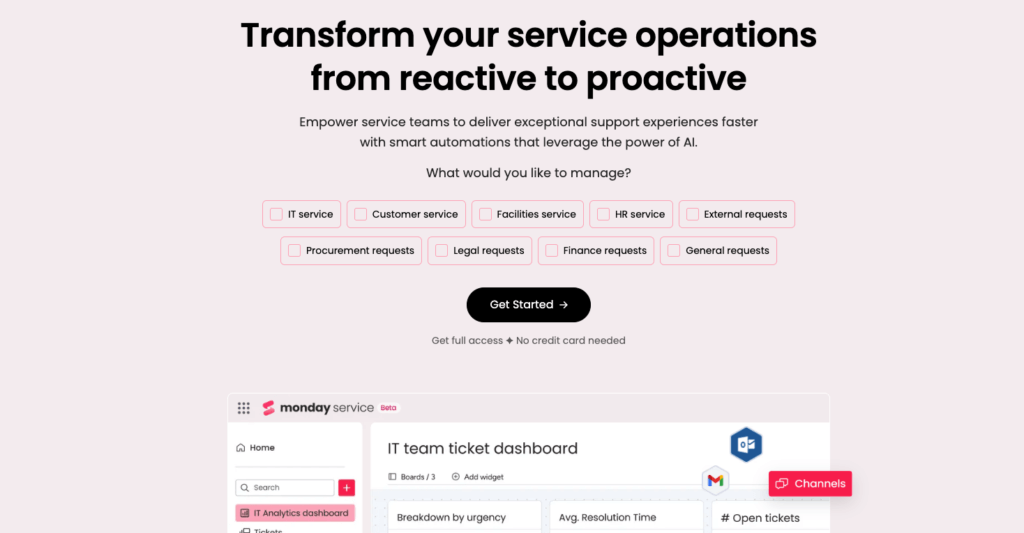
monday service is a flexible service management platform built for teams that want visual workflows, no-code automation, and fast adoption. It is a strong option for small businesses that need to organize IT requests without deploying a heavy enterprise ITSM system.
The platform is especially useful if your business already uses monday.com or wants to manage IT, HR, operations, facilities, and internal service requests in one work management environment.
Key Features:
✔️ No-Code Workflow Builder – Create service workflows without technical setup.
✔️ Ticketing and Request Management – Centralize IT and internal service requests.
✔️ Dashboards and Reporting – Track workload, response times, and service performance.
✔️ Integrations – Connect with tools such as Slack, Microsoft Teams, Jira, and more.
Pricing:
💰 monday service pricing starts from the Standard plan. Public pricing may vary by region, seat count, and billing cycle, so confirm the final cost on the vendor’s pricing page.
Best Fit:
monday service is best for small businesses that want simple, visual, no-code ITSM workflows. It is less ideal if you need deep ITIL functionality out of the box.
InvGate Service Management

Overview:
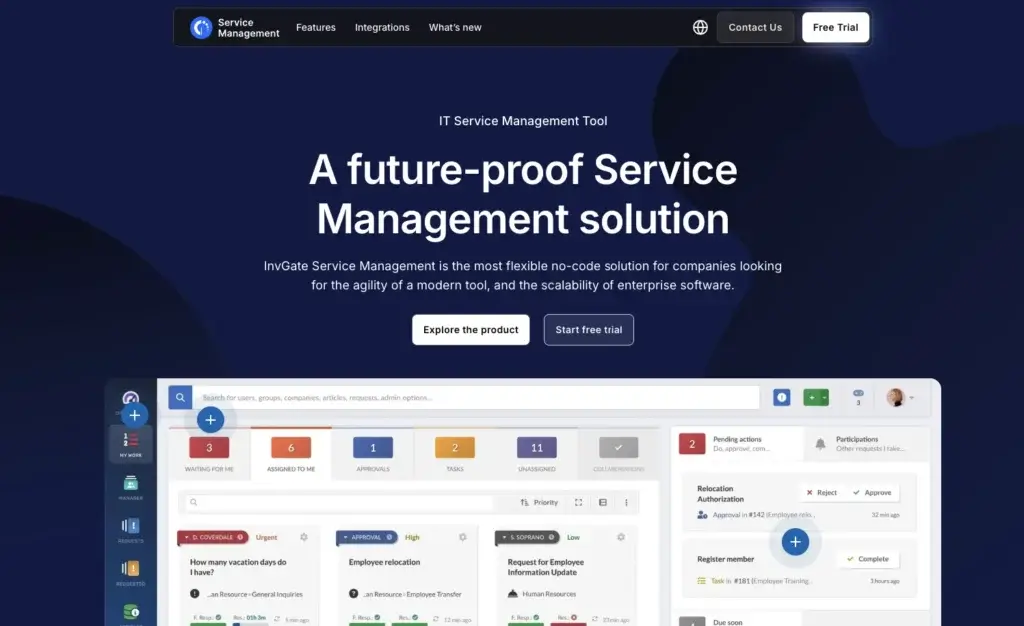
InvGate Service Management is a practical ITSM platform for small and mid-sized businesses that want ITIL-aligned service management without jumping straight into a complex enterprise system.
It combines incident management, problem management, change management, automation, reporting, SLA tracking, and self-service capabilities in a clean interface. This makes it a strong option for teams that want more structure than a basic help desk but less complexity than a full enterprise ITSM deployment.
Key Features:
✔️ Incident, Problem, and Change Management – Support ITIL-aligned workflows.
✔️ Workflow Automation – Automate repetitive service processes and approvals.
✔️ Self-Service Portal – Help users find answers and submit requests easily.
✔️ Reporting and SLA Tracking – Monitor service quality and team performance.
Pricing:
💰 InvGate Service Management offers annual plans. The Starter plan starts at $1,499/year as a fixed-price package, while the Pro plan starts at $500/agent/year with a minimum annual cost. Enterprise pricing is available for larger or more complex needs.
Best Fit:
InvGate Service Management is best for small businesses that want affordable ITIL-aligned workflows, reporting, automation, and service structure. It is less ideal if you only need a very basic ticketing tool.
Atera

Overview:
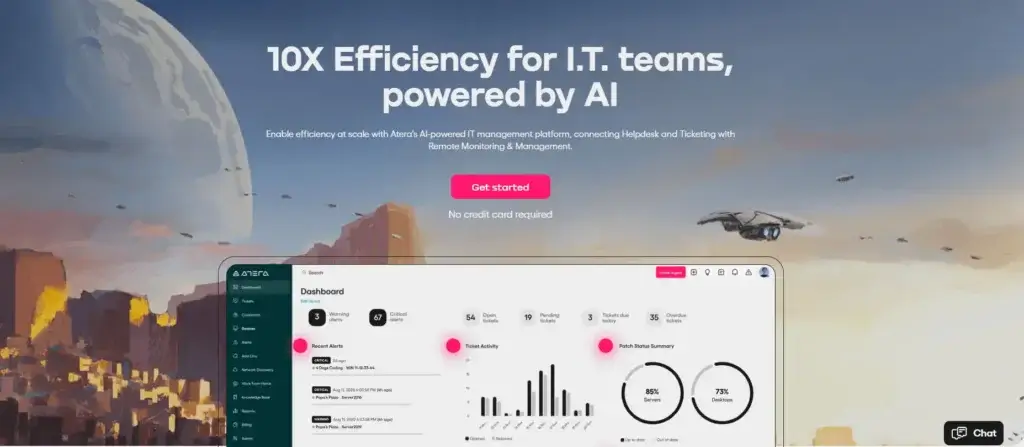
Atera is an all-in-one IT management platform that combines RMM, PSA, helpdesk ticketing, remote access, patch management, and automation. It is especially strong for MSPs and small IT teams that support many devices or multiple clients.
Atera’s main advantage is its per-technician pricing model. Instead of charging per endpoint, Atera lets teams manage unlimited devices under technician-based plans, which can be cost-effective when each technician manages a large environment.
Key Features:
✔️ Remote Monitoring and Management – Monitor devices, networks, and endpoints.
✔️ Helpdesk and Ticketing – Manage support requests from one dashboard.
✔️ Patch Management – Automate updates and improve endpoint security.
✔️ PSA Capabilities – Manage clients, contracts, reporting, and billing workflows.
Pricing:
💰 Atera uses per-technician pricing. Public pricing varies by plan and billing cycle, with IT department plans starting from listed monthly technician-based packages.
Best Fit:
Atera is best for MSPs and small IT teams that manage many endpoints or clients. It may be less cost-effective for a company with many technicians but only a small number of devices.
Best ITSM Software for Small Business by Use Case
There is no single ITSM tool that is best for every small business. The right choice depends on your team structure, number of endpoints, support volume, budget, and how much ITIL structure you need.
| Use Case | Recommended Tool | Why It Fits |
| Best for endpoint-heavy IT teams | NinjaOne | Strong endpoint monitoring, patching, remote access, and automation |
| Best for no-code service workflows | monday service | Visual workflows, simple automation, and fast adoption |
| Best for ITIL-aligned value | InvGate Service Management | Structured ITSM features without enterprise-level complexity |
| Best for AI-powered ITSM | Freshservice | AI-assisted service workflows, asset management, and modern ITSM features |
| Best for MSPs | Atera | Per-technician pricing and strong remote monitoring features |
Cloud-Based vs On-Premise ITSM for Small Businesses
Most small businesses should start with cloud-based ITSM software. It is faster to deploy, easier to maintain, and better suited for remote support.
Cloud-based ITSM is especially useful if you have employees working from different locations, an outsourced IT provider, or a small team that does not want to manage servers and manual updates.
On-premise ITSM can still be relevant if your business has strict data residency, compliance, or internal security requirements. However, it usually requires more technical maintenance, higher upfront investment, and a more experienced IT team.
| Deployment Factor | Cloud-Based ITSM | On-Premise ITSM |
| Setup speed | Fast deployment | Longer setup process |
| Infrastructure cost | Lower upfront cost | Requires internal infrastructure |
| Remote access | Strong fit for remote teams | May require extra configuration |
| Maintenance | Vendor manages updates | Internal IT manages updates |
| Best fit | Most small businesses and MSPs | Highly regulated environments |
If you are unsure which model fits your business, cloud-based ITSM is usually the better starting point. It gives you faster time to value and fewer infrastructure responsibilities.
How to Implement ITSM Software in a Small Business
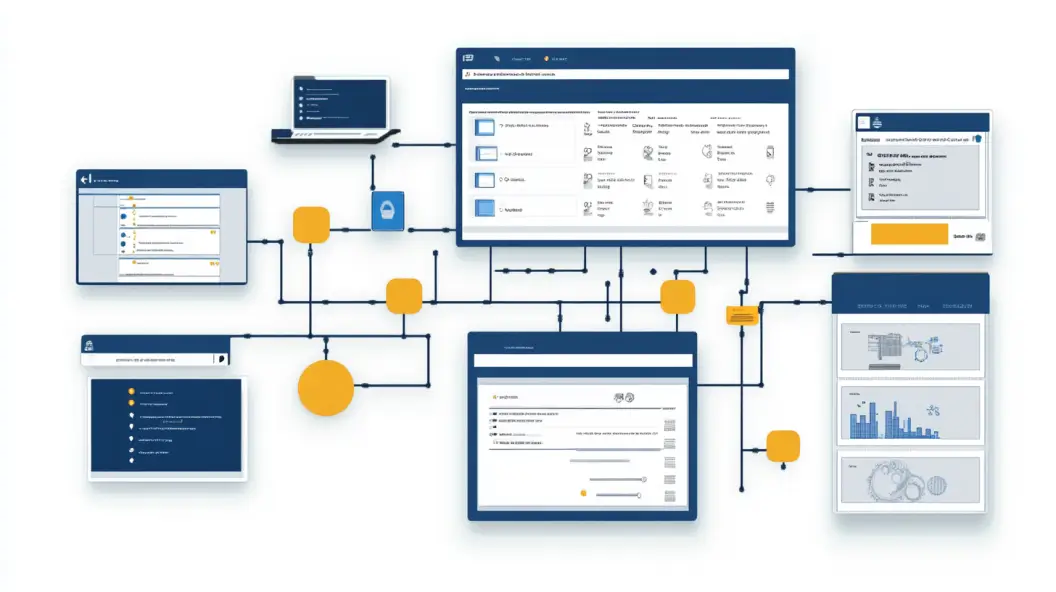
Selecting a platform is only the first step. To get value from your ITSM software, you need a simple implementation plan that matches your team size, support volume, and maturity level.
1. Map Your Current IT Requests
Start by identifying the types of requests your IT team handles most often. This may include password resets, access requests, device issues, software problems, hardware needs, and onboarding tasks.
Ask yourself:
✔️ Which requests happen most often?
✔️ Which issues take the longest to resolve?
✔️ Which tasks could be automated?
✔️ Which requests need approval?
✔️ Which assets or devices need better tracking?
This helps you avoid overbuilding your ITSM system. Start with the workflows that create the most operational friction.
2. Choose the Right Tool and Plan
Once you understand your needs, choose a tool based on your actual IT environment rather than feature lists alone.
For example, choose NinjaOne if endpoint automation is your main priority. Choose monday service if you want flexible workflows. Choose InvGate if you need affordable ITIL structure. Choose Freshservice if you want AI-powered ITSM. Choose Atera if you manage many endpoints as an MSP or IT provider.
3. Configure Core Ticket Categories
Do not start with too many categories. A small business ITSM setup should be simple enough for users and technicians to understand.
Common ticket categories include:
✔️ Access requests
✔️ Hardware issues
✔️ Software support
✔️ Network problems
✔️ Security requests
✔️ Employee onboarding and offboarding
After you launch, review ticket trends and refine your categories based on real usage.
4. Add Automation Gradually
Automation is valuable, but too much automation too early can create confusion. Start with simple automations that save time without adding risk.
Good first automations include:
✔️ Routing tickets by category
✔️ Assigning urgent tickets to the right technician
✔️ Sending status updates to requesters
✔️ Creating approval flows for access requests
✔️ Scheduling patching or maintenance workflows
Once your team is comfortable, you can add more advanced workflows for SLA alerts, asset updates, recurring tasks, and self-service recommendations.
5. Build a Self-Service Knowledge Base
A knowledge base can reduce ticket volume by helping employees solve common issues on their own. Start with short, practical articles for frequent questions.
Useful knowledge base topics include password reset steps, VPN troubleshooting, software request instructions, printer setup, device security guidelines, and onboarding checklists.
6. Review Reports Monthly
ITSM software should help you improve over time. Review reports every month to understand where your team is improving and where bottlenecks still exist.
Track metrics such as:
✔️ Ticket volume by category
✔️ Average first response time
✔️ Average resolution time
✔️ SLA performance
✔️ Reopened tickets
✔️ Self-service usage
Use these insights to improve workflows, update knowledge base content, and adjust staffing or support priorities.
Sample ITSM Implementation Timeline for Small Businesses
You do not need a complex rollout plan to get started. A simple four-week implementation timeline is often enough for small businesses launching a new ITSM tool.
| Timeline | Implementation Step | Goal |
| Week 1 | Map IT requests and support channels | Understand current pain points |
| Week 2 | Choose the tool and configure ticket forms | Create a basic service desk structure |
| Week 3 | Add automation and integrations | Reduce repetitive manual work |
| Week 4 | Launch self-service and reporting | Improve visibility and adoption |
This timeline works best when you keep the first rollout focused. Start with the most important workflows, then expand once your team understands how the platform supports daily operations.
When Each ITSM Tool May Not Be the Best Fit
A strong comparison should also explain where each tool may fall short. This helps you make a better decision and avoid choosing software that looks good on paper but does not fit your operating model.
| Tool | May Not Be Best If… |
| NinjaOne | You need deep ITIL change, problem, and service catalog workflows as your main priority. |
| monday service | You need mature ITIL processes already configured out of the box. |
| InvGate Service Management | You only need very basic ticketing and want the lowest possible entry cost. |
| Freshservice | You want a simple help desk without broader ITSM, asset, or automation features. |
| Atera | You have many technicians but only a small number of endpoints to manage. |
Final Recommendations
The best ITSM software for small businesses depends on how your IT team works, what you need to automate, and how much structure you want in your service management processes.
If you manage many endpoints and need strong remote support, NinjaOne is one of the best options. If you want a flexible, visual platform that is easy to customize, monday service is a strong fit. If you need ITIL-aligned workflows at a more accessible level, InvGate Service Management deserves serious consideration.
For teams that want AI-powered ITSM with asset management and structured service workflows, Freshservice is a strong choice. For MSPs and small IT providers managing many client devices, Atera offers a practical pricing model and a broad set of IT management features.
Our Recommendations:
✅ Best for endpoint automation: NinjaOne
✅ Best for no-code workflows: monday service
✅ Best for affordable ITIL-aligned ITSM: InvGate Service Management
✅ Best for AI-powered ITSM: Freshservice
✅ Best for MSPs: Atera
If you are still comparing broader ITSM options, you can also read our full guide to the best ITSM software or explore our guide on how to choose ITSM software.
FAQ
What is the best ITSM software for small businesses?
The best ITSM software for small businesses depends on your needs. NinjaOne is strong for endpoint automation, monday service is best for no-code workflows, InvGate Service Management is useful for ITIL-aligned processes, Freshservice is strong for AI-powered ITSM, and Atera is a good fit for MSPs.
What is the most affordable ITSM software for small business?
The most affordable option depends on your pricing model. Atera can be cost-effective for MSPs because it charges per technician. monday service can be affordable for teams that want visual workflows. InvGate may offer strong value for teams that need ITIL-aligned features at an annual plan structure.
Is ITSM software different from help desk software?
Yes. Help desk software mainly focuses on support tickets and user requests. ITSM software is broader and may include incident management, service requests, asset management, change management, knowledge management, automation, reporting, and service level tracking.
Do small businesses need ITIL-aligned ITSM software?
Not every small business needs full ITIL implementation. However, ITIL-aligned features can help if you want more structured incident, problem, change, and request management. InvGate Service Management and Freshservice are good examples of tools that support more structured ITSM workflows.
What is the best ITSM tool for MSPs?
Atera and NinjaOne are strong options for MSPs. Atera is useful because of its per-technician pricing model, while NinjaOne is strong for endpoint monitoring, patch management, remote access, and automation across many client environments.
What is the best cloud-based ITSM software for small businesses?
NinjaOne, monday service, InvGate Service Management, Freshservice, and Atera all offer cloud-based service management or IT management capabilities. The best choice depends on whether you prioritize endpoint automation, workflow flexibility, ITIL structure, AI features, or MSP support.
How much does ITSM software cost for small businesses?
ITSM software pricing varies by vendor and model. Some tools charge per agent, some charge per seat, some use per-device pricing, and others charge per technician. Costs also change based on billing cycle, number of users, modules, and support requirements.
Is ServiceNow good for small businesses?
ServiceNow can be powerful for growing organizations with mature IT operations, but it is usually not the first choice for smaller teams that need a lightweight and affordable ITSM tool. Most small businesses should evaluate NinjaOne, monday service, InvGate, Freshservice, or Atera first.
What features should small businesses look for in ITSM software?
Small businesses should look for ticket management, automation, self-service portals, asset tracking, reporting, integrations, cloud deployment, easy onboarding, and pricing that matches team size and support volume.
How long does it take to implement ITSM software?
A small business can often launch a basic ITSM setup in a few weeks. A practical rollout includes mapping support requests, configuring ticket forms, adding automations, connecting integrations, launching self-service, and reviewing reports after launch.