
Introduction
Choosing the right landing page platform is not just about building attractive pages. For ecommerce brands, it can directly affect paid media performance, message match, conversion rates, average order value, and how quickly your team can test new campaign angles.
In this Auware review, you will get a practical look at what the platform does, how it works, where it stands out, where it still has limits, and whether it is the right fit for your Shopify growth stack in 2026.
Auware is best understood as an AI-powered landing page builder built specifically for Shopify merchants and DTC marketers. Instead of creating one generic campaign page for everyone, Auware helps you generate audience-specific landing pages that match the visitor’s intent, persona, pain point, buying trigger, and social proof needs.
What Is Auware?
Auware is an AI landing page builder for Shopify that creates personalized landing pages for different audience segments. It is designed to help ecommerce brands connect the message in their ads with the message on the landing page, so each visitor sees a page that feels more relevant to them.
The core idea is simple. Your ads already target different audiences. Auware helps your landing pages do the same.
For example, a skincare brand may want one landing page for busy parents, another for sensitive-skin shoppers, another for gift buyers, and another for ingredient-conscious consumers. Instead of manually writing and designing each page, Auware uses AI to generate relevant copy, structure the page, match social proof, and publish the page directly to Shopify.
Background and Positioning
Auware is built by Buyist, a team with deep experience in DTC ecommerce and landing page conversion. This background matters because Auware does not feel like a generic page builder with AI added later. It is more focused on one specific problem: helping Shopify brands improve post-click relevance at scale.
That makes Auware different from traditional landing page builders. Most tools help you build pages faster. Auware tries to help you build smarter pages for different audience segments.
Target Users and Use Cases
Auware is most relevant for ecommerce teams that already run paid traffic, test creative angles, and care about conversion performance.
- DTC brands – Create personalized landing pages for different customer segments.
- Shopify merchants – Publish campaign pages directly into the Shopify environment.
- Paid media teams – Match ad angles to post-click page experiences.
- Growth marketers – Test messaging, offers, and audience-specific page formats.
- Ecommerce agencies – Build campaign pages faster for multiple clients.
Auware is less relevant if you only need a simple website page, a general drag-and-drop builder, or a broad CMS. It is a specialized conversion tool for Shopify-focused marketing teams.
Key Features of Auware
How Does Auware Work?
Auware’s workflow is built around one main objective: help you move from a product and audience idea to multiple personalized landing pages without relying on a designer, copywriter, and developer for every campaign.
The platform guides you through campaign setup, marketing voice, content generation, audience selection, Shopify publishing, and performance measurement. This makes it more structured than a blank-page builder and more specialized than a general ecommerce page editor.
AI Campaign Setup
Auware starts by connecting to your Shopify store and using your product data as the foundation for the page. You choose the product you want to promote, define the campaign, and apply the relevant offer or discount.
This is useful because the AI does not create landing pages from a disconnected prompt alone. It can work from your product, store context, reviews, audience segments, and campaign goals.
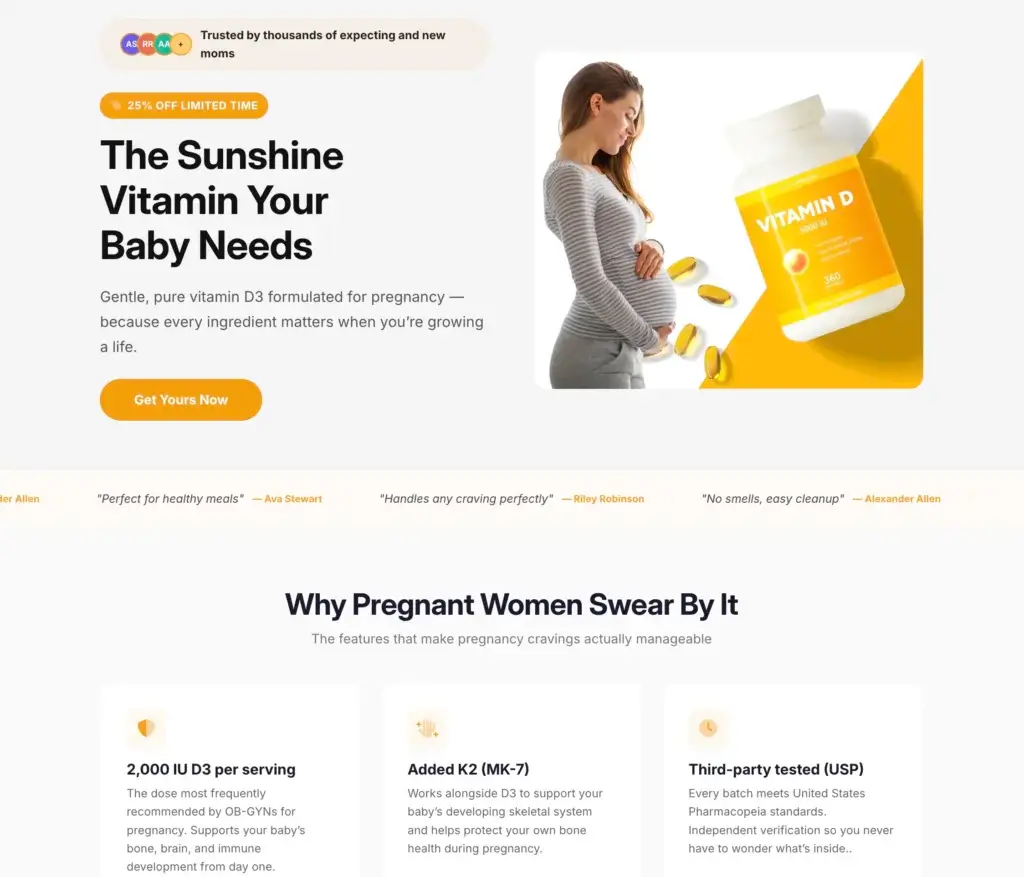
Audience-Specific Landing Pages
The main feature of Auware is audience-specific page generation. You can define audiences manually or let the AI suggest relevant personas for your product.
Each audience can receive its own landing page variation. That means the headline, product angle, benefits, FAQs, CTAs, objections, and social proof can be adjusted to match the visitor segment.
This is where Auware has a clear strategic advantage. Many Shopify brands already segment campaigns in Meta Ads, TikTok Ads, Google Ads, and email. Auware extends that segmentation into the landing page itself.
Marketing Voice and Message Control
Auware lets you define a marketing voice before generating the page. This helps reduce the generic AI tone that often appears in automated copywriting tools.
You can guide the AI toward different angles, such as direct, story-driven, humorous, minimalist, emotional, or compliance-conscious messaging. This matters for ecommerce teams because different products and audiences need different levels of persuasion.
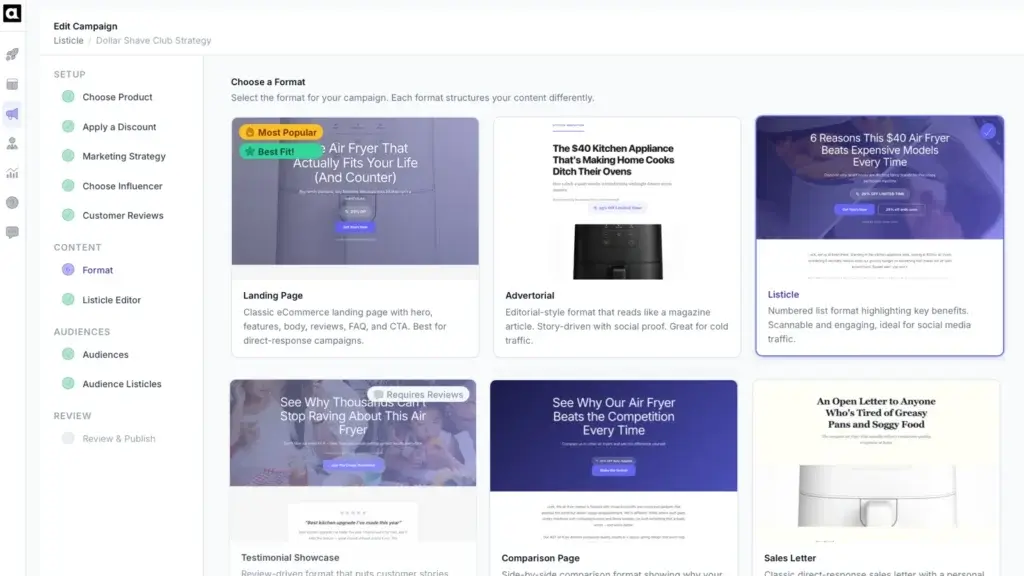
Conversion-Focused Page Formats
Auware supports several campaign page formats, including landing pages, advertorials, listicles, sales letters, testimonial showcases, comparison pages, and PDP-style pages.
This gives marketers more flexibility than a standard product page. For cold traffic, a story-driven advertorial may work better. For comparison shoppers, a comparison page may be stronger. For trust-building, testimonial-focused pages can be more relevant.
Visual Page Editor
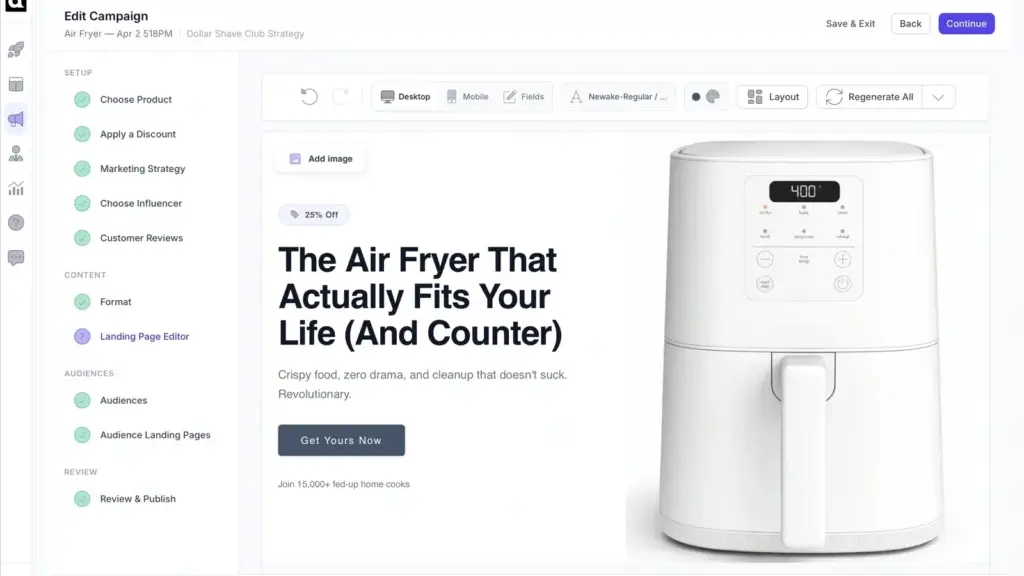
After the AI generates a page, you are not locked into the first output. Auware includes a visual editor that lets you adjust headlines, images, copy, sections, and design details.
This is important because AI-generated pages still need human review. The best use case is not full automation without oversight. The better workflow is AI-assisted creation followed by marketer-led refinement.
Brand-Aligned Design
Auware is designed to detect Shopify store styling, including fonts, colors, and visual identity. The goal is to create landing pages that feel native to the store rather than external or disconnected.
This is a useful advantage over some third-party landing page tools that create pages outside the store experience or require more design work to match the existing brand.
Audience-Matched Social Proof
Social proof is one of Auware’s strongest ideas. The platform can import reviews from tools such as Judge.me, Okendo, and Yotpo, then help match relevant reviews to different audience segments.
For example, a parent may respond better to reviews from other parents, while a fitness buyer may respond better to reviews focused on performance, durability, or results. This type of review relevance can make the page feel more persuasive.
Shopify-Native Publishing
Auware publishes pages directly to Shopify. This matters because cart, checkout, tracking pixels, analytics, and store operations can stay inside the existing Shopify environment.
For Shopify brands, that is a major practical benefit. It reduces the friction of sending paid traffic to an external landing page system that may complicate checkout, analytics, or tracking.
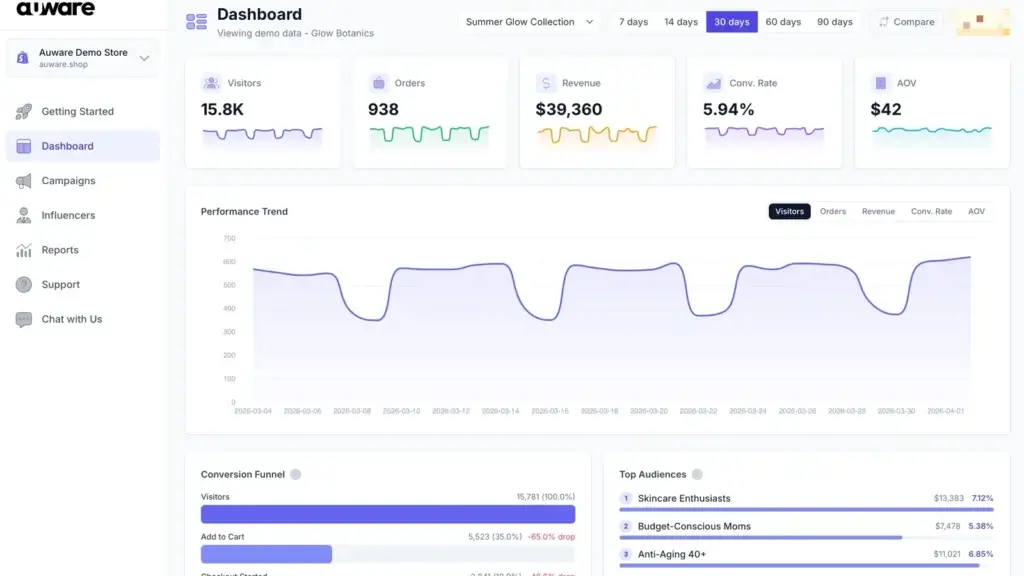
Audience-Level Analytics
Auware includes reporting that helps you analyze performance by campaign, audience, channel, and revenue. The pricing page also references conversion rate, average order value, CPA, and ROAS tracking.
This is one of the most important reasons to consider the platform. It does not only create personalized pages. It also helps you understand which audiences respond best.
AI Features
Auware AI Capabilities
Auware’s AI capabilities are focused on ecommerce conversion, not broad content creation. That distinction is important. This is not a generic AI writing assistant. It is an AI-assisted landing page system built around Shopify products, audiences, and campaign performance.
AI Audience Discovery
Auware can help identify potential audience personas based on the product you are promoting. This is useful for marketers who know they need more personalized pages but do not want to manually create every segment from scratch.
The practical value is speed. Instead of starting with a blank strategy document, you can generate a first set of audience ideas, review them, and decide which ones deserve campaign pages.
AI Copy Generation
Auware generates tailored copy for each audience segment. This can include headlines, benefit statements, product descriptions, FAQs, calls to action, and objection-handling sections.
This can save significant time for teams running several ad campaigns at once. However, the copy should still be reviewed for accuracy, brand voice, compliance, and product claims.
AI Review Selection
One of the more interesting AI use cases is audience-matched social proof. Instead of showing the same generic review block to everyone, Auware can help surface reviews that are more relevant to a specific audience.
For ecommerce conversion, this is more meaningful than basic AI text generation. Buyers often trust relatable proof more than polished sales copy.
AI-Assisted Page Variation
Auware helps create multiple versions of a page based on audience segments. This can make campaign testing faster because your team can move beyond one generic page and test different post-click experiences.
This is especially useful for brands running multiple ad angles. A creative angle should not stop at the ad. The landing page should continue the same story.
AI with Human Editing
The strongest Auware workflow is AI plus human control. The AI helps generate pages faster, while your marketing team reviews the claims, refines the angle, improves the visuals, and chooses which variants to publish.
That balance is important. For ecommerce pages, you should never treat AI copy as automatically ready for paid traffic without review.
Pros and Cons
Benefits and Limitations of Using Auware
Positive
✅ Excellent for Shopify campaigns
✅ Strong audience personalization
✅ Fast AI page generation
✅ Useful social proof matching
Negatives
❌ Shopify-only focus
❌ Not ideal for basic sites
❌ Still needs copy review
❌ Limited public review volume
Strengths & Benefits
Auware is strongest when you use it as a performance marketing tool rather than a simple page builder.
- Excellent for Shopify campaigns – Pages publish natively into Shopify.
- Strong audience personalization – Each audience can receive a tailored landing page.
- Fast AI page generation – Campaign pages can be created much faster than manual builds.
- Useful social proof matching – Reviews can be aligned with audience motivations.
The biggest benefit is message match. If your ad speaks to one persona but your landing page speaks to everyone, conversion performance can suffer. Auware helps close that gap.
Limitations & Drawbacks
Auware is focused, which is both a strength and a limitation.
- Shopify-only focus – It is not built for WordPress, WooCommerce, Webflow, or general websites.
- Not ideal for basic sites – Smaller stores may not need this level of personalization.
- Still needs copy review – AI-generated claims should be checked before publishing.
- Limited public review volume – The product is newer than established page builders.
The main drawback is that Auware is not for everyone. If you are not running segmented ecommerce campaigns, the value may be harder to justify.
Growth Features
Auware Marketing, CRO, and Reporting Tools
Auware is most compelling when viewed through a CRO and paid media lens. It is not only about creating attractive pages. It is about creating landing pages that continue the same targeting logic used in your ads.
Post-Click Personalization
Many ecommerce campaigns personalize the ad but not the destination page. Auware solves this by generating landing pages around audience intent.
This is useful for campaign structures where each ad set targets a distinct persona, need, use case, or objection. Instead of sending everyone to one product page, you can send each segment to a more relevant page.
Meta Ads Support
Auware integrates with Meta Ads and can help generate ad copy variations. This creates a closer relationship between audience targeting, ad messaging, and landing page messaging.
For paid social teams, this can reduce the operational gap between creative testing and landing page testing.
Discount Integration
Auware supports Shopify discount integration, allowing promotions to be reflected in page messaging and applied at checkout.
This is helpful for campaign-specific offers because the page can align the offer, CTA, and checkout flow more tightly.
Influencer Page Add-On
Auware also offers an Influencer Pages add-on. This allows teams to import influencer profiles by URL and add “Sponsored by” or “Influenced by” layers to landing pages.
For brands that use creator campaigns, this can be useful because influencer trust can carry into the landing page experience, not just the ad creative.
Reporting for Performance Teams
Auware’s reporting focuses on metrics that matter to ecommerce teams, including conversion rate, AOV, CPA, ROAS, audience performance, campaign performance, and revenue data.
This gives performance marketers a more useful view than page visits alone. The question is not only whether the page was viewed. The question is which audience page generated the best commercial outcome.
Integrations
Auware Shopify Integrations
Auware is built for Shopify-native ecommerce workflows. Its integration strategy is focused on the tools DTC brands already use for advertising, social proof, attribution, visuals, subscriptions, and checkout.
Shopify
Shopify is the core integration. Auware connects to your store, pulls product context, publishes pages directly to Shopify, and keeps checkout inside the existing store flow.
This is one of the most important reasons to consider Auware over a general landing page tool. For Shopify teams, fewer disconnected systems usually means cleaner tracking and fewer checkout issues.
Reviews and Social Proof
Auware connects with review platforms such as Judge.me, Okendo, and Yotpo. This supports its audience-specific social proof functionality.
For many ecommerce brands, this can be more useful than simply adding a generic testimonial carousel. The more relevant the proof, the more believable the page can feel.
Advertising and Attribution
Auware supports integrations with Meta Ads and Triple Whale. Meta Ads helps with campaign and ad workflow, while Triple Whale supports ecommerce attribution and analytics use cases.
This makes Auware more appealing for paid media teams that need landing page performance connected to campaign performance.
Creative and Subscription Tools
Auware also references Shutterstock integration for images and compatibility with several subscription apps, including Recharge, Skio, Appstle, Loop, Stay AI, Smartrr, Bold, Ordergroove, Seal, Recurpay, PayWhirl, and Shopify Subscriptions.
This is important for DTC brands that rely on recurring revenue. If your landing page can promote subscriptions clearly, you can test offers that support LTV instead of only first-order conversion.
Developer API and HTML Export
Auware includes developer API and HTML export capabilities in its Pro plan. This gives more technical teams additional flexibility if they need to fit Auware into a more customized workflow.
Most marketers may not need this immediately, but agencies and larger ecommerce teams may appreciate the extra control.
Pricing
Auware Pricing & Plans
Auware uses a straightforward pricing model. The main Pro plan costs $199 per month per Shopify store and includes a 30-day free trial.
For smaller stores, that may feel expensive compared with basic page builders. For active DTC brands spending meaningful budget on paid traffic, the pricing is easier to justify if audience-specific pages improve campaign efficiency.
Pro Plan
The Pro plan includes the full landing page platform, AI content generation, multiple marketing voices, brand-aligned design, visual editing, conversion-focused formats, audience segmentation, personalized pages, audience-matched reviews, Shopify publishing, analytics, reporting, integrations, developer API, and HTML export.
The plan includes 10 active campaigns and 6 personalized audience pages per product. Each store requires its own subscription.
Influencer Pages Add-On
Auware offers Influencer Pages as an add-on at $99 per month. This is useful for brands that use creators, ambassadors, or influencer-led paid social campaigns.
The add-on lets you import influencer profiles and add sponsored or influenced-by elements to landing pages.
Tailored Solutions
For scaling businesses and Shopify Plus merchants, Auware offers tailored solutions with flexible limits, custom integrations, onboarding, and priority support.
This is the route that will likely make sense for agencies, larger DTC brands, and companies managing multiple stores or high-volume campaigns.
Pricing Table
The table below gives a practical view of Auware’s current pricing structure.
| Plan / Option | Price | Best For | Key Features |
| Pro Plan | $199/month per store | Shopify brands running paid campaigns | AI landing pages, 10 active campaigns, 6 audience pages per product, Shopify publishing, analytics |
| Influencer Pages Add-On | $99/month | Brands using creators or influencer campaigns | Influencer profile import, sponsored page layers, creator-led landing pages |
| Tailored Solutions | Custom pricing | Shopify Plus merchants and scaling teams | Flexible limits, priority onboarding, custom integrations, dedicated support |
Overall, Auware is not the cheapest Shopify page builder. It is better positioned as a performance tool for brands that want to improve campaign conversion by personalizing landing pages for different audiences.
Use Cases
Who Should Use Auware?
Auware is best for brands that already understand the value of segmentation. If you are still sending every paid visitor to the same product page, Auware can help you test a more refined approach.
DTC Brands Running Paid Social
Auware is a strong fit for DTC brands that run Meta, TikTok, Google, or influencer campaigns. These brands often have multiple audience angles but not enough time to manually create landing pages for each one.
If your team regularly tests creative hooks, pain points, personas, or seasonal offers, Auware can help your landing pages keep pace with your ad testing.
Shopify Stores with Multiple Customer Personas
Some products appeal to several different buyer types. A wellness product may appeal to athletes, parents, professionals, and gift buyers. A home product may appeal to renters, homeowners, pet owners, and design-conscious buyers.
Auware is useful in these situations because each persona may care about different benefits, objections, proof points, and CTAs.
Agencies Managing Ecommerce Campaigns
Auware can also be valuable for ecommerce agencies. Agencies often need to create landing pages quickly for different clients, products, offers, and ad angles.
The platform can shorten production cycles and help agencies offer more sophisticated campaign testing without adding too much manual work.
Brands Focused on CRO
If you already care about conversion rate optimization, Auware gives you another layer to test. Instead of only testing button colors or page sections, you can test whether different audiences respond better to different page narratives.
This is a more strategic CRO angle. It focuses on relevance rather than cosmetic changes.
When Auware Might Not Be Right
Auware may not be the right fit if you are not using Shopify, do not run paid campaigns, have very low traffic, or only need a basic landing page builder.
It may also be too much for early-stage stores that do not yet have enough traffic, reviews, or audience data to support meaningful segmented testing.
Competitors
Competitor Alternatives to Auware
Auware competes with Shopify page builders, ecommerce landing page tools, and broader landing page platforms. The main difference is that Auware is more focused on AI-powered audience personalization than general page design.
Relevant alternatives include PageFly, GemPages, Shogun, Replo, Unbounce, and Shopify’s own theme and product page tools. The best option depends on whether you care most about design flexibility, AI generation, Shopify-native publishing, or campaign personalization.
| Feature Type | Auware | PageFly | GemPages | Replo |
| Core focus | AI audience-specific Shopify landing pages | Flexible Shopify page building | AI-assisted Shopify page design | High-performance ecommerce landing pages |
| Best for | DTC brands running segmented campaigns | Merchants needing design flexibility | Stores wanting template-driven page creation | Growth teams and agencies |
| AI personalization | Strong audience-based personalization | Limited compared with Auware | AI features available, less audience-specific | More focused on building and testing pages |
| Shopify fit | Excellent | Excellent | Excellent | Excellent |
| Ease of use | Strong guided workflow | Moderate to strong | Strong | Moderate |
| Best advantage | Message match by audience | Broad page design control | Fast page creation | Advanced ecommerce page workflow |
Compared with PageFly and GemPages, Auware is less of a general-purpose design tool and more of a campaign personalization tool. Compared with Replo, Auware feels more guided and AI-led, while Replo may appeal more to teams that want advanced ecommerce page building and design control.
Compared with Unbounce, Auware has a clearer Shopify-native advantage. Unbounce is a strong landing page platform, but Auware is more directly built around Shopify products, checkout, reviews, and ecommerce campaign segmentation.
My recommendation is straightforward. If you need a flexible design builder, compare PageFly, GemPages, and Replo. If your main problem is that your ads are segmented but your landing pages are still generic, Auware is the more relevant tool to test.
Best Practices
Getting Started with Auware
To get the most value from Auware, you should approach it as a campaign system, not just another page editor.
Start with Your Highest-Value Product
Do not begin by creating pages for every product in your store. Start with a product that already has traffic, sales data, strong reviews, and clear audience segments.
This gives Auware better material to work with and gives your team a better chance of seeing measurable impact.
Map Audiences Before You Build
Before generating pages, define the audience segments you actually target in ads. These may include personas, pain points, use cases, price sensitivities, objections, or buying occasions.
The better your audience strategy, the better your landing page strategy will be.
Use Reviews Strategically
Auware can help match reviews to audiences, but your review library still matters. Make sure your store has enough meaningful product reviews before relying heavily on social proof personalization.
If your reviews are thin, generic, or outdated, improve your review collection process first.
Review AI Copy Before Publishing
AI-generated copy can save time, but it should not replace editorial judgment. Check product claims, compliance language, tone, guarantees, discount details, and brand positioning before sending paid traffic to a page.
This is especially important for regulated categories, health-related products, financial products, supplements, and any product with sensitive claims.
Compare Against a Baseline
Auware becomes more valuable when you compare audience-specific pages against a baseline page. This helps you understand whether personalization is actually improving performance.
Do not assume every personalized page will win. Treat each variant as a test.
Measure More Than Conversion Rate
Conversion rate matters, but it is not the only metric. Track AOV, CPA, ROAS, subscription take rate, bounce rate, and post-purchase behavior when possible.
A page that gets more conversions but attracts lower-quality buyers may not be the best long-term winner.
Conclusion
Final Thoughts
Auware is one of the more interesting Shopify-focused landing page tools because it solves a real performance marketing problem. Many ecommerce brands segment their ads carefully but send visitors to the same generic landing page. Auware helps fix that disconnect.
Its biggest strengths are audience-specific page generation, Shopify-native publishing, AI copy creation, review matching, conversion-focused formats, and performance reporting. It is especially useful for DTC brands and agencies that run multiple paid campaign angles and need to create landing pages faster.
Its biggest limitations are its Shopify-only focus, higher monthly cost compared with basic page builders, reliance on human review for AI outputs, and relatively limited public review history compared with older tools.
Overall, Auware is a strong recommendation for Shopify brands that already invest in paid acquisition and want to improve post-click relevance. If your store has meaningful traffic, several customer personas, and enough campaign volume to test audience-specific pages, Auware can be a valuable addition to your growth stack.
If you only need a simple drag-and-drop page builder, you may be better served by a broader Shopify page builder. If your main challenge is turning segmented traffic into more relevant landing page experiences, Auware is exactly the type of tool worth testing.
Frequently Asked Questions
Have more questions?
What is Auware?
Auware is an AI-powered landing page builder for Shopify. It helps ecommerce brands create audience-specific landing pages for paid campaigns, product promotions, and segmented customer journeys.
Who is Auware best for?
Auware is best for Shopify merchants, DTC brands, paid media teams, growth marketers, and ecommerce agencies that run segmented campaigns and want more relevant post-click landing pages.
Does Auware work with Shopify?
Yes. Auware is built for Shopify and publishes landing pages directly to the store, so cart, checkout, tracking, and analytics can stay inside the Shopify environment.
How much does Auware cost?
Auware’s Pro plan costs $199 per month per Shopify store. It also offers a 30-day free trial, an Influencer Pages add-on, and tailored options for scaling teams and Shopify Plus merchants.
Does Auware use AI?
Yes. Auware uses AI to generate landing page copy, suggest audience segments, tailor messaging, match social proof, and create personalized page variations for different customer personas.
Can Auware replace a page builder?
For Shopify campaign landing pages, yes, Auware can replace a standard page builder for many use cases. However, it is more specialized for audience-specific ecommerce pages than broad website design.
Does Auware work for non-Shopify websites?
Auware is primarily built for Shopify stores. If you use WordPress, WooCommerce, Webflow, or another platform, a more general landing page builder may be a better fit.
What makes Auware different from PageFly or GemPages?
PageFly and GemPages are broader Shopify page builders. Auware is more focused on AI-powered audience personalization, message match, social proof relevance, and campaign-specific landing pages.
Is Auware good for agencies?
Yes. Auware can be useful for ecommerce agencies that need to build multiple campaign pages quickly, especially when managing paid media and CRO for Shopify clients.
Is Auware worth it in 2026?
Auware is worth considering if you run Shopify paid campaigns and need personalized landing pages for different audiences. It is less necessary for small stores that only need basic pages or do not yet have meaningful campaign traffic.