Introduction
AI search is changing how buyers discover brands, compare products, and decide which companies deserve attention. Instead of browsing several search results, many users now ask tools like ChatGPT, Perplexity, Gemini, Claude, and Google AI Overviews for direct recommendations.
That creates a new challenge for marketing teams. Your website may rank well in traditional search, but if AI answer engines do not mention your brand, cite your content, or describe your product accurately, you may lose influence before buyers ever reach your site.
Profound is built to help solve that problem. It gives brands a way to monitor how they appear in AI-generated answers, understand which competitors are being recommended, identify which sources influence AI responses, and improve visibility across answer engines.
In this Profound review, you’ll get a practical look at its core features, user experience, pricing considerations, strengths, limitations, best use cases, and alternatives. The goal is to help you decide whether Profound is the right AI search visibility platform for your business in 2026.
What Is Profound?
Profound is an AI search visibility and answer engine optimization platform. It helps marketing teams understand how their brand, products, competitors, and content appear across AI-generated answers.
Instead of focusing only on keyword rankings, Profound tracks brand mentions, citations, sentiment, answer visibility, prompt demand, AI crawler activity, and competitive share of voice. This makes it especially useful for brands that want to understand their presence in AI-driven discovery.
In simple terms, Profound helps answer one critical question: when your target audience asks AI tools about your category, does your brand show up, and is it represented accurately?
Background and Market Position
Profound sits in a fast-growing category often described as answer engine optimization, generative engine optimization, or AI search visibility. These terms all point to the same shift: brands now need to optimize for AI-generated answers, not only traditional search results.
The platform is positioned toward serious marketing teams, enterprise brands, growth teams, PR teams, agencies, and content teams that need more than manual AI testing. Rather than asking a few prompts manually and saving screenshots, Profound provides structured monitoring and reporting.
This matters because AI answers can influence product discovery, brand perception, comparison research, and purchase consideration. If your competitors are consistently mentioned and cited while your brand is absent, that gap can affect demand generation even when your classic SEO metrics look healthy.
Target Users and Use Cases
Profound is best suited for teams that already care deeply about search visibility, brand authority, content strategy, and competitive positioning. It is particularly relevant for companies in crowded markets where buyers ask AI tools for recommendations and comparisons.
- AEO teams – Track AI visibility across key prompts and answer engines.
- SEO teams – Add AI visibility data to traditional search reporting.
- Content teams – Find content gaps that may limit AI citations.
- PR and brand teams – Understand how AI systems describe the company.
- Agencies – Monitor client visibility and competitive share of voice.
If your company relies on search, thought leadership, comparison pages, product-led education, reviews, or third-party mentions, Profound can help you see how those assets perform in AI answer environments.
Profound Key Features
How Does It Work?
Profound is built around the full AI visibility workflow. It helps you understand what people ask AI tools, how your brand appears in the answers, which competitors are winning visibility, which sources are being cited, and how AI crawlers interact with your website.
That makes it different from a traditional SEO platform. Classic SEO tools focus on keyword rankings, backlinks, technical audits, and organic traffic. Profound focuses on how AI answer engines understand, cite, and represent your brand.
Answer Engine Insights
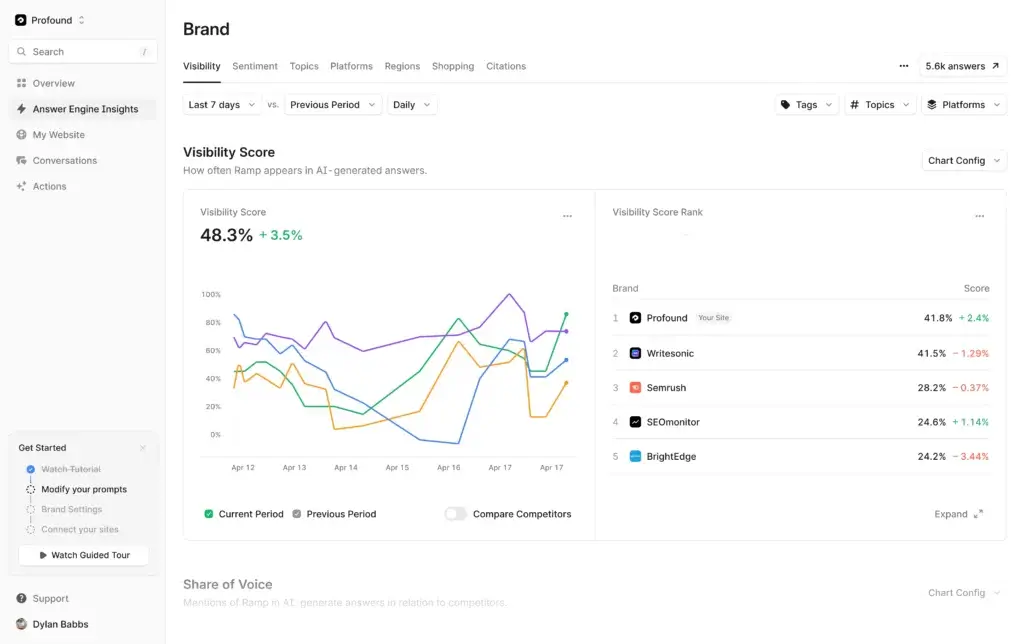
Answer Engine Insights is one of Profound’s core features. It helps you see how AI platforms represent your brand across relevant conversations, prompts, and category-level answers.
This is important because AI search visibility is not only about being mentioned. It is also about how you are mentioned. A brand can appear in an AI answer but still be positioned poorly, described inaccurately, or placed below stronger competitors.
With this type of insight, marketing teams can monitor brand mentions, competitive visibility, answer position, citations, and sentiment. This gives you a clearer view of your presence in AI-generated discovery journeys.
Prompt Volumes
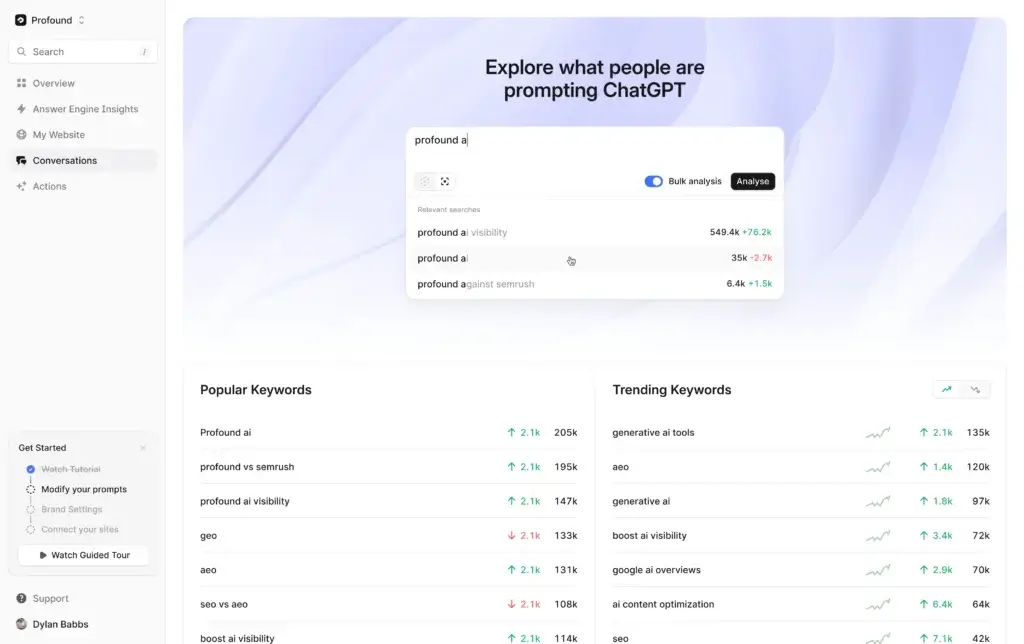
Prompt Volumes helps teams understand what people are asking AI systems. This is a major advantage because AEO is not built only around short keywords. It is built around conversational prompts, buyer questions, and intent-rich queries.
For example, a traditional SEO tool may help you analyze a keyword like “best CRM software.” Profound is more useful when you want to understand AI-style prompts such as “What CRM should a fast-growing B2B company use?” or “Which project management platform is best for agencies?”
This helps content and demand generation teams align their strategy with real AI search behavior. Instead of guessing which prompts matter, you can prioritize topics based on demand and competitive visibility.
Competitive AI Visibility Tracking
AI visibility is competitive by nature. If an AI answer recommends three brands and yours is missing, your competitors may be shaping the buyer’s shortlist before your website gets a chance to convert.
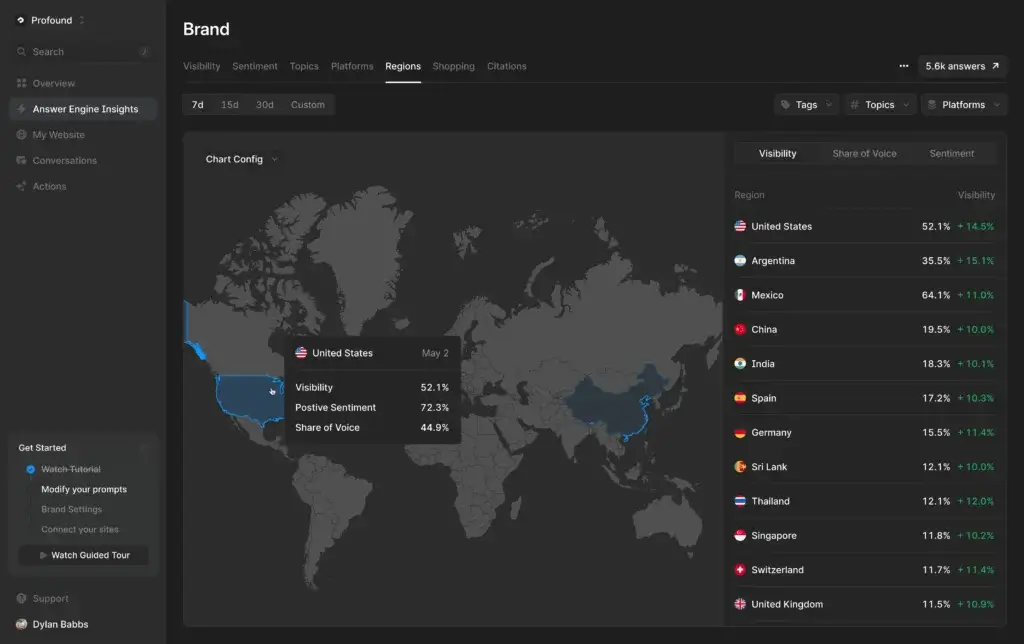
Profound helps you compare your brand against competitors across relevant prompts and answer engines. This can reveal where competitors are mentioned more often, where they are cited more strongly, and where their positioning is better aligned with buyer intent.
For B2B SaaS companies, this is especially valuable. Buyers often ask AI tools for product recommendations, alternatives, comparison summaries, use-case fit, pricing context, and implementation advice. Profound helps you see whether your brand is present in those moments.
Citation and Source Analysis
AI answer engines often rely on cited or referenced sources when generating responses. Those sources may include product pages, documentation, review websites, comparison articles, forums, media coverage, and industry guides.
Profound helps identify which sources are influencing AI answers. This matters because AEO is not only an owned-content strategy. It is also shaped by third-party authority, digital PR, review visibility, partner content, and category coverage.
If AI systems regularly cite competitor pages or third-party articles that exclude your brand, that is a signal to update your content strategy, improve external visibility, and strengthen your presence on trusted sources.
Agent Analytics
Agent Analytics helps teams understand how AI crawlers and agents interact with their website. This is a useful layer for technical marketers because AI visibility is influenced not only by content quality, but also by how AI systems can access and interpret that content.
Profound positions this feature around tracking how your site is interpreted and crawled by AI systems such as ChatGPT, Gemini, Claude, Perplexity, and others.
For larger websites, this can be particularly helpful. If important pages are not being accessed, interpreted, or surfaced correctly, your content may be less visible in AI-generated answers even if it performs well in traditional search.
Profound Agents
Profound also includes AI agents designed to support marketing work. These agents are positioned as autonomous workers for different marketing functions, including AEO, SEO, content, demand generation, PR, and communications.
This is where Profound moves beyond monitoring. The platform is not only trying to show what is happening in AI search. It also aims to help teams act on that data through automated workflows and content-related execution.
For experienced teams, this can reduce manual work. For newer teams, it may require careful oversight to ensure recommendations and outputs align with brand voice, editorial standards, and business goals.
AI Shopping Visibility
Profound also references shopping-related capabilities. This is especially relevant for ecommerce brands and product-led companies that want to understand how AI tools recommend products, summarize categories, and influence commercial discovery.
As AI assistants become more involved in product discovery and comparison behavior, shopping visibility may become increasingly important. Brands in ecommerce, consumer goods, retail, and marketplaces should pay close attention to this area.
Reporting and Exports
Profound is designed for teams that need reporting, not only one-off diagnostics. Depending on the plan and setup, teams may use exports, dashboards, historical data, and enterprise-level reporting to track visibility trends over time.
This is important because AI answers are dynamic. One prompt result is not enough to prove success or failure. The real value comes from monitoring patterns across prompts, engines, competitors, citations, and time periods.
Pros and Cons
Benefits and Limitations of Profound
Positive
✅ Broad AI engine coverage
✅ Prompt intelligence
✅ Competitive analysis
✅ Citation tracking
Negative
❌ Higher cost
❌ Enterprise orientation
❌ Data interpretation required
❌ Dynamic answers
Strengths and Benefits
Profound’s biggest strength is depth. It is not just a brand mention checker. It provides a more complete view of AI search visibility, including prompts, citations, competitors, sentiment, AI crawler behavior, and reporting.
- Broad AI engine coverage – Track visibility across several leading AI platforms.
- Prompt intelligence – Understand the questions users ask AI tools.
- Competitive analysis – Compare your AI visibility against key competitors.
- Citation tracking – See which sources influence AI-generated answers.
This makes Profound especially useful for brands that compete in high-intent categories. If buyers ask AI tools for recommendations in your market, Profound helps you understand whether your brand is part of the answer.
Another major benefit is that Profound connects AEO with broader marketing strategy. It can support SEO, content planning, PR, brand positioning, demand generation, and executive reporting.
Limitations and Drawbacks
Profound is powerful, but it is not the best fit for every company. Its strongest value appears when your team has enough content maturity, budget, and strategic focus to act on the data.
- Higher cost – It may be expensive compared with simpler AI visibility tools.
- Enterprise orientation – Smaller teams may not need the full feature depth.
- Data interpretation required – AI visibility metrics need strategic context.
- Dynamic answers – AI results can change by prompt, model, and timing.
The biggest limitation is that AI visibility is still a developing measurement category. There is no universal standard that works exactly like traditional keyword rank tracking.
That does not reduce Profound’s value, but it does mean the tool should be used for trend analysis, competitive intelligence, and strategic decision-making rather than as a perfect single-number score.
Ease of Use and Workflow
Profound User Experience
Profound is designed for modern marketing teams, but it is not a basic tool. The interface and workflow are built around data, prompt tracking, visibility analysis, and optimization opportunities.
For experienced SEO, content, growth, and brand teams, this depth is a major advantage. For smaller teams or marketers new to AEO, the platform may require a learning period.
Setup and Onboarding
The setup process should start with your brand, competitors, category, target audience, and the prompts you want to monitor. This part is critical because poor prompt selection can lead to weak insights.
For example, tracking a broad prompt like “best software” will not be as useful as tracking specific buyer-intent prompts such as “best AI visibility tools for enterprise SaaS brands” or “best project management software for agencies.”
To get the most value from Profound, your team should define prompts based on real buyer behavior, sales conversations, comparison searches, and category-specific pain points.
Daily Workflow
A practical Profound workflow usually includes reviewing visibility trends, checking competitor mentions, analyzing citations, identifying content gaps, and prioritizing optimization actions.
This makes the platform useful for recurring marketing planning. Instead of treating AEO as a one-time audit, teams can use Profound as an ongoing visibility intelligence system.
For example, a content team might use Profound to identify prompts where competitors dominate. A PR team might use it to understand which third-party sources influence AI answers. An SEO team might use it to update pages that are underperforming in AI search visibility.
Learning Curve
Profound’s learning curve is moderate to high, depending on your team’s experience. The platform is easier to understand if you already work with SEO reporting, content strategy, competitive analysis, and marketing analytics.
The challenge is not only learning the interface. It is learning how to interpret AI visibility data correctly. AI answers vary more than traditional rankings, so teams need to look for patterns rather than overreacting to individual responses.
This is why Profound is best for teams that can connect insights to execution. The data becomes more valuable when you can turn it into better content, stronger positioning, improved PR coverage, and clearer category authority.
Best Practice for Better Results
The best way to use Profound is to build a structured AEO workflow. Start with your most commercially important prompts, track your top competitors, review citations, and connect findings to a content roadmap.
You should also separate informational prompts from buying-intent prompts. A prompt like “what is answer engine optimization” has educational value, while a prompt like “best AEO tools for enterprise marketing teams” has stronger commercial value.
Prioritize prompts that influence buying decisions, competitive shortlists, and category perception. That is where Profound can have the clearest business impact.
Pricing
Plans, Trial, and Cost Considerations
Profound pricing should be evaluated carefully because the platform is more advanced than many lightweight AI visibility tools. It is generally positioned for teams that need serious monitoring, reporting, and optimization support.
Profound’s public pricing page may require direct engagement or a demo depending on current availability. Third-party sources have reported entry-level pricing around the high hundreds per month, with custom pricing for larger enterprise needs. Always confirm the latest pricing, plan limits, and included features directly with Profound before buying.
Reported Entry-Level Plan
Some third-party pricing research has referenced a Profound Lite or standard plan around $499 per month. Reported inclusions may include prompt monitoring, response analysis, multiple domains, content opportunities, user seats, exports, and email support.
Because pricing can change, you should treat this as a budgeting signal rather than a fixed quote. The most important questions are how many prompts you can track, how frequently responses are refreshed, which engines are included, how much historical data you get, and whether exports or integrations are included.
Enterprise Pricing
Profound is especially relevant for enterprise teams that need custom reporting, higher response limits, more seats, deeper historical data, API access, dedicated support, or strategic guidance.
For large brands, the value is not only in monitoring AI visibility. It is in connecting AI visibility to brand strategy, content planning, competitive positioning, PR, and executive reporting.
Pricing Table
| Pricing Area | What It Means | What to Check Before Buying |
| Public Pricing | May require demo or direct sales contact | Confirm the latest plan structure with Profound |
| Reported Entry Plan | Third-party sources report pricing around $499/month | Verify current cost, limits, and contract terms |
| Prompt Limits | Number of prompts or responses tracked | Check whether limits match your category needs |
| Engine Coverage | AI platforms included in monitoring | Confirm support for ChatGPT, Gemini, Perplexity, Claude, and others |
| Historical Data | How far back visibility data is stored | Review whether history is enough for trend reporting |
| Enterprise Support | Dedicated support, API, strategy, and custom limits | Evaluate whether your team needs enterprise-level service |
For small teams, Profound may feel expensive if you only need basic brand mention monitoring. For larger teams, the platform can be easier to justify if AI search visibility is already part of your SEO, content, PR, or demand generation strategy.
Best Use Cases
Who Should Use Profound?
Profound is not for every business. It works best when AI visibility has strategic value and your team has the ability to act on the findings.
Best for Enterprise Marketing Teams
Profound is a strong fit for enterprise marketing teams that need to monitor brand visibility across multiple AI platforms. Larger companies often compete across many prompts, product categories, geographies, and audience segments.
For these teams, manual AI search testing is not scalable. Profound provides a more structured way to monitor visibility, compare competitors, and report changes over time.
Best for SEO and AEO Teams
Profound is highly relevant for SEO teams expanding into answer engine optimization. Traditional SEO tools remain important, but they do not fully show how AI systems describe, cite, or recommend your brand.
By adding Profound to the stack, SEO teams can connect keyword strategy with prompt strategy. This helps them understand where traditional search visibility supports AI visibility and where AI answers create a separate visibility challenge.
Best for Content Teams
Content teams can use Profound to identify missing topics, weak positioning, citation gaps, and prompts where competitors are more visible. This can support stronger content briefs and better update priorities.
For example, if AI answers cite competitor comparison pages but ignore your own content, you may need to improve content structure, add clearer direct answers, strengthen evidence, update FAQs, or build better third-party authority.
Best for PR and Brand Teams
Profound is also useful for PR and communications teams because AI systems do not only summarize product features. They also shape brand perception.
If AI tools describe your company inaccurately, omit key differentiators, or rely on outdated sources, brand teams need to know. Profound can help identify where perception gaps exist and which sources may be influencing them.
Best for Agencies
Agencies can use Profound to support AEO audits, competitive reports, content planning, and client education. AI visibility is still new for many clients, so clear reporting can help explain why this channel matters.
However, agencies should evaluate cost, client separation, reporting flexibility, exports, and workflow fit before standardizing on Profound for all accounts.
When Profound Might Not Be the Right Fit
Profound may not be the best fit if you are a very small business, have a limited content budget, or only need occasional AI search checks. In those cases, a lighter AEO tool or manual audit may be enough to start.
It may also be too early if your website lacks basic SEO strength. If your content is thin, outdated, poorly structured, or not authoritative, you may need to improve your foundation before investing heavily in AI visibility monitoring.

Profound Alternatives
Competitors and Comparisons
Profound is one of the stronger platforms in the AI search visibility category, but it is not the only option. The best alternative depends on your budget, reporting needs, team size, and whether you want a specialized AEO platform or a broader SEO workflow.
| Tool | Best For | Main Advantage | When to Choose It Over Profound |
| Profound | Enterprise AI visibility teams | Deep AI search monitoring and competitive intelligence | Choose it when AEO is a strategic, ongoing function |
| HubSpot AEO | HubSpot users and B2B marketing teams | Accessible AI visibility workflow connected to HubSpot | Choose it if you want AEO inside a HubSpot marketing workflow |
| Semrush AI Visibility Toolkit | SEO teams using Semrush | AI visibility inside a broader SEO platform | Choose it if your team already depends on Semrush |
| Ahrefs Brand Radar | Brand and competitive intelligence teams | Brand visibility and share-of-voice research | Choose it if brand monitoring matters more than full AEO workflows |
| Peec AI | Focused AI visibility tracking | Clear monitoring across AI answer engines | Choose it if you want a dedicated AEO tool with a leaner setup |
| Otterly.AI | SMBs and lightweight monitoring | Simple AI search monitoring | Choose it if you need a more affordable entry point |
| SE Ranking AEO / AEO Vision | SEO teams testing AI visibility | AI visibility features within an SEO-oriented workflow | Choose it if you want AEO added to a familiar SEO stack |
| Frase | Content optimization teams | AI-assisted content briefs and optimization | Choose it if content creation matters more than AI visibility monitoring |
Profound vs HubSpot AEO
Profound is generally the stronger option for teams that need deeper AI visibility intelligence, broader monitoring, and more advanced reporting. It is better suited for enterprise teams, agencies, and brands that treat AEO as a serious strategic channel.
HubSpot AEO is more accessible for teams already working inside HubSpot. It may be easier to adopt if your CRM, marketing automation, and content workflows already live in that ecosystem.
Choose Profound if you need advanced AI search visibility. Choose HubSpot AEO if you want a simpler AEO workflow connected to HubSpot.
Profound vs Semrush AI Visibility Toolkit
Semrush is still stronger as a broad SEO platform. It is useful for keyword research, technical SEO, backlinks, competitor analysis, and organic performance tracking.
Profound is more specialized for AI answer visibility. It is the better fit when your main goal is understanding how AI systems mention, cite, and position your brand.
For many serious teams, the best setup is not Profound or Semrush. It is Profound and Semrush together. Use Semrush for SEO foundations and Profound for AI visibility measurement.
Profound vs Ahrefs Brand Radar
Ahrefs Brand Radar is useful for brand visibility, mentions, and competitive intelligence. It fits teams that care about how often a brand appears across digital surfaces and how it compares with competitors.
Profound is more focused on AI answer engines and prompt-level visibility. If your main question is “How does AI describe and recommend us?” Profound is likely the stronger choice.
Profound vs Peec AI
Peec AI is a focused AI visibility platform that may appeal to teams looking for a more streamlined AEO workflow. It can be a strong option for companies that want clear monitoring without the full enterprise depth of Profound.
Profound is better when you need deeper intelligence, broader use cases, and more robust reporting. Peec AI may be better if your team wants a simpler and potentially more cost-effective dedicated AEO platform.
Profound vs Otterly.AI
Otterly.AI is often a better fit for smaller teams that want lightweight AI search monitoring. It can help you track mentions and visibility without committing to a more advanced enterprise platform.
Profound is stronger for larger teams that need more depth, more reporting, and a broader AI visibility strategy. If budget is limited, Otterly.AI may be a better first step. If AI visibility is already mission-critical, Profound is more compelling.
Profound vs Frase
Frase is mainly a content optimization and AI content workflow tool. It helps with briefs, topic coverage, and content creation, but it is not a direct replacement for a dedicated AI visibility platform.
Profound is better for monitoring how your brand appears in AI answers. Frase is better for creating and optimizing content. The two can work together if your team wants both visibility insights and content execution support.
Profound vs Traditional SEO Tools
What It Replaces and What It Does Not
Profound should not be viewed as a full replacement for your SEO stack. It solves a different problem.
Traditional SEO tools help you understand how your website performs in search engines. They are still essential for keyword research, technical SEO, backlink analysis, content optimization, rank tracking, and organic traffic reporting.
Profound helps you understand how your brand appears in AI-generated answers. That includes whether your brand is mentioned, how competitors are positioned, which sources are cited, and how AI crawlers interact with your site.
What Traditional SEO Tools Do Better
Traditional SEO platforms are still stronger for technical and search performance tasks. You need them to understand organic rankings, search volume, keyword difficulty, backlink profiles, crawl errors, page health, and traffic trends.
If your website has poor technical SEO, weak content, thin topical coverage, or limited authority, an AEO platform alone will not solve those issues.
AI answer engines often rely on content that is clear, authoritative, and discoverable. That means SEO fundamentals still matter.
What Profound Does Better
Profound is better for prompt-level visibility, AI citations, competitor mentions, sentiment, and AI answer analysis. It gives you visibility into a layer of discovery that classic SEO tools were not originally designed to measure.
This is valuable because AI-generated answers can influence buyers before they click a result. If your brand is absent from important AI answers, you may lose awareness even if your website traffic looks stable.
Best Approach: Use Both Together
The strongest strategy is to use Profound alongside traditional SEO tools. Use SEO software to build the foundation, then use Profound to see how that foundation performs in AI-generated discovery.
For example, you can use keyword research tools to identify search demand, then use Profound to monitor related AI prompts and understand whether your brand appears in the answers.
For more context, you can also review our guides to AI marketing tools, keyword research tools, and marketing automation software.
Best Practices
Getting Started With Profound
Profound is most valuable when it is part of a clear process. The platform can reveal AI visibility gaps, but the business impact comes from how you act on those insights.
Start With High-Intent Prompts
Begin with prompts that reflect real buying behavior. These are the questions prospects ask when they compare tools, evaluate use cases, look for recommendations, or build a shortlist.
Examples include “best AEO tools for enterprise brands,” “top CRM platforms for B2B SaaS,” or “best project management software for client collaboration.”
These prompts are more useful than broad informational questions because they are closer to commercial decision-making.
Map Competitors Carefully
Your competitor list should reflect the companies your buyers actually compare. Do not only track the biggest brands in the category. Track direct competitors, emerging competitors, and category leaders that influence buyer perception.
This helps you understand whether your brand is losing visibility to companies that matter commercially.
Review Cited Sources
AI answers are often shaped by the sources they cite or reference. Review these sources carefully.
If AI engines cite competitor documentation, review sites, media articles, or third-party lists, your strategy may need to include more than on-page SEO. You may need better digital PR, stronger review visibility, partner mentions, comparison content, and clearer product positioning.
Turn Insights Into Content Briefs
Profound insights should become actionable content briefs. Each visibility gap should lead to a clear next step, such as updating a comparison page, improving a product page, adding FAQ schema, creating a use-case guide, or strengthening a third-party presence.
For example, if your brand is missing from “best AI search visibility tools,” you may need a stronger category page, clearer feature explanations, more direct comparison content, and better external validation.
Measure Trends, Not Single Answers
AI answers can change. A single response is useful, but it should not be treated as final proof.
Look for recurring patterns across prompts, answer engines, competitors, cited sources, and time periods. This gives you a more reliable view of whether your AI visibility is improving.
Conclusion
Final Thoughts
Profound is one of the more advanced platforms in the AI search visibility category. It is built for teams that want to understand how their brand appears across AI-generated answers, which competitors are being recommended, which sources influence responses, and where content or authority gaps exist.
Its strongest features include Answer Engine Insights, Prompt Volumes, competitive visibility tracking, citation analysis, Agent Analytics, and AI-focused reporting. These capabilities make it especially relevant for enterprise marketers, SEO teams, content teams, PR teams, and agencies.
At the same time, Profound is not the simplest or cheapest option. Smaller teams may prefer a lighter AEO tool, especially if they only need basic monitoring. Profound makes the most sense when AI visibility is important enough to justify a structured platform and a repeatable optimization workflow.
Overall, Profound is a strong choice for companies that take AI search seriously. It will not replace traditional SEO tools, but it can fill an important gap by showing how your brand performs in the AI answer layer where more buyers are now discovering and comparing products.
Choose Profound If
Profound is worth considering if your company needs serious AI search visibility intelligence. It is especially valuable if you compete in a crowded category, rely on content-led growth, invest in PR, or need executive reporting on AI visibility.
- You need enterprise-grade AEO monitoring – Profound is built for structured visibility tracking.
- You compete in a high-intent category – AI recommendations can influence buyer shortlists.
- You care about citations – The platform helps identify sources shaping AI answers.
- You want competitor intelligence – Profound helps compare visibility across brands.
Consider Alternatives If
You may want to compare alternatives if your budget is limited, your team is new to AEO, or you only need lightweight AI search monitoring. Tools like Otterly.AI, Peec AI, HubSpot AEO, or SEO platforms with AI visibility features may be easier starting points.
You should also invest in traditional SEO fundamentals if your website still lacks strong content, technical health, authority, and clear positioning. Profound can identify visibility gaps, but your team still needs to create the assets and authority that help close them.
Have more questions?
Frequently Asked Questions
What is Profound?
Profound is an AI search visibility and answer engine optimization platform. It helps brands track how they appear across AI-generated answers, monitor competitors, analyze citations, and improve visibility in answer engines.
What does Profound do?
Profound tracks brand visibility across AI platforms, analyzes prompts, monitors citations, compares competitor presence, measures sentiment, and helps teams identify content and authority gaps that affect AI search visibility.
Is Profound an SEO tool?
Profound is not a traditional SEO tool. It focuses on AI search visibility and answer engine optimization. It should complement SEO tools that handle keyword research, backlinks, technical audits, and organic rankings.
Which AI platforms does Profound track?
Profound is designed to track visibility across major AI answer engines, including platforms such as ChatGPT, Perplexity, Claude, Gemini, Grok, Microsoft Copilot, Meta AI, DeepSeek, and Google AI Overviews.
What is Profound Prompt Volumes?
Prompt Volumes helps marketers understand what users ask AI systems. It supports AEO planning by showing demand around conversational prompts, buyer questions, and AI search behavior.
What is Profound Answer Engine Insights?
Answer Engine Insights helps teams see how AI platforms represent their brand. It can support visibility tracking, competitor comparison, citation analysis, sentiment monitoring, and answer-level performance review.
How much does Profound cost?
Profound pricing may vary by plan and contract. Third-party sources have reported entry-level pricing around $499 per month, with custom enterprise pricing. You should confirm current pricing directly with Profound before buying.
Who should use Profound?
Profound is best for enterprise marketing teams, SEO teams, AEO teams, content teams, PR teams, agencies, and brands that need structured visibility tracking across AI-generated answers.
What are the best Profound alternatives?
The best Profound alternatives include HubSpot AEO, Semrush AI Visibility Toolkit, Ahrefs Brand Radar, Peec AI, Otterly.AI, SE Ranking AEO or AEO Vision, and Frase. The right choice depends on budget, workflow, and reporting needs.
Is Profound worth it?
Profound can be worth it for brands that treat AI visibility as a strategic channel. It is strongest for teams that need deep AI search monitoring, competitor intelligence, citation analysis, and repeatable AEO workflows.